
Technical Support & Resources
Information provided in the product description is from published literature. Due to the nature of scientific experimentation, your results (e.g., selectivity and effective concentrations) or specific application for this product may differ. If you have questions about how this product fits your application, please contact our technical support staff.
Visit our FAQ
Contact Us
Toll Free Phone (USA and Canada Only): (888) 526-5351
Direct Phone: (734) 975-3888
Product Categories
Research Area
Application
Technical Information
- PDA
- PDecA
Shipping & Storage Information
Recommended Products
Certificates of Analysis & Batch Specific Data
Provide batch numbers separated by commas to download or request available product inserts, QC sheets, certificates of analysis, data packs, and GC-MS data.
Lipid Resource Center
Discover Products & Resources for Lipid Research
- High-purity lipid standards
- Lipid roles in biology
- Lipids in health & disease
- Lipids for pharmaceutical development
- Protocols, advice, & resources
Product Description
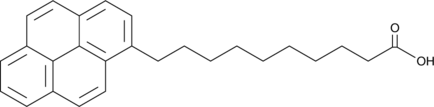
1-Pyrenedecanoic acid (PDA) is a fluorescently tagged form of decanoic acid (Item Nos. 46905 | 20838) that contains a fluorescent pyrene group at carbon 10. PDA forms excimers, an excited-state dimer formed through pyrene-pyrene interactions between adjacent PDA molecules.1,2 Upon formation of PDA excimers, the emission maximum shifts from 395 to 478 nm when excited at 320 nm. The ratio of the PDA monomer to excimer signal has been used in the study of lipid membrane organization and dynamics in vitro.1,2 PDA has also been used in the development of cellular assays to monitor lipid metabolism and storage and to track the degradation of lipid nanocarriers in vitro.3,4,5
WARNING This product is not for human or veterinary use.
References & Product Citations
1. Excimer-
2. Effects of molecular organization on photophysical behavior. Excimer kinetics and diffusion of l‐pyrenedecanoic acid in lipid monolayers at the nitrogen‐water interface. Chemischer Informationsdienst 17(3), (1984).
3. Neutral lipid storage diseases as cellular model to study lipid droplet function. Cells 8(2), 187 (2019).
4. Metabolism of 1-
5. Nanocarriers made of natural fatty acids: Modulation of their release profiles through photo-
Contact Info
Cayman Chemical1180 East Ellsworth RoadAnn Arbor, Michigan 48108 USAToll Free: (800) 364-9897(USA and Canada only)Fax: (734) 971-3640


