
Technical Support & Resources
Visit our FAQ
Contact Us
Toll Free Phone (USA and Canada Only): (888) 526-5351
Direct Phone: (734) 975-3888
Technical Information
- 5-LO
- 5-LOX
- ALOX5
- Arachidonate 5-lipoxygenase
- LOG5
Shipping & Storage Information
Recommended Products
Certificates of Analysis & Batch Specific Data
Provide batch numbers separated by commas to download or request available product inserts, QC sheets, certificates of analysis, data packs, and GC-MS data.
Lipid Resource Center
Discover Products & Resources for Lipid Research
- High-purity lipid standards
- Lipid roles in biology
- Lipids in health & disease
- Lipids for pharmaceutical development
- Protocols, advice, & resources
Product Description
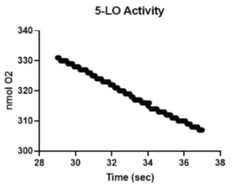
5-Lipoxygenase (5-LO) is an enzyme encoded by ALOX5 in humans that is involved in leukotriene biosynthesis.1 It is composed of an N-terminal regulatory domain and a C-terminal catalytic domain and is primarily expressed in leukocytes. Increases in intracellular calcium levels or cellular stress induce translocation of 5-LO from the cytosol or nucleoplasm, depending on the cell type and 5-LO phosphorylation status, to the nuclear envelope, where it interacts with 5-LO-activating protein (FLAP), which transfers arachidonic acid (Item Nos. 90010 | 90010.1 | 10006607) to 5-LO.1,2 5-LO catalyzes the conversion of arachidonic acid to 5(S)-HpETE (Item No. 44230) and then to leukotriene A4 (LTA4).3 Other substrates of 5-LO include 5,8,11,14,17-eicosapentaenoic acid, 5,8,11-eicosatrienoic acid, 5,8-eicosadienoic acid, 12-HpETE, and 15-HpETE. Alox5 knockout mice are protected against arthritis and pulmonary inflammation.2 Knockout of Alox5 also protects apolipoprotein E-deficient hyperlipidemic mice from high-fat diet-induced hepatic injury and inflammation.4 Levels of 5-LO are elevated in postmortem hippocampus and cortex of patients with Alzheimer's disease.5 Cayman's 5-Lipoxygenase (human, recombinant) can be used for enzyme activity assays.
WARNING This product is not for human or veterinary use.
References & Product Citations
1. 5-
2. The 5-
3. Arachidonate 5-
4. 5-
5. 5-
Characterization of spirostanol glycosides and furostanol glycosides from anemarrhenae rhizoma as dual targeted inhibitors of 5-
Discovery of an inhibitor of the proteasome subunit Rpn11. J. Med. Chem. 60(4), 1343-1361 (2017).
Detection of mammalian 5-
Contact Info
Cayman Chemical1180 East Ellsworth RoadAnn Arbor, Michigan 48108 USAToll Free: (800) 364-9897(USA and Canada only)Fax: (734) 971-3640


