
Technical Support & Resources
Information provided in the product description is from published literature. Due to the nature of scientific experimentation, your results (e.g., selectivity and effective concentrations) or specific application for this product may differ. If you have questions about how this product fits your application, please contact our technical support staff.
Visit our FAQ
Contact Us
Toll Free Phone (USA and Canada Only): (888) 526-5351
Direct Phone: (734) 975-3888
Product Categories
Technical Information
- DL-erythro/threo-PDMP
Shipping & Storage Information
Recommended Products
Certificates of Analysis & Batch Specific Data
Provide batch numbers separated by commas to download or request available product inserts, QC sheets, certificates of analysis, data packs, and GC-MS data.
Lipid Resource Center
Discover Products & Resources for Lipid Research
- High-purity lipid standards
- Lipid roles in biology
- Lipids in health & disease
- Lipids for pharmaceutical development
- Protocols, advice, & resources
Product Description
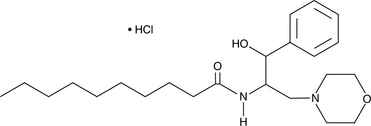
PDMP is a ceramide analog first prepared in a search for inhibitors of glucosylceramide synthase.1 PDMP has two adjacent chiral centers (C1 and C2) allowing for the formation of four possible isomers. PDMP contains all four of these stereoisomers. PDMP inhibits glucosylceramide synthase by 90% when used at a concentration of 0.8 μM in MDCK cell homogenates, however, the ability to inhibit glucosylceramide synthase has been found to reside in the D-threo (1R,2R) enantiomer.2 The D-threo PDMP enantiomer is also responsible for inhibition of β-1,4-galactosyltransferase 6 and prevention of lactosylceramide synthesis, which is a promotor of neuroinflammation in mice during chronic experimental autoimmune encephalomyelitis (EAE), a model of multiple sclerosis.3 PDMP enhances curcumin-induced inhibition of proliferation, JNK activation, and Akt inhibition, as well as induction of apoptosis in WM-115 melanoma cells in vitro.4
WARNING This product is not for human or veterinary use.
References & Product Citations
1. Analogs of ceramide that inhibit glucocerebroside synthetase in mouse brain. Chem. Phys. Lipids 26(3), 265-278 (1980).
2. Structural and stereochemical studies of potent inhibitors of glucosylceramide synthase and tumor cell growth. J. Lipid Res. 36(3), 611-621 (1995).
3. Regulation of astrocyte activation by glycolipids drives chronic CNS inflammation. Nat. Med. 20(10), 1147-1156 (2014).
4. 1-
Contact Info
Cayman Chemical1180 East Ellsworth RoadAnn Arbor, Michigan 48108 USAToll Free: (800) 364-9897(USA and Canada only)Fax: (734) 971-3640


