A fluorescence-based method for detecting D-lactate in biological samples such as serum, plasma, blood, urine, and saliva
Features
  • Measure D-lactate in biological samples such as serum, plasma, blood, urine, and saliva
  • Assay 40 samples in duplicate
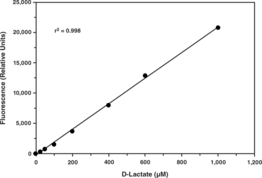
  • Assay Range: 25 μM-1 mM
  • Plate-based fluorometric measurement (ex 530-540 nm, em 585-595 nm)
Technical Support & Resources

Visit our FAQ

Contact Us

Toll Free Phone (USA and Canada Only): (888) 526-5351
Direct Phone: (734) 975-3888

Request Technical Support

Technical Support Request

To streamline the process attach the appropriate questionnaire to your inquiry.

Download IHC QuestionnaireDownload WB Questionnaire

View Our Privacy Statement for details on how we use and protect your data. In addition, this site is protected by hCaptcha and its Privacy Policy and Terms of Service apply.

D-Lactate Assay Kit

Item No. 700520

Technical Information
Shipping & Storage Information
Storage
-20°C
Shipping
Wet ice in continental US; may vary elsewhere
Recommended Products

Certificates of Analysis & Batch Specific Data

Provide batch numbers separated by commas to download or request available product inserts, QC sheets, certificates of analysis, data packs, and GC-MS data.

    Add

    Cayman Chemical
    Explore Obesity & Metabolic Disease Resources

    Discover high-quality research tools to investigate GLP-1 mechanisms and next-generation metabolic targets.

    OBESITY RESEARCH SOLUTIONS
    Product Description

    D(−)-Lactate is a stereoisomer of lactate and is present in blood at only 1-5% the concentration of L(+)-lactate. Exogenous sources of D-lactate include fermented foods such as yogurt, sauerkraut, and pickles. D-lactate is normally produced in the gastrointestinal tract, mainly by lactobacilli and bifidobacteria or is produced in the cytosol of cells by the glyoxylase pathway. Cayman’s D-Lactate Assay provides a fluorescence-based method for detecting D-lactate in biological samples such as serum, plasma, blood, urine, and saliva. It can also be utilized to determine intracellular and extracellular lactate concentrations in cell culture samples. In the assay, D-lactate dehydrogenase catalyzes the oxidation of D-lactate to pyruvate, along with the concomitant reduction of NAD+ to NADH. NADH reacts with the fluorescent substrate to yield a highly fluorescent product. The fluorescent product is analyzed with an excitation wavelength of 530-540 nm and an emission wavelength of 585-595 nm.

    Needed but not supplied: Please download the kit booklet to verify if UltraPure Water (Milli-Q or equivalent) or any other components are needed for this assay.

    WARNING This product is not for human or veterinary use.

    References & Product Citations
    Product Citations

    Angelin, A., Gil-de-Gómez, L., Dahiya, S., et alFoxp3 reprograms T cell metabolism to function in low-glucose, high-lactate environments. Cell. Metab. 25(6), 1282-1293 (2017).