
Technical Support & Resources
Information provided in the product description is from published literature. Due to the nature of scientific experimentation, your results (e.g., selectivity and effective concentrations) or specific application for this product may differ. If you have questions about how this product fits your application, please contact our technical support staff.
Visit our FAQ
Contact Us
Toll Free Phone (USA and Canada Only): (888) 526-5351
Direct Phone: (734) 975-3888
Product Categories
Application

Technical Information
Shipping & Storage Information
Recommended Products
Certificates of Analysis & Batch Specific Data
Provide batch numbers separated by commas to download or request available product inserts, QC sheets, certificates of analysis, data packs, and GC-MS data.
Lipid Resource Center
Discover Products & Resources for Lipid Research
- High-purity lipid standards
- Lipid roles in biology
- Lipids in health & disease
- Lipids for pharmaceutical development
- Protocols, advice, & resources
Product Description
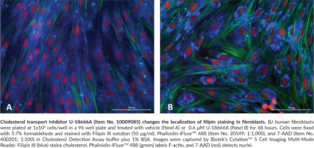
Filipin III is a polyene and an active component of the polyene antibiotic filipin complex (Item No. 25073).1 It is active against various fungi, including B. dermatitidis, C. neoformans, H. capsulatum, C. albicans, and T. mentagrophytes (MICs = 1-10 μg/ml). Filipin III induces hemolysis of isolated rabbit erythrocytes (EC50 = 0.8 µg/ml).2 It induces apoptosis in HaCaT keratinocytes in a concentration-dependent manner.3 Filipin III binds to cholesterol and has been used to fluorescently label sterols in biological structures.4,5 The filipin complex has excitation maxima of 338 and 357 nm and an emission maxima of 480 nm.6
WARNING This product is not for human or veterinary use.
References & Product Citations
1. The filipin complex. Biochemistry 7(2), 653-659 (1968).
2. Effects of four components of the polyene antibiotic, filipin, on phospholipid spherules (liposomes) and erythrocytes. The Journal of Biological Chemisty 243(16), 4364-4371 (1968).
3. Depletion of membrane cholesterol causes ligand-
4. Fluorescence studies of the binding of the polyene antibiotics filipin 3, amphotericin B, nystatin, and lagosin to cholesterol. Proc. Natl. Acad. Sci. USA 69(12), 3795-3799 (1972).
5. Fluorescent in situ visualization of sterols in Arabidopsis roots. Nat. Protoc. 6(4), 446-456 (2011).
6. Filipin as a fluorescent probe for the location of cholesterol in the membranes of fragmented sarcoplasmic reticulum. Biochim. Biophys. Acta 291, 61-70 (1973).
Harnessing AxDNA for precision exatecan delivery in cancer: A novel antibody-
Cross-
Trypanosoma cruzi infection results in an increase in intracellular cholesterol. Microbes Infect. 16(4), 337-344 (2014).
Membrane-
Spatial distribution of the pathways of cholesterol homeostasis in human retina. PLoS One 7(5), e37926 (2012).
Abnormal vascularization in mouse retina with dysregulated retinal cholesterol homeostasis. J. Clin. Invest. 122(8), 3012-3023 (2012).
Contact Info
Cayman Chemical1180 East Ellsworth RoadAnn Arbor, Michigan 48108 USAToll Free: (800) 364-9897(USA and Canada only)Fax: (734) 971-3640


