
Technical Support & Resources
Information provided in the product description is from published literature. Due to the nature of scientific experimentation, your results (e.g., selectivity and effective concentrations) or specific application for this product may differ. If you have questions about how this product fits your application, please contact our technical support staff.
Visit our FAQ
Contact Us
Toll Free Phone (USA and Canada Only): (888) 526-5351
Direct Phone: (734) 975-3888
Product Categories
Research Area
Technical Information
Shipping & Storage Information
Recommended Products





Certificates of Analysis & Batch Specific Data
Provide batch numbers separated by commas to download or request available product inserts, QC sheets, certificates of analysis, data packs, and GC-MS data.
Lipid Resource Center
Discover Products & Resources for Lipid Research
- High-purity lipid standards
- Lipid roles in biology
- Lipids in health & disease
- Lipids for pharmaceutical development
- Protocols, advice, & resources
Product Description
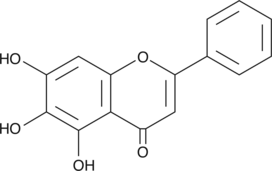
Baicalein is a flavonoid originally isolated from the roots of S. baicalensis that has diverse biological activities.1 It inhibits human platelet 12-lipoxygenase (12-LO) and human reticulocyte 15-LO-1 (IC50s = 0.64 and 1.6 µM, respectively) but is less potent at 15-LO-1 when the detergent Triton-X is present (IC50 = 38 µM).2 Baicalein inhibits lipid peroxidation, as assessed by production of thiobarbituric acid (TBARS; IC50 = 5 µM), and inhibits growth of Huh-7, KIM-1, and HLF human hepatocellular carcinoma cells (IC50s = 17-70 µg/ml).3,4 Baicalein increases intracellular calcium levels by increasing release from the endoplasmic reticulum and via PKC-dependent calcium channels in the plasma membrane, leading to increases in reactive oxygen species (ROS), caspase-9 and -3 activation, and apoptosis in ZR-75-1 human breast cancer cells.5 Baicalein increases levels of peroxisome proliferator-activated receptor β/δ (PPARβ/δ) in BV-2 microglia and primary microglia and decreases the level of 12- and 15-LO products.6 It also decreases symptoms of experimental autoimmune encephalomyelitis (EAE) in a mouse model of multiple sclerosis, when administered at a dose of 75 mg/kg per day.
WARNING This product is not for human or veterinary use.
References & Product Citations
1. Baicalin, a new flavone-
2. Baicalein is a potent in vitro inhibitor against both reticulocyte 15-
3. Cell death induced by baicalein in human hepatocellular carcinoma cell lines. Jpn. J. Cancer Res. 87(2), 170-177 (1996).
4. Inhibition of microsomal lipid peroxidation by baicalein: A possible formation of an iron-
5. The mechanism of Ca2+ movement in the involvement of baicalein-
6. Inhibition of 12/15-
Contact Info
Cayman Chemical1180 East Ellsworth RoadAnn Arbor, Michigan 48108 USAToll Free: (800) 364-9897(USA and Canada only)Fax: (734) 971-3640


