
Technical Support & Resources
Information provided in the product description is from published literature. Due to the nature of scientific experimentation, your results (e.g., selectivity and effective concentrations) or specific application for this product may differ. If you have questions about how this product fits your application, please contact our technical support staff.
Visit our FAQ
Contact Us
Toll Free Phone (USA and Canada Only): (888) 526-5351
Direct Phone: (734) 975-3888
Technical Information
- U-72107
Shipping & Storage Information
Recommended Products
Certificates of Analysis & Batch Specific Data
Provide batch numbers separated by commas to download or request available product inserts, QC sheets, certificates of analysis, data packs, and GC-MS data.

Explore Obesity & Metabolic Disease Resources
Discover high-quality research tools to investigate GLP-1 mechanisms and next-generation metabolic targets.
OBESITY RESEARCH SOLUTIONSProduct Description
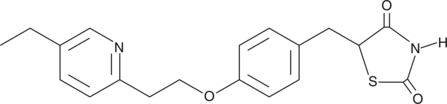
Pioglitazone is an agonist of the peroxisome proliferator-activated receptor γ (PPARγ; EC50 = ~500-600 nM for both human and murine PPARγ).1,2 It is selective for PPARγ over PPARα, exhibiting low level activation of PPARα at 1 µM and 5.4-fold activation at a concentration of 10 µM.1 Pioglitazone inhibits pyruvate oxidation and glucose production in hepatocytes when used at a concentration of 10 μM.3 In vivo, pioglitazone (0.3-3 mg/kg per day) reduces hyperglycemia, hyperlipidemia, and hyperinsulinemia in a dose-dependent manner in male Wistar fatty rats.4 It reduces the number of lesions in a transgenic rat adenocarcinoma of prostate (TRAP) model.5 Pioglitazone (2.5 mg/kg) also decreases production of neuroinflammatory cytokines and reduces immobility in the forced swim and tail suspension tests in a mouse model of chronic mild stress, indicating antidepressant-like activity that can be reversed by the PPARγ antagonist GW9662 (Item No. 70785).6
WARNING This product is not for human or veterinary use.
References & Product Citations
1. Activation of human peroxisome proliferator-
2. The PPARs: From orphan receptors to drug discovery. J. Med. Chem. 43(4), 527-550 (2000).
3. Pioglitazone inhibits mitochondrial pyruvate metabolism and glucose production in hepatocytes. FEBS J. 284(3), 451-465 (2017).
4. Effects of pioglitazone on glucose and lipid metabolism in Wistar fatty rats. Arzneimittelforschung. 40(3), 263-267 (1990).
5. Pioglitazone, a peroxisome proliferator-
6. The antidepressant-
Beyond DPPH: Use of fluorescence-
Enzymatic activity of HPGD in Treg cells suppresses Tconv cells to maintain adipose tissue homeostasis and prevent metabolic dysfunction. Immunity 50(5), 1232-1248 (2019).
Contact Info
Cayman Chemical1180 East Ellsworth RoadAnn Arbor, Michigan 48108 USAToll Free: (800) 364-9897(USA and Canada only)Fax: (734) 971-3640


