
Technical Support & Resources
Information provided in the product description is from published literature. Due to the nature of scientific experimentation, your results (e.g., selectivity and effective concentrations) or specific application for this product may differ. If you have questions about how this product fits your application, please contact our technical support staff.
Visit our FAQ
Contact Us
Toll Free Phone (USA and Canada Only): (888) 526-5351
Direct Phone: (734) 975-3888
Technical Information
- NE 19550
- N-
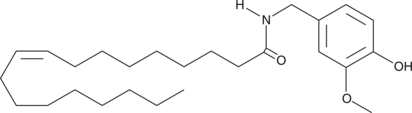
Vanillyloleamide
Shipping & Storage Information
Recommended Products
Certificates of Analysis & Batch Specific Data
Provide batch numbers separated by commas to download or request available product inserts, QC sheets, certificates of analysis, data packs, and GC-MS data.
Cannabinoid Resource Center
Discover Our Tools to Support Cannabinoid Research and Analysis.
- Cannabinoid signaling research products
- Analytical standards and certified reference materials
- Endocannabinoid profiling services
- Lab wall posters
- Articles, application notes, and webinars
Product Description
Olvanil is a structural analog of capsaicin, which is the noxious active component of hot peppers of the Capsicum genus. It is the amide of vanillylamine and oleic acid. Olvanil acts as an agonist at the vanilloid receptor, VR1, inducing desensitization analgesia in rat and mouse models of pain.1 Olvanil has complex interactions with the cannabinoid system, in that it potentiates the agonist activity of endogenous cannabinoids by inhibiting the reuptake of arachidonyl ethanolamide (AEA). Olvanil is a more potent reuptake inhibitor than AM404, which is commonly used for this purpose (50% inhibition of reuptake at 10 µM versus 12% for AM404 at the same dose).2 Olvanil is also a CB1 agonist, but does not bind to CB2 receptors or inhibit fatty acid amide hydrolase. The overall activity of olvanil in most models is that of an analgesic, but it is unclear how these effects are mediated by VR1, the CB1 receptor, or other components of the endogenous pain sensation system.
WARNING This product is not for human or veterinary use.
References & Product Citations
1. Vanilloids. 1. Analogs of capsaicin with antinociceptive and antiinflammatory activity. J. Med. Chem. 36, 2595-2604 (1993).
2. Interactions between synthetic vanilloids and the endogenous cannabinoid system. FEBS Lett. 436, 449-454 (1998).
Contact Info
Cayman Chemical1180 East Ellsworth RoadAnn Arbor, Michigan 48108 USAToll Free: (800) 364-9897(USA and Canada only)Fax: (734) 971-3640


