
Creating Custom Cannabis CRM Mixtures: Forty-seven Phytocannabinoids, One HPLC Method
Application notes
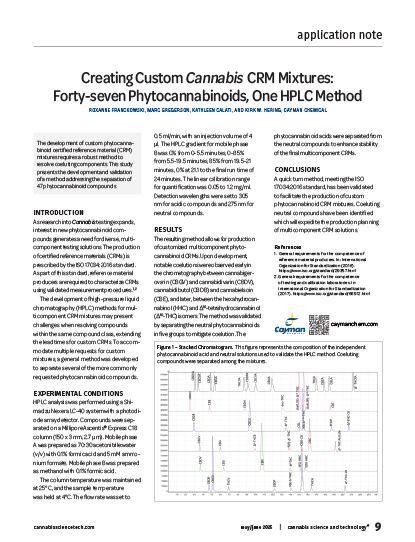
- Chromatography was run on 47 phytocannabinoid compounds (12 acid and 35 neutral).
- Co-eluting neutral compounds were identified and segregated for the acceptable validation of an HPLC method.
- This method supports Cayman’s quick turn production of custom phytocannabinoid CRMs.
To cite this application note: Franckowski, R., Gregerson, M., Calati, K., et al. Creating Custom Cannabis CRM Mixtures: Forty-seven Phytocannabinoids, One HPLC Method. Application Note, Cayman Chemical (2025).
GC Separation for Identification of iso-THC Contaminants and Accurate Quantification of Δ8 -THC and Δ9-THC in Cannabis Samples
Application notes
Key Features
- Synthetic conversion of cannabidiol (CBD) to the tetrahydrocannabinols (THCs) Δ9-THC and Δ8 -THC produces measurable quantities of the iso-THC products Δ8-iso-THC and Δ4(8)-iso-THC.
- Co-elution of THCs and iso-THCs makes C18 reversed phase-HPLC (RP-HPLC) methods unsuitable for the quantification of THCs. Quantities of THCs are distorted if the testing methods are unable to resolve the iso-THCs in analyzed samples.
- Gas chromatography (GC) offers a reliable and robust method for quantification of Δ9-THC, Δ8-THC, Δ8-iso-THC, and Δ4(8)-iso-THC. Additionally, this method represents a method for identifying THC derived from CBD conversion.
To cite this application note: Williams, J.B., Liu, J., and Hering, K.W. GC separation for identification of iso-THC contaminants and accurate quantification of Δ8-THC and Δ9-THC in Cannabis samples. Application Note, Cayman Chemical (2023).
Comparison of CRM Concentrations Among Four Different Reference Material Producers
Application notes
Key Features
- ISO-certified CRMs from multiple manufacturers are employed by analytical facilities to identify Cannabis components and report potency values.
- Reference material consistency across vendors is needed to ensure accuracy of reporting.
- We compare the reported concentration of 11 individual cannabinoid CRMs from four different reference material producers.
- No significant variability in CRM concentrations exists among products produced under the ISO 17034 standard, reaffirming the competence of manufacturers.
To cite this application note: Goodwin, S.K., Franckowski, R.E., and Edwardsen, J.T. Comparison of CRM Concentrations Among Four Different Reference Material Producers. Application Note, Cayman Chemical (2020).
Analytical Data Confidence is Highest with Commercially Prepared CRM Mixtures
Application notes
CRM Mixtures Improve Quantitation Accuracy
Application notes
Key Features:
- High-quality reference materials with established metrological traceability are an essential element for measurement accuracy.
- Reproducibility errors that arise during standard curve preparations using certified reference materials (CRMs) may stem from inherent variability around pipetting procedures.
- We compare two different methods to generate a standard for the quantitation of ten prevalent phytocannabinoids against a calibration curve.
- Pre-made, multi-component CRM mixtures save time and consumable cost in the preparation of standard curves and improve quantitation accuracy during routine analytical checks as well as Cannabis product quality testing and profiling.
Contact Info
Cayman Chemical1180 East Ellsworth RoadAnn Arbor, Michigan 48108 USAToll Free: (800) 364-9897(USA and Canada only)Fax: (734) 971-3640


