
News & Announcements
9(10)-DiHOME and 12(13)-DiHOME
Article from 2019-04-03
Mediating the gamut from leukotoxin to lipokine
Linoleic acid is a major essential ω-6 polyunsaturated fatty acid (PUFA) obtained directly from the diet and is one of the most abundant fatty acids found in the lipids of cell membranes. It can be converted to longer ω-6 PUFAs such as arachidonic acid, which is used to produce pro-inflammatory eicosanoids with important immune functions. Substantial amounts of epoxide and diol linoleic acid metabolites are also produced and influence biological activity through interactions with receptors or intracellular effectors. They arise when linoleic acid is converted by cytochrome P450 (CYP) to epoxy-octadecenoic acids (EpOMEs) in the form of either 9(10)-EpOME (leukotoxin, coronaric acid) or its regioisomer 12(13)-EpOME (isoleukotoxin, vernolic acid) (Figure 1). Soluble epoxide hydrolase (sEH) hydrolyzes the epoxy acid into corresponding vicinal diols (dihydroxy-octadecenoic acids (DiHOMEs)): 9(10)-DiHOME (leukotoxin diol) and 12(13)-DiHOME (isoleukotoxin diol), respectively.
These mono-epoxy fatty acid metabolites of linoleic acid are formed in lung and other tissues and called leukotoxins because they produce their primary toxic effects against leukocytes. Together with dihydroxy metabolites formed on ring opening, they are believed to be involved in acute respiratory distress syndrome and exert toxicity on alveolar epithelial cells.1,2 In addition, they can have deleterious cardiovascular effects and serve as a signal of adaptive immune dysfunction in the gut microenvironment.3,4 Alternatively, these metabolites have been shown to facilitate thermogenic activity in brown adipocytes.
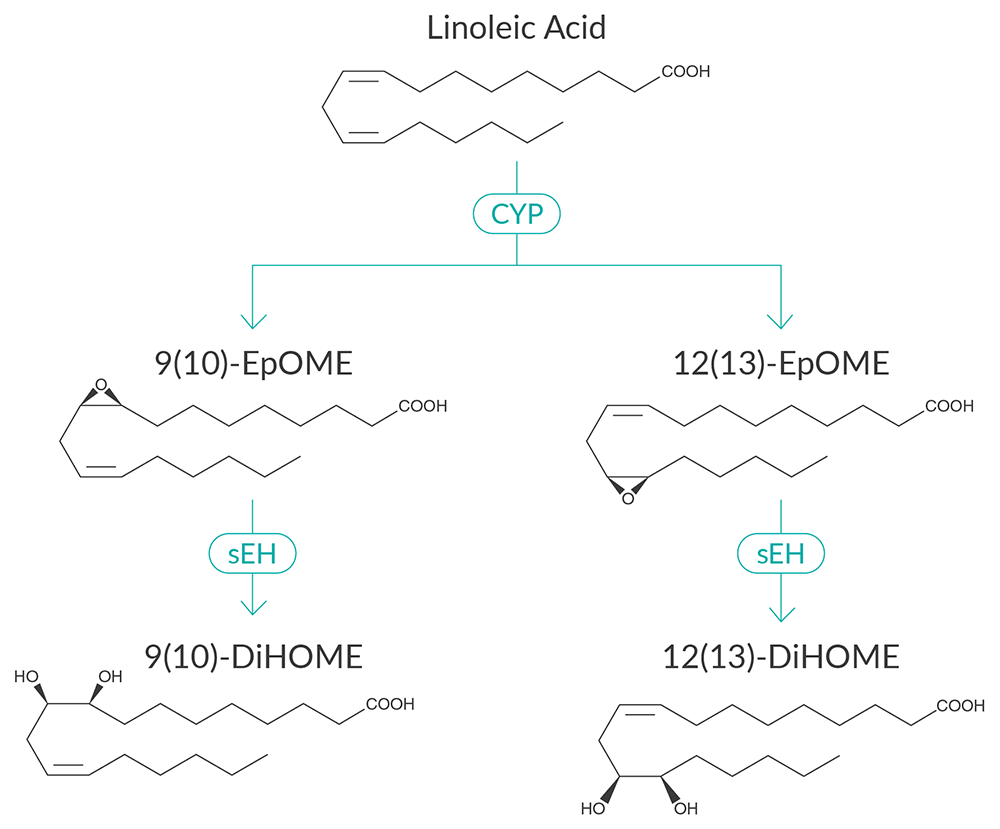
Figure 1. Biosynthetic pathway for production of EpOMEs and DiHOMEs from linoleic acid.
Inflammatory Activity
Whereas EpOMES are thought to act as protoxins, DiHOMEs are direct agents in exerting immunotoxicity. Examples of DiHOME effects on mammalian cells include stimulation of MCF-7 breast cancer cell proliferation, modulation of the sodium cation current in cardiac cells, elevation of oxidative stress, and inhibition of mitochondrial function. Both EpOMEs and DiHOMEs are known to have neutrophil chemotactic activity, and DiHOMEs have been shown to inhibit neutrophil respiratory burst, a mechanism important for the immune-mediated elimination of unwanted microorganisms.5 9(10)-DiHOME and 12(13)-DiHOME also act as peroxisome proliferator-activated receptor (PPAR)γ ligands, increasing expression of the fatty acid transporter CD36 as well as increasing the expression genes involved in fatty acid uptake and metabolism: FABP4 (Fatty Acid Binding Protein 4) and HADH (Hydroxyacyl-CoA Dehydrogenase) and decreasing expression of immune markers (CD1a, CD80, and CCR7) involved in lipid presentation, antigen presentation, and cell trafficking . Through inhibition of PPARγ signaling in dendritic cells, 12(13)-DiHOME has been shown to induce pro-allergic immune dysfunction, decreasing dendritic cell secretion of IL-10—an anti-inflammatory cytokine that protects against allergic inflammation—and reducing the number of regulatory T cells (Treg).6 This finding is not surprising since PPARγ activation in dendritic cells traditionally produces anti-inflammatory effects.7 Loss of PPARγ impairs immune tolerance and prevents Treg maturation. Increased levels of 12(13)-DiHOME in neonatal infants have been correlated with subsequent development of atopy and/or asthma.4,6 9(10)-DiHOME and 12(13)-DiHOME have also been identified as activators of transient receptor potential vanilloid 1 (TRPVI) and transient receptor potential ankyrin1 (TRPAI) channels, causing increased sensitivity to inflammatory pain.8
Thermogenic Activity
Paradoxically, 12(13)-DiHOME is released from brown adipose tissue (BAT) upon exposure to cold and functions to decrease circulating triglycerides and promote fatty acid uptake specifically in BAT. This is accomplished by promoting the translocation of CD36 and related fatty acid transporters to the cell membrane.9 Therefore, 12(13)-DiHOME seems to have a role as a thermogenic lipokine, stimulating BAT to burn lipids during cold exposure to maintain metabolic homeostasis. Incidentally, plasma concentrations of 12(13)-DiHOME are negatively correlated with body-mass index and insulin resistance.9 12(13)-DiHOME is also released from BAT during moderate exercise and has been shown to increase skeletal muscle fatty acid uptake and oxidation.10 These reports suggest that 12(13)-diHOME, or a functional analog, could be developed as a treatment for metabolic disorders.
Microbiome-produced DiHOMEs
sEH—one of the two enzymes responsible for producing DiHOMEs from linoleic acid—is encoded by humans, bacteria, and fungi alike. In studies conducted on neonates with elevated levels of 12(13)-DiHOME who developed atopy and/or asthma, bacterial sEH genes were significantly more abundant compared to that of human or fungus.6 The bacterial sEH genes identified were primarily encoded by Enterococcus faecalis, Streptococcus, Bifidobacterium bifidum, and Lactobacillus strains, which comprise the intestinal microbiota in early life.11 Moreover, only E. faecalis and B. bifidum sEHs demonstrate a specific capacity to convert 12(13)-EpOME to 12(13)-DiHOME, suggesting that production of DiHOME isotypes may be bacterial strain specific.6 Thus, as the research suggests, 12(13)-DiHOME enrichment via particular bacterial strains found in the neonate microbiome may serve as an early indicator of allergic asthma. If true, interventions to manipulate the composition and function of the gut microbiome might offer a viable strategy for disease prevention.
Assaying DiHOMEs
Larger studies are needed to validate DiHOMEs as biomarkers for risk of development of asthma and to further understand their role in fatty acid metabolism. Cayman offers competitive ELISAs to quantify (±)9(10)-DiHOME and (±)12(13)-DiHOME in plasma and serum. Each assay can be run in just three hours. Click the links in the table below to learn more about each assay. Corresponding unlabeled and deuterated standards for EpOMEs and DiHOMEs are also available for quantification by GC- or LC- mass spectrometry.
9(10)-DiHOME
| Item No. | Product Name |
|---|---|
| 501710 | (±)9(10)-DiHOME ELISA Kit |
| 52400 | (±)9(10)-EpOME |
| 10009995 | (±)9(10)-EpOME-d4 |
| 53400 | (±)9(10)-DiHOME |
| 10009993 | (±)9(10)-DiHOME-d4 |
12(13)-DiHOME
| Item No. | Product Name |
|---|---|
| 501720 | (±)12(13)-DiHOME ELISA Kit |
| 52450 | (±)12(13)-EpOME |
| 10009996 | (±)12(13)-EpOME-d4 |
| 10009832 | (±)12(13)-DiHOME |
| 10009994 | (±)12(13)-DiHOME-d4 |
References
1. Kosaka, K., Suzuki, K., Hayakawa, M., et al. Leukotoxin, a linoleate epoxide: Its implication in the late death of patients with extensive burns. Mol. Cell Biochem. 139(2), 141-148 (1994).
2. Sevanian, A., Mead, J.F., and Stein, R.A. Epoxides as products of lipid autoxidation in rat lungs. Lipids 14(7), 634-643 (1979).
3. Siegfried, M.R., Aoki, N., Lefer, A.M., et al. Direct cardiovascular actions of two metabolites of linoleic acid. Life Sci. 46(6), 427-433 (1990).
4. Fujimura, K.E., Sitarik, A.R., Havstad, S., et al. Neonatal gut microbiota associates with childhood multisensitized atopy and T cell differentiation. Nat. Med.22(10), 1187-1191 (2016).
5. Thompson, D.A. and Hammock, B.D. Dihydroxyoctadecamonoenoate esters inhibit the neutrophil respiratory burst. J. Biosci. 32(2), 279–291 (2007).
6. Levan, S.R, Stamnes, K.A., Lin, D.L., et al. Neonatal gut-microbiome-derived 12,13 DiHOME impedes tolerance and promotes childhood atopy and asthma. BioRxiv311704 (2018).
7. Wahli, W. and Michalik, L. PPARs at the crossroads of lipid signaling and inflammation. Trends Endocrinol. Metab. 23(7), 351-363 (2012).
8. Green, D.P., Ruparel, S., Gao, X., et al. Central activation of TRPV1 and TRPA1 by novel endogenous agonists contributes to mechanical allodynia and thermal hyperalgesia after burn injury. Mol. Pain12, (2016).
9. Lynes, M.D., Leiria, L.O., Lundh, M., et al. The cold-induced lipokine 12,13-diHOME promotes fatty acid transport into brown adipose tissue. Nat. Med. 23(5), 631-637 (2017).
10. Stanford, K.I., Lynes M.D., Takahashi, H., et al. 12,13-diHOME: An exercise-induced lipokine that increases skeletal muscle fatty acid uptake. Cell Metab. 27(5), 1111-1120 (2018).
11. Scholtens, P.A.M.J., Oozeer, R., Martin, R., et al. The early settlers: Intestinal microbiology in early life. Annu. Rev. Food Sci. Technol.3, 425-447 (2012).
Contact Info
Cayman Chemical1180 East Ellsworth RoadAnn Arbor, Michigan 48108 USAToll Free: (800) 364-9897(USA and Canada only)Fax: (734) 971-3640


