
News & Announcements
Functions of the Neuronal Lipid Trisialoganglioside GT1b
Functions of the Neuronal Lipid Trisialoganglioside GT1b
Article from 2017-04-03
This article was originally published in the April 2017 edition of Matreya’s Newsletter for Glyco/Sphingolipid Research (PDF).
Gangliosides, which consist of a ceramide moiety, an oligosaccharide head group, and one or more sialic acids, are vitally important amphipathic lipids that are involved in a multitude of cellular tasks. Gangliosides bind to lectins, serving as immunological and cell-adhesion receptors. They also participate in cell signaling, oncogenesis, and cell differentiation, as well as affect placentation. Additionally, they affect nerve growth, participate in myelin stability and nerve regeneration, and function as viral and toxin entry points to cells. Although more than a dozen ganglioside species are known to exist, GM1, GD1a, GD1b, and GT1b compose 96% of brain gangliosides.1
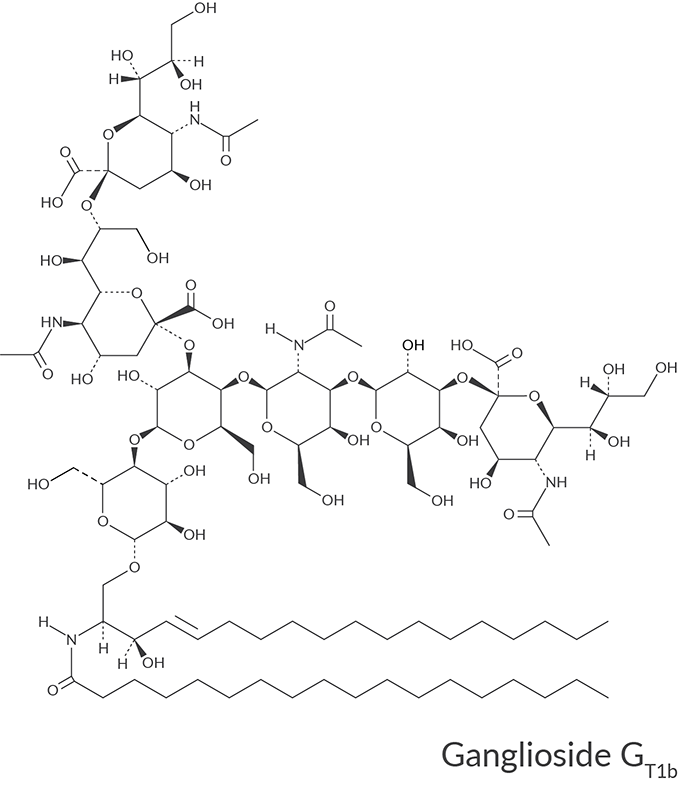
GT1b is notable among gangliosides in that it exists almost exclusively in nerve cells, being expressed on the outer membrane. Both GM1 and GT1b promote neuronal differentiation and dendrite generation as well as the entry of neuronal progenitor cells into a postmitotic stage, and thus neuronal maturation, by enhancing neural growth factor-induced dimerization and phosphorylation of TrkA.2 Because of its role in nerve cells, GT1b produces nociception and enhances hyperalgesia and allodynia.3 GT1b and GD1a are known to complex with myelin-associated glycoprotein, which inhibits axonal growth.4
GT1b is also associated with several neuronal cancers and is considered a brain metastasis-associated ganglioside. In particular, GM1, GD1a, and GT1b all have inhibitory effects on epidermal growth factor receptor (EGFR) signaling and keratinocyte adhesion and migration.2 Studies have found that GT1b plays an important role in increasing the nuclear maturation rate and decreasing the intracellular ROS levels during in vitro maturation by maintaining intracellular Ca2+ in the process of oocyte maturation regardless of the cell cycle stage.5 The presence of GT1b could be a useful biomarker for estimating metastatic potentials in the brain.6 GT1b negatively regulates cell motility, spreading, and adhesion on fibronectin through direct molecular interactions with the α5 subunit of the α5β1 integrin, a finding that could be used to develop cancer therapies.7 Botulinum neurotoxin type C, which enters nerve cells through GT1b binding, has been studied for its possible neuroblastoma apoptosis effects.8
GT1b is a receptor for various toxins, which recognize its oligosaccharide structure. GT1b (and possibly other polysialogangliosides) is the receptor by which botulinus neurotoxins from Clostridium botulinum bacteria enter nerve cells.9 Tetanus toxin, a major threat to human and animal health, which inhibits neurotransmitter release in the central nervous system to elicit spastic paralysis, gains entry to nerve cells by complexing with GT1b and other nerve gangliosides.10,11 The Merkel cell polyomavirus likely interacts with sialic acids on both branches of the GT1b carbohydrate chain to gain access to cells.12 Murine polyomavirus binds to gangliosides GD1a and GT1b, and the BK virus binds to gangliosides GD1b and GT1b to gain entry into cells.12
In the immune system, GT1b has inhibitory effects towards human humoral immune responses and suppresses immunoglobulin production by human peripheral blood mononuclear cells.13 Evidence suggests that GD1b, GT1b, and GQ1b may enhance Th1 cytokine production while suppressing Th2 production by inhibiting adenylate cyclase activity.14
Cayman produces all the major gangliosides in very high-purity formulations. These products are useful for studies exploring the cellular roles of these lipids and their association with various diseases and disorders. Cayman specializes in extracting and purifying gangliosides in multi-gram quantities while maintaining the strictest quality assurance for purity. We are pleased to see how our products have been used over the years to further the understanding of these important lipids in healthy cells and in treating diseases.
You May Also Be Interested In…
Deuterated GD3 as a New Mass Spectrometry Ganglioside Standard
Ganglioside GD2 and Breast Cancer
Novel Adamantane-Labeled Sphingolipids
References
1. Rubovitch, V., Zilberstein, Y., Chapman, J., et al. Restoring GM1 ganglioside expression ameliorates axonal outgrowth inhibition and cognitive impairments induced by blast traumatic brain injury. Sci. Rep.7, 41269 (2017).
2. Russo, D., Parashuraman, S., and D'Angelo, G. Glycosphingolipid-protein interaction in signal transduction. Int.J. Mol. Sci.17(10), E1732 (2016).
3. Watanabe, S., Iwai, T., and Tanabe, M. Intraplantar injection of sialidase reduces mechanical allodynia during inflammatory pain. J. Pharmacol. Sci.133(1), 49-52 (2017).
4. Al-Bashir, N., Mellado, W., and Filbin, M.T. Sialic acid is required for neuronal inhibition by soluble MAG but not for membrane bound MAG. Front. Mol. Neurosci.9, 21 (2016).
5. Hwang, S.-U., Jeon, Y., Yoon, J.D., et al. Effect of ganglioside GT1b on the in vitro maturation of porcine oocytes and embryonic development. J. Reprod. Dev.61(6), 549-557 (2015).
6. Hamasaki, H., Aoyagi, M., Kasama, T., et al. GT1b in human metastatic brain tumors: GT1b as a brain metastasis-associated ganglioside. Biochim. Biophys. Acta1437(1), 93-99 (1999).
7. Paller, A.S., Arnsmeier, S.L., Chen, J.D., et al. Ganglioside GT1b inhibits keratinocyte adhesion and migration on a fibronectin matrix. J. Invest. Dermatol.105(2), 237-242 (1995).
8. Rust, A., Leese, C., Binz, T., et al. Botulinum neurotoxin type C protease induces apoptosis in differentiated human neuroblastoma cells. Oncotarget 7(22), 33220-33228 (2016).
9. Wild, E., Bonifas, U., Klimek, J., et al.In vitro potency determination of botulinum neurotoxin B based on its receptor-binding and proteolytic characteristics. Toxicol. In Vitro34, 97-104 (2016).
10. Chen, C., Fu, Z., Kim, J.-J.P., et al. Gangliosides as high affinity receptors for tetanus neurotoxin. J. Biol. Chem. 284(39), 26569-26577 (2009).
11. Yousefi, M., Younesi, V., Bayat. A.A., et al. Comparative human and mouse antibody responses against tetanus toxin at clonal level. J. Immunotoxicol.13(2), 243-248 (2016).
12. Erickson, K.D., Garcea, R.L., and Tsai, B. Ganglioside GT1b is a putative host cell receptor for the Merkel cell polyomavirus. J. Virol.83(19), 10275-10279 (2009).
13. Kanda, N. and Tamaki, K. Ganglioside GT1b suppresses immunoglobulin production by human peripheral blood mononuclear cells. Immunology96(4), 628-633 (1999).
14. Kanda, N. and Watanabe, S. Gangliosides GD1b, GT1b, and GQ1b enhance IL-2 and IFN-γ production and suppress IL-4 and IL-5 production in phytohemagglutinin-stimulated human T cells. J. Immunol.166(1), 72-80 (2001).
Contact Info
Cayman Chemical1180 East Ellsworth RoadAnn Arbor, Michigan 48108 USAToll Free: (800) 364-9897(USA and Canada only)Fax: (734) 971-3640


