
News & Announcements
Detecting DNA/RNA Damage
Article from 2019-01-14
A comparison of Cayman’s DNA/RNA Damage ELISAs
The area most prone to oxidation when DNA and RNA are damaged is the C-8 position on guanine. During the repair processes initiated to correct damage to DNA or RNA, several oxidized guanine species are released into the urine. Cayman offers two different ELISA kits that measure the following damage markers:
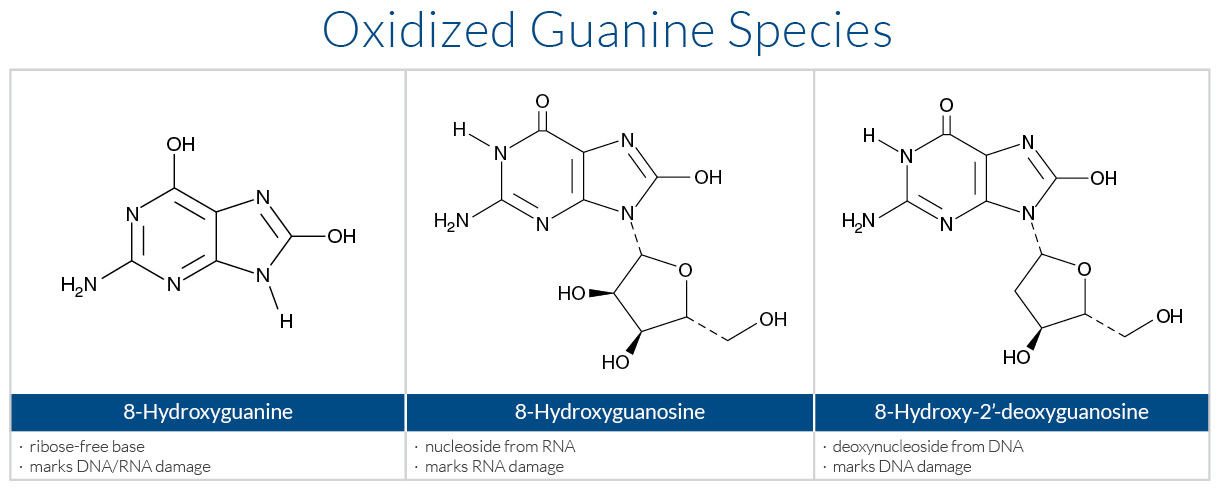
Historically, 8-hydroxy-2'-deoxyguanosine was the most accepted biomarker for oxidative damage to DNA, yet in recent years it has become increasingly understood that RNA damage markers should also be assessed. For example, 8-hydroxyguanosine is reported to be a better marker of age-related oxidant damage.1,2 Assays that can detect multiple oxidized guanine species capture a more complete set of biologically relevant products of oxidative damage than do assays that are restricted to analysis of only one (e.g., 8-hydroxy-2'-deoxyguanosine).3
Here’s a comparison of the two ELISA kits that Cayman offers to measure these DNA damage markers:
At-A-Glance Assay Comparison
| Product Name | Detects | Methodology | Sample Type | Sensitivity | LC/MS Correlation | |
|---|---|---|---|---|---|---|
| DNA/RNA Oxidative Damage (Clone 7E6.9) ELISA Kit (Item No. 501130) | 8-hydroxy-2’-deoxyguanosine 8-hydroxyguanosine | Plate-based colorimetric measurement (405-420 nm) | Urine (other sample types have not been validated but may be used) | Assay Range = 0.15-20 ng/ml 80% B/B0 = 0.45 ng/ml 50% B/B0 = 1.25-1.75 ng/ml | Correlates with LC/MS measurements of a combination of 8-hydroxy-2'-deoxyguanosine and 8-hydroxyguanosine | |
| DNA/RNA Oxidative Damage (High Sensitivity) ELISA Kit (Item No. 589320) | 8-hydroxy-2’-deoxyguanosine 8-hydroxyguanosine 8-hydroxyguanine | Plate-based colorimetric measurement (405-420 nm) | Urine, cell culture medium, cell lysates, tissue samples, saliva, and plasma/serum samples | Assay Range = 0.0103-3 ng/ml 80% B/B0 = 0.03 ng/ml 50% B/B0 = 0.9-0.14 ng/ml | Selectivity and sensitivity highest for 8-hydroxy-2’-deoxyguanosine, though high slope indicates other unknown species are detected | |
Detection Antibody: Each kit is based on a different clone of a monoclonal detection antibody, which cross-reacts with other closely related guanine species. Because of this, each kit distinguishes a distinct set of oxidized guanine species.
| DNA/RNA Oxidative Damage (Clone 7E6.9) ELISA Kit | DNA/RNA Oxidative Damage (High Sensitivity) ELISA Kit |
|---|---|
| 8-hydroxy-2’-deoxyguanosine……..100% cross reactivity 8-hydroxyguanosine…………….……..100% cross reactivity 8-hydroxyguanine…….…………………0.15% cross reactivity | 8-hydroxy-2’-deoxyguanosine……..100% cross reactivity 8-hydroxyguanosine……………………..38% cross reactivity 8-hydroxyguanine………………….……..23% cross reactivity |
Methodology: Both kits use plate-based colorimetric measurement (405-420 nm) and have similar incubation (18 hours) and development (90-120 minutes) protocols.
Sample Type Validation: Detection in urine offers the advantage of a non-invasive approach to assess oxidative damage. However, various sample types may be used for these kits. The following samples have been tested by our assay developers.
| DNA/RNA Oxidative Damage (Clone 7E6.9) ELISA Kit | DNA/RNA Oxidative Damage (High Sensitivity) ELISA Kit |
|---|---|
| Urine (other sample types have not been validated but may be used) | Urine, cell culture medium, cell lysates, tissue samples, saliva, and plasma/serum samples |
Sensitivity: While the DNA/RNA Oxidative Damage (High Sensitivity) ELISA Kit demonstrates higher sensitivity between the two kits, the sensitivity of the clone 7E6.9 ELISA is well within the detectable range of oxidized guanine species in human urine.
LC/MS Correlation: Our assay developers have compared the ELISA results from these two kits in human urine to LC/MS values obtained for the same biological samples. The LC/MS method precision proved 3.74% relative standard deviation at 1 ng/ml with a limit of quantitation equal to 100 pg/ml and a detection limit of 30 pg/ml. The clone 7E6.9-based ELISA demonstrated a tight correlation to LC/MS measurements of a combination of 8-hydroxy-2’-deoxyguanosine and 8-hydroxyguanosine than to 8-hydroxy-2’-deoxyguanosine alone.
The DNA/RNA Oxidative Damage (High Sensitivity) ELISA Kit also correlated with LC/MS values but exhibited a high slope. It was unclear what other metabolites besides 8-hydroxy-2’-deoxyguanosine the DNA/RNA Oxidative Damage ELISA Kit was measuring.
See our poster for more information: "Critical comparison of three 8-hydroxy-2’-deoxyguanosine monoclonal antibodies."
Still unsure of which kit is best for your experiment? Contact techserv@caymanchem.com
References
1. Gan, W., Nie, B., Shi, F., et al.] Free Radic. Biol. Med.52, 1700-1707 (2012).
2. Shi, F., Nie, B., Gan, W., et al. Free Radic. Res. 46(9), 1093-1098 (2012).
3. Weimann, A., Broedbaek, K., Henriksen, T., et al. Free Radic. Res.46(4), 531-540 (2012).
Contact Info
Cayman Chemical1180 East Ellsworth RoadAnn Arbor, Michigan 48108 USAToll Free: (800) 364-9897(USA and Canada only)Fax: (734) 971-3640


