
News & Announcements
Eicosanoid Sample Collection, Preparation, and Storage Advice
Article from 2021-01-20
Because of the shift in localization of lipid mediators from their tissues/cells of origin to the circulation and finally for excretion in urine, careful consideration of whole-body metabolism must be made when choosing specific sample types used for measurement. The complexity of the sample may also dictate whether or not purification is needed prior to analysis.
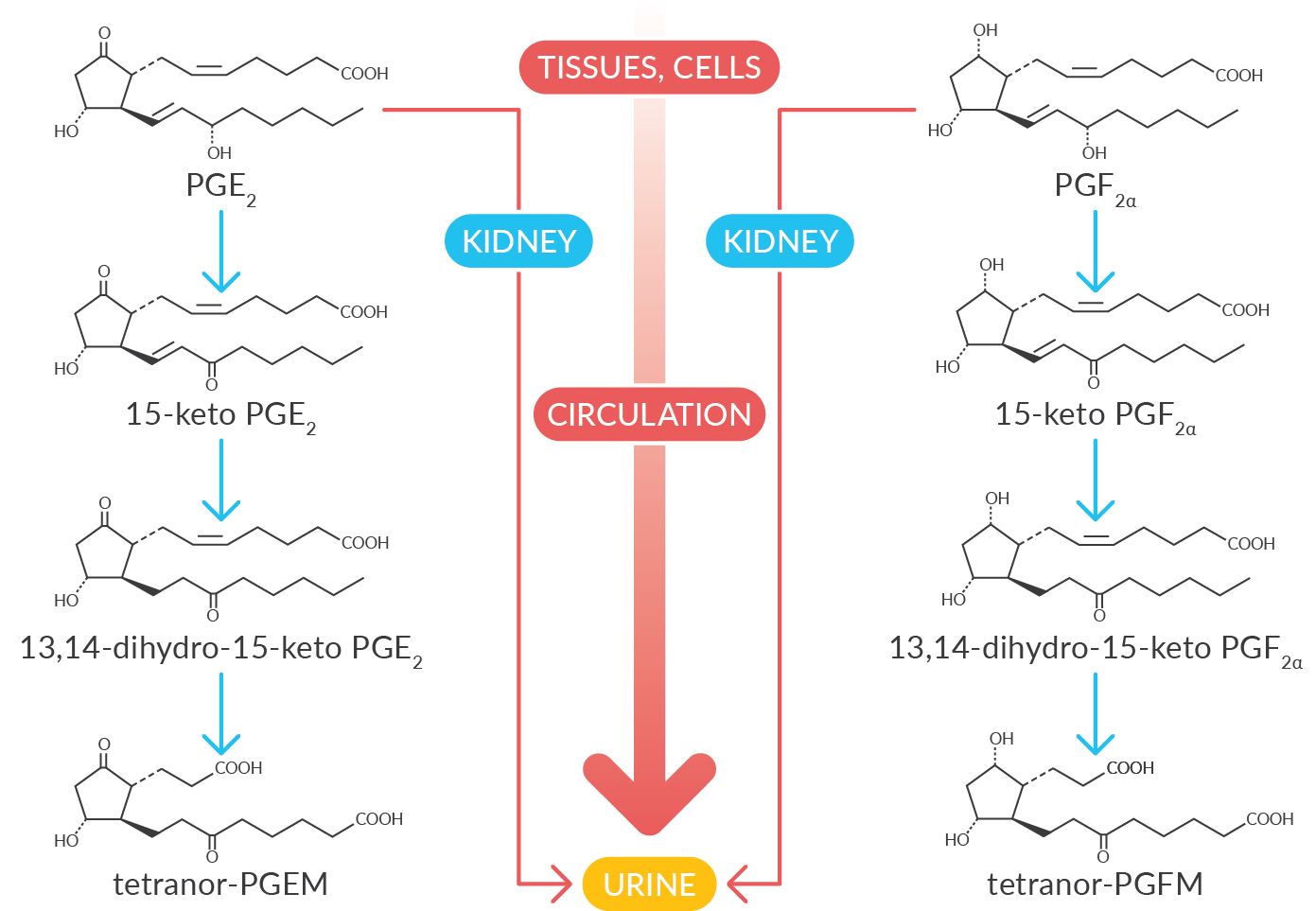
Prostaglandin metabolism from source to excretion.
Cell culture supernatants
Often contain high levels of bioactive lipids
Metabolism of bioactive lipids is limited, so measurement of the parent compound is appropriate
Generally do not require purification
Cell lysates
May contain higher levels of bioactive lipids than found in vivo
Metabolism of bioactive lipids is generally limited, so measurement of the parent compound is often appropriate
Plasma/Serum
Contains low levels of most bioactive lipids, the exception being those that are synthesized during the clotting process in serum preparation
Measurement of bioactive lipids in serum can provide an index of synthetic capacity of some bioactive lipids formed during the clotting process, particularly platelet thromboxane synthesis, rather than a measurement of systemically circulating compounds
Bioactive lipids are often rapidly metabolized in vivo; to gauge circulating levels of bioactive lipids it is more appropriate to measure downstream metabolites rather than the parent compound
Due to the complexity of these sample matrices and the relatively low level of bioactive lipids present, purification is advised
Tissue
Levels of bioactive lipids may be higher than found in plasma
It is often appropriate to measure the parent compound, but will depend on the tissue being tested
Due to the complexity of this sample matrix, purification is advised
Urine
Contains much higher levels of bioactive lipids than are found in plasma
The kidney is capable of producing a wide range of bioactive lipids; therefore, urine contains a mixture of bioactive lipids of both systemic and renal origin
Measurement of systemically produced bioactive lipids is best achieved by measurement of downstream metabolites to minimize the contribution of those of renal origin
Due to the relatively high levels of bioactive lipids in urine, purification is generally not necessary
Examples of eicosanoids that are appropriate to measure in different sample types:
Thromboxane A2 (TXA2)
| Sample Type | Analyte | Notes |
| Cell culture supernatants and lysates | TXA2 is extremely unstable and is converted non-enzymatically to TXB2. Note: the presence of TXB2 in FBS can be significant and should be accounted for in the final analysis; alternatively use serum-free culture conditions. | |
| Tissue | TXB2 | There is little conversion of TXB2 to downstream metabolites in most tissue types. |
| Plasma/Serum | 11-dehydro TXB2 | Platelets are activated during blood collection, producing high levels of TXB2, which will mask the signal from circulating TXB2. Since TXB2 will not be metabolized to 11-dehydro TXB2 ex vivo, the levels of this metabolite should better reflect systemic levels of thromboxane. |
| Urine | 11-dehydro TXB2 | Circulating TXB2 is rapidly metabolized in both liver and kidney. |
Prostaglandin D2 (PGD2)
| Sample Type | Analyte | Notes |
Cell culture supernatants and lysates | Metabolism is limited in vitro, so measurement of the parent compound is appropriate. | |
Plasma | PGD2 is rapidly metabolized to 11β-PGF2α in vivo. It also adducts to proteins through Michael addition following dehydration to PGJ2, so attempts to measure PGD2 itself in plasma or urine will be inaccurate. 11β-PGF2α is a relatively stable PGD2 metabolite that can be measured in plasma. | |
Urine | While 11β-PGF2α may provide useful information about urinary PGD2 levels in some species, in other species, such as rodents, it is found at very low levels and is, therefore, not a reliable index of systemic PGD2 formation. tetranor- PGDM is a further downstream metabolite of PGD2, which provides a more accurate index of systemic PGD2 levels. |
Prostaglandin E2 (PGE2)
Sample Type | Analyte | Notes |
Cell culture supernatants and lysates | Metabolism is limited in vitro, so measurement of the parent compound is appropriate. | |
Plasma | PGE2 is rapidly metabolized in vivo. PGEM provides a good tool for measurement of these downstream metabolites. | |
Urine | The kidney is capable of PGE2 production, therefore urinary PGE2 is a mixture of eicosanoid produced systemically and that of renal origin. PGEM found in urine will represent only PGE2 that is produced systemically. |
Preventing Artifacts
Several different potential sources of artifacts could result in inaccurate quantification of bioactive lipids. Here are some solutions to avoid confounding variables.
Time Frame | Cause | Problem | Solution(s) |
During experiment | Arachidonic acid added to cultured cells | Arachidonic acid cross-reacts at a very low level with many eicosanoid ELISAs. Although the cross-reactivity is low, the total amount of arachidonic acid added to the cells may be quite high, resulting in artificially elevated measurement of eicosanoid in the sample. |
|
During sample collection | Activation of platelets and endothelial cells during venipuncture | Exogenous formation of prostaglandins and thromboxane in plasma samples |
|
During sample collection, storage, and processing | Oxidation of bioactive lipids | Exogenous formation of oxidatively damaged lipids, such as isoprostanes |
|
During sample processing | AEBSF added to cells or tissues during processing | AEBSF inhibits acetylcholinesterase, which is used as a tracer in many of Cayman's ELISAs. |
|
Minimizing exogenous formation of eicosanoids
Eicosanoids and other bioactive lipids are often formed exogenously during the collection and processing of samples. Inhibitors of the enzymes responsible for eicosanoid formation, or those that inhibit oxidation can be added during sample collection and processing to attenuate the formation of these unwanted products. A list of suggested inhibitors is below.
Compound | Inhibitor of: | Why? |
Cyclooxygenases | Inhibits formation of exogenous prostaglandins and thromboxanes. | |
Lipoxygenases | Inhibits exogenous formation of leukotrienes and HETEs. | |
Oxidation | Attenuates oxidation of lipids, which could otherwise result in artificially elevated levels of compounds such as isoprostanes. |
Ready-to-use preservation vials are available for storing blood samples
Sampling tubes with Indomethacin– designed to preserve 1 ml samples for future analysis of prostaglandins and thromboxanes
Sampling tubes with BHT – designed to preserve 1 ml samples for future analysis of isoprostanes
Sampling tubes with BHT and Indomethacin – designed to preserve 1 ml samples for future analysis of prostaglandins, thromboxanes, and isoprostanes
Storage
Cayman recommends storing biological samples to be used for measurement of bioactive lipids at -80°C. This is of particular importance when measuring oxidative damage (i.e., isoprostanes), as lipid oxidation continues at -20°C.
Sample preparation/purification
The goal of sample prep and purification is to remove substances that interfere with accurate quantification of a bioactive lipid in your sample. When bioactive lipid levels are high, purification may not be necessary as interfering substances will be diluted out. When bioactive lipid levels are lower, more stringent purification will be required. Some general techniques are listed below.
Protein precipitation – Protein precipitation is most commonly used with highly proteinaceous samples, such as cell lysates or tissues, prior to performing solid phase extraction.
Liquid:liquid extraction – This technique takes advantage of the organic solubility of bioactive lipids, separating them from compounds that are only soluble in aqueous solution.
Solid phase extraction (SPE) – C18-SPE is commonly used in a manner similar to liquid:liquid extraction to separate bioactive lipids from compounds that are soluble only in aqueous solution.
Immuno-affinity sorbent – Cayman has immuno-affinity sorbents that will specifically recognize individual bioactive lipids (e.g., 8-isoprostane ). Purification of a sample using an immuno-affinity sorbent is the most analyte-specific method for purification.
Technical Support and Services
Our scientists are available to provide technical support, research tools, and services to help make your research possible. Feel free to contact them if you need further assistance in your lipid research.
Contact a technical support scientist
Learn more about our Biomarker Development Services
You May Also Be Interested In

Contact Info
Cayman Chemical1180 East Ellsworth RoadAnn Arbor, Michigan 48108 USAToll Free: (800) 364-9897(USA and Canada only)Fax: (734) 971-3640


