
News & Announcements
Fluorescent Cerebrosides for Cellular Studies
Fluorescent Cerebrosides for Cellular Studies
Article from 2016-01-04
This article was originally published in the January 2016 edition of Matreya’s Newsletter for Glyco/Sphingolipid Research (PDF).
Cerebrosides (galactosylceramides) are found primarily in neuronal tissues and are a major component of the central nervous system. They are the largest single component of the myelin sheath of nerves and seem to act, along with other molecules, to form part of the structural support of the myelin sheath.1 Cerebrosides are involved in a very wide range of biological activities such as cell agglutination, intracellular communication, cellular development, and antitumor/cytotoxic effects.2 They can be metabolized into sulfatide, which is also abundant in the nervous system and myelin sheath. Due to the relatively high melting point of cerebrosides (much greater than physiological body temperature), they have a paracrystalline structure.
The lysosomal enzyme β-galactosylceramidase is responsible for cleaving the glycosidic linkage of galactosylceramide and galactosylsphingosine for their degradation. Krabbe disease (globoid cell leukodystrophy) is characterized by a deficiency in β-galactosylceramidase, which is responsible for degrading cerebroside. This leads to a cytotoxic accumulation of cerebroside and galactosylsphingosine, which can result in demyelination of nerves, loss of axonal conductivity, and infiltration of activated macrophages into the brain.3 Cayman offers a few different probes to study galactosylceramide.
Fluorescent Galactosylceramide Probes
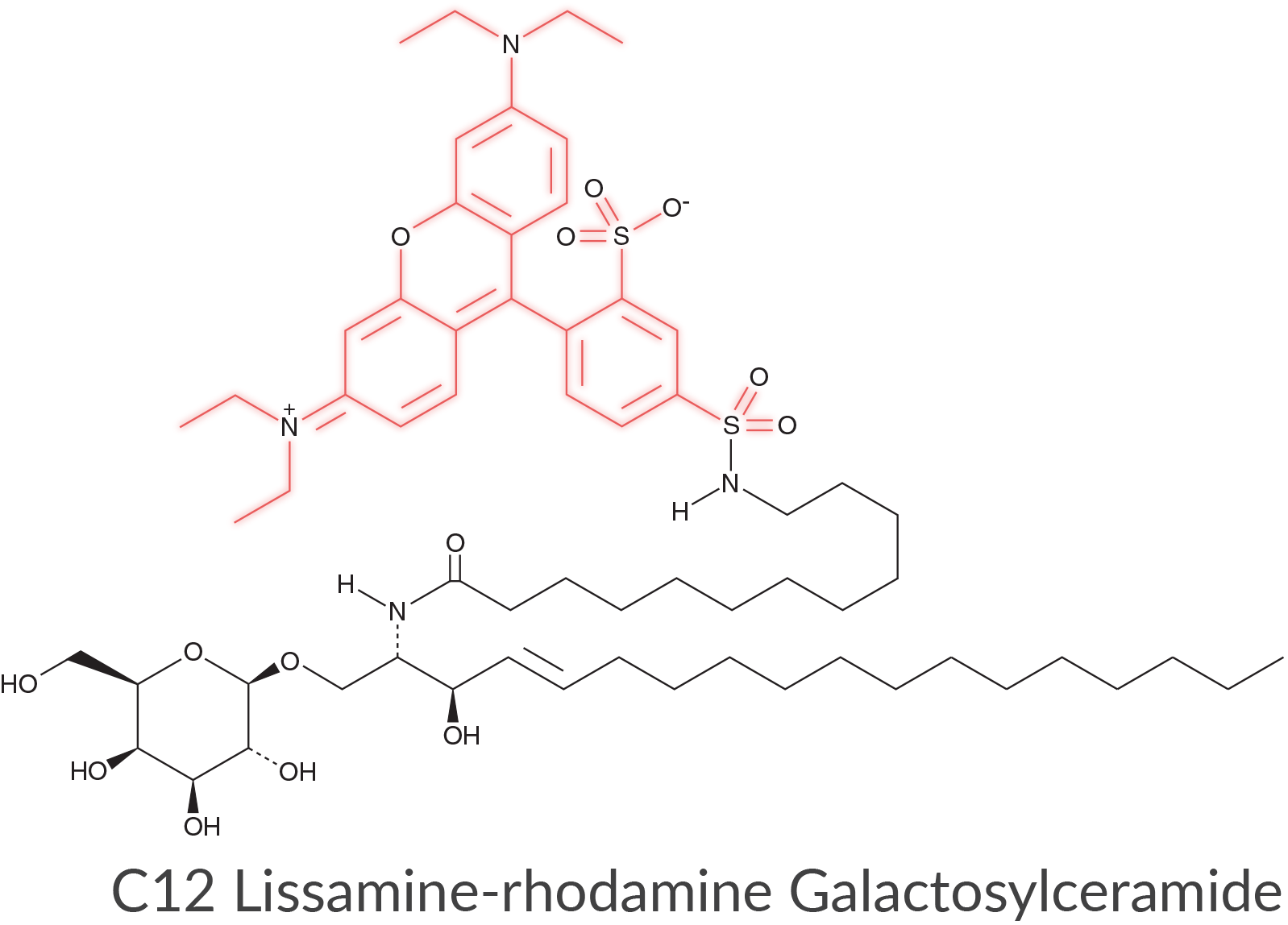
C12 Lissamine-rhodamine galactosylceramide is a fluorescently labeled glycosphingolipid version of C12 galactosylceramide. This fluorescent standard can be used to study Krabbe disease and other disorders.4 The fluorescent marker is attached via a 12-carbon linker, reducing the interaction of the fluorophore with the sphingolipid. Lissamine-rhodamine B dyes display excitation and emission maxima of 560 and 575 nm, respectively.
C6 NBD galactosylceramide (d18:1/6:0) and C12 NBD galactosylceramide (d18:1/12:0) are biologically active derivatives of galactosylceramide tagged with a fluorescent nitrobenzoxadiazole group. They have been used to study intracellular localization and metabolism of galactosylceramide as well as an internal standard to detect products of NBD ceramide glycosylation.5-8
You May Also Be Interested In
References
1. Miller, S.L. and Denisova, L. Cycloserine-induced decrease of cerebroside in myelin. Lipids 33(4), 441-443 (1998).
2. Zhou, X., Tang, L., and Liu, Y. An isomeric mixture of novel cerebrosides isolated from Impatiens pritzellii reduces lipopolysaccharide-induced release of IL-18 from human peripheral blood mononuclear cells. Lipids 44(8), 759-763 (2009).
3. Graziano, A.C.E. and Cardile, V. History, genetic, and recent advances on Krabbe disease. Gene 555(1), 2-13 (2015).
4. Zama, K., Hayashi, Y., Ito, S., et al. Simultaneous quantification of glucosylceramide and galactosylceramide by normal-phase HPLC using O-phtalaldehyde derivatives prepared with sphingolipid ceramide N-deacylase. Glycobiology 19(7), 767-775 (2009).
5. Lipsky, N.G. and Pagano, R.E. Sphingolipid metabolism in cultured fibroblasts: Microscopic and biochemical studies employing a fluorescent ceramide analogue. Proc. Natl. Acad. Sci. USA 80(9), 2608-2612 (1983).
6. Kok, J.W., Babia, T., and Hoekstra, D. Sorting of sphingolipids in the endocytic pathway of HT29 cells. J. Cell Biol. 114(2), 231-239 (1991).
7. Won, J.-S., Kim, J., Paintlia, M.K., et al. Role of endogenous psychosine accumulation in oligodendrocyte differentiation and survival: Implication for Krabbe disease. Brain Res. 1508, 44-52 (2013).
8. Turáková, K., Pavlíková, L., Messingerová, L., et al. Reduced UDP-glucose levels are associated with P-glycoprotein over-expression in L1210 cells and limit glucosylceramide synthase activity. Anticancer Res. 35(5), 2627-2634 (2015).
Contact Info
Cayman Chemical1180 East Ellsworth RoadAnn Arbor, Michigan 48108 USAToll Free: (800) 364-9897(USA and Canada only)Fax: (734) 971-3640


