
News & Announcements
Ganglioside GD3 and Neural Stem Cell Renewal
Ganglioside GD3 and Neural Stem Cell Renewal
Article from 2016-03-01
This article was originally published in the March 2016 edition of Matreya’s Newsletter for Glyco/Sphingolipid Research (PDF).
Gangliosides are vital acidic glycosphingolipids that are present in all vertebrate cells and are strongly associated with several regulatory roles in neurogenesis. Ganglioside GD3 is a major ganglioside species in embryonic mouse brain, constituting over 80% of the total gangliosides.
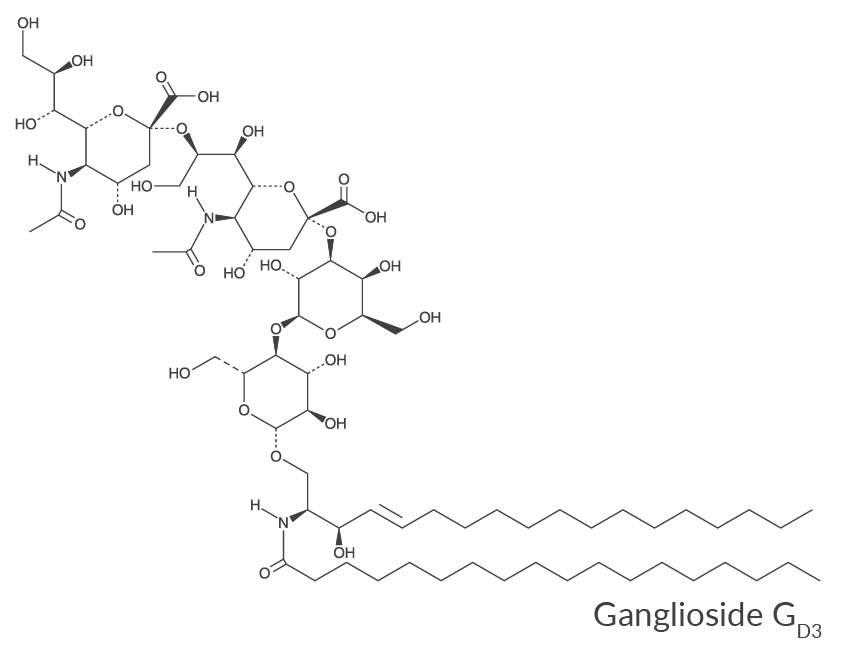
It plays an important role in maintaining neural stem cell (NSC) self-renewal capability.1 GD3 colocalizes and interacts with epidermal growth factor receptors (EGFRs) in the microdomain structure of the plasma membrane of NSCs. This interaction preserves EGFRs through an endosomal-plasma membrane recycling pathway after endocytosis of EGF. This facilitates the EGF-mediated signaling responsible for regulating NSC cell fate determination. Thereby, GD3 mediates the reuse of a mitogen receptor for promoting efficient cellular proliferation.
Mice with deficiency in GD3 synthase have a profound loss of NSCs, which results in impaired neurogenesis. Defects of the self-renewal capacity could be improved in the mice by restoring GD3 synthesis. Moreover, evidence suggests a strong link between GD3 deficiency and behavioral deficits such as depression-like behaviors.2 This research indicates a crucial role for gangliosides in the long-term maintenance of NSCs. To study such phenomena, Cayman offers a ganglioside GD3 mixture that contains ganglioside GD3 molecular species with C18:1 and C20:1 sphingoid backbones, as well as an internal standard for the quantification of ganglioside GD3, a biotin-labeled affinity probe for identification of ganglioside GD3 binding partners, a monoclonal antibody for immunochemical detection of ganglioside GD3, and (−)-L-threo-PDMP, which can enhance ganglioside biosynthesis.
You May Also Be Interested In
Deuterated GD3 as a New Mass Spectrometry Ganglioside Standard
Direct Reprogramming Strategies for Neurons
References
1. Wang, J. and Yu, R.K. Interaction of ganglioside GD3 with an EGF receptor sustains the self-renewal ability of mouse neural stem cells in vitro. Proc. Natl. Acad. Sci. USA 110(47), 19137-19142 (2013).
2. Wang, J., Cheng, A., Wakade, C., et al. Ganglioside GD3 is required for neurogenesis and long-term maintenance of neural stem cells in the postnatal mouse brain. J. Neurosci.34(41), 13790-13800 (2014).
Contact Info
Cayman Chemical1180 East Ellsworth RoadAnn Arbor, Michigan 48108 USAToll Free: (800) 364-9897(USA and Canada only)Fax: (734) 971-3640


