
News & Announcements
Direct Reprogramming Strategies for Neurons
Article from 2019-12-02
How functional neurons can be created from a chemical cocktail
Cell fates can be changed by deft manipulation of cell signaling pathways and cell-fate-determining programs using only small molecules. This discovery side steps the clinically risky business of introducing genomic alterations via viral vectors for transgenes and microRNAs and potentially inducing oncogenic factors. A chemical-only strategy represses the original cell fate program (e.g., downregulating fibroblast-specific genes) and activates the target-cell regulatory program (e.g., increasing the expression of neuronal transcription factors). Various cell lineages, including cardiomyocytes and endothelial cells, can be induced directly from somatic cells (non-reproductive cells of any type) using lineage-specific conditions.
Here we will discuss types of compounds that have been used to convert mouse fibroblasts into functional neurons, neural progenitor cells, and neural stem cells without the need for exogenous gene expression. By merely regulating key signaling pathways, these compounds directly modify epigenetic factors and improve somatic cell reprogramming to determine the fate of the fibroblasts. In contrast to genomic manipulations, these small molecule combinations are easy to use, easy to optimize, easy to synthesize, and easy to formulate into a conventional pharmaceutical. Synergy from multiple chemicals is crucial as each small molecule alone is not capable of generating neuron-like cells. A hierarchical transcription activation process must occur in which the neuron-specific transcriptional program is initiated and stabilized. Importantly, many of these chemicals can be swapped with alternate inhibitors of the same target and still achieve the same effects.
Chemically induced reprogramming of fibroblasts to stem cells and neurons.
Epigenetic Modifiers
Selective epigenetic modulation using small molecules can change the status of a transcription factor and its access to the promotor. If this is achieved successfully, then ectopic expression of that gene will not be required. The importance of an open chromatin state during reprogramming has been demonstrated by the fact that modulators of DNA methylation, histone acetylation, and histone methylation can improve the efficiency of reprogramming. For instance, DNA hypermethylation plays an important role in the downregulation and silencing of genes by directly blocking transcription factor binding to the promoter. Histone methylation also plays a role in the repression of transcription in pluripotent cells. Thus, reactivation of hypermethylated pluripotency genes, which can be achieved by using methyltransferase inhibitors, is critical for reprogramming.
Histone deacetylation plays a role in gene expression by altering chromatin structure and is involved in cell cycle progression, cell survival, and differentiation. The use of HDAC inhibitors enables the activation of pluripotency genes along with Oct4 and Sox2 expression, eliminating the need for c-Myc and Klf4 oncogenes in a somatic cell reprogramming induction protocol. This technique improves the reprogramming efficiency two-fold from that of the original protocols of Shinya Yamanaka and colleagues who showed that pluripotent stem cells could be obtained by introducing just four genes in an adult cell: Oct4, Sox2, Klf4, and c-Myc. The use of HDAC inhibitors also appears to protect cells from senescent stress by increasing proliferation, inhibiting apoptosis, and preventing blockage of the G2/M phase.
Additionally, inhibition of BRD BET bromodomains that also play a role in gene expression can disrupt the fibroblast core transcriptional network, which is necessary to suppress the fibroblast state. Cayman offers many small molecule epigenetic modifiers, of which the most commonly used in stem cell reprogramming are listed below.
| Compound | Target |
| I-BET151 | BRD2, BRD3, and BRD4 |
HDACs HDACs HDACs | |
G9a histone methyltransferase EZH2 lysine methyltransferase | |
| Tranylcypromine (hydrochloride) | Lysine-specific demethylase 1 |
DNA methyltransferases DNA methyltransferases DNA methyltransferases |
Modifiers of Cell Signaling Pathways and Apoptosis
Inhibition of Rho kinase (ROCK), glycogen synthase kinase 3 (GSK3), MAPK kinase (MEK), and TGF-β receptors have been shown to enhance somatic cell reprogramming. ROCK signaling pathways mediate proliferation, gene expression, motility, cell shape, and cross talk with other signaling pathways that influence reprogramming. ROCK inhibition has been shown to maintain the survival of pluripotent stem cells and neurons, which serves to improve reprogramming efficiency.
Wnt signaling and control of GSK3 activity are important for stem cell renewal and proliferation. The Wnt/β-catenin pathway signals cells to divide and proliferate but also plays a role in controlling cell structure, growth, motility, and apoptosis. Activation of canonical Wnt signaling causes the translocation of β-catenin to the nucleus where it binds to transcription factors TCF/LEF to stimulate transcription of Wnt target genes. In a resting state, this process is inhibited through GSK3 phosphorylation of β-catenin, which triggers β-catenin destabilization and degradation. Presumably acting as Wnt pathway activators, GSK3 inhibitors have been shown to induce neural development from pluripotent cells. It is important to consider, though, that GSK3 has over 40 protein targets and is involved in other signaling pathways including metabolic regulation that may also have an influence on reprogramming.
MEK is a member of the RAS/RAF/MEK/ERK signaling cascade whose activity can regulate various genes through the ability of ERK to translocate to the nucleus and phosphorylate transcription factors that influence cell cycle arrest, cell proliferation, terminal differentiation, and apoptosis. This signaling pathway has also been shown to accelerate the mesenchymal-to-epithelial transition. When added at late stages of reprogramming, MEK inhibitors promote pluripotency and prevent non-specific differentiation.
Proteins in the TGF-β family, including bone morphogenetic protein (BMP) receptors and TGF-β receptor 1 kinase (ALK5), play a role in reprogramming. Activation of TGF-β receptors induces signaling via formation of SMAD complexes that are translocated to the nucleus where they act as transcription factors, as well as via non-SMAD pathways, including the ERK1/2, JNK, p38 MAPK, and PI3K pathways. Inhibitors of TGF-β signaling that block the activation of SMAD can promote the expression of genes related to the mesenchymal-to-epithelial transition in fibroblasts, which can enhance the generation of pluripotent stem cells. Cayman offers many modifiers of cell signaling and apoptosis, the most common of which are listed below.
| Compound | Target |
ROCK ROCK | |
GSK3α, GSK3β GSK3β | |
| PD 0325901 | MEK |
ALK5 Inhibitor II (RepSox) | ALK4, ALK5, ALK7 ALK5 ALK1, ALK2, ALK3, ALK6 ALK4, ALK5, ALK7 TGF-β1 |
Further Regulators of Reprogramming
Bmi1 expression leads to the reprogramming of fibroblasts into neural stem cells in combination with Oct4 and can replace Sox2, Klf4, and c-Myc during the reprogramming of fibroblasts into pluripotent cells. Activation of sonic hedgehog (Shh) signaling compensates for the effects of Bmi1, and, in combination with Oct4, reprograms mouse embryonic and adult fibroblasts into pluripotent cells. Smoothened (SMO) is a cell surface receptor that, with Patched, mediates Shh signaling to regulate gene expression through the Gli transcription factors. SMO agonists have been used to promote the differentiation of neural stem cells.
Activators of adenylyl cyclase (or compounds that prevent the degradation of cyclic AMP (cAMP) increase the level of cAMP, a second messenger that often exerts its effects through protein kinase A. cAMP-responsive element binding (CREB), a downstream target of cAMP, has been shown to potentiate neuron differentiation. cAMP activators can act as chemical substitutes for Oct4.
The c-Jun N-terminal kinases (JNKs) are key components of networks that mediate cell adaptation to stress and apoptosis as well as cell fate decisions and differentiation. JNK inhibitors have been shown to facilitate neural conversion of fibroblasts in combination with other signaling inhibitors, arresting cells in the G2/M phase.
Protein kinase C (PKC) signaling is also critical to balancing embryonic stem cell self-renewal and lineage commitment and might be involved in regulating gene expression during formation of the neural cell lineage. PKC inhibitors have been shown facilitate neural conversion by enabling the reprogramming of fibroblasts to a pluripotent state.
A recent high-throughput screen of small molecules revealed that isoxazole 9 (ISX-9) facilitates neural differentiation. The effects of ISX-9 involve the expression of myocyte-enhancer factor 2 (MEF2), a family of transcription factors important in early development as proneuronal and prosurvival factors.
Active retinoids induce differentiation primarily by binding to retinoic acid receptor (RAR) transcription factors that associate with retinoid X receptors (RXRs) and bind retinoic acid DNA response elements in the nucleus. Binding of retinoids initiates changes in interactions of RAR/RXRs with co-repressor and co-activator proteins, activating transcription of primary target genes, altering interactions with proteins that induce epigenetic changes, and inducing transcription of genes encoding transcription factors and signaling proteins that further modify gene expression. Evidence has also emerged that retinoids support the self-renewal of stem cells by activating the endogenous machinery for self-renewal via a retinoic acid-independent mechanism. See below for the most common of these regulators of stem cell reprogramming available from Cayman.
| Compound | Target |
SMO SMO | |
| Forskolin | cAMP |
| SP 600125 | JNK |
| Gö 6983 | PKC |
| ISX-9 | MEF2-dependent signaling |
RARs RARs |
Moderators of Cell Senescence
Activation of p53 elicits cell cycle-blocking transcriptional events to restore cellular homeostasis through either DNA repair, senescence, or apoptosis. This pathway is crucial to protect against cancer cell growth but also plays a role in aging and is associated with premature exhaustion of stem cells. Studies have reported a role for p53 in suppressing the pluripotency of embryonic stem cells after DNA damage and blocking the reprogramming of somatic cells into induced pluripotent stem cells. Thus, inactivating p53 can increase efficiency of reprogramming to induce pluripotent stem cells. The two most common regulators of senescence used in stem cell research are listed below.
| Compound | Target |
p53 p53 |
Modulators of Metabolism
Autophagy is a metabolic mechanism that maintains cellular homeostasis through degradation and recycling of intracellular components. It regulates self-renewal, differentiation, senescence, and apoptosis, all of which require a strict control of protein turnover and lysosome-mediated degradation of organelles. Upon activation during stem cell self-renewal and differentiation, neural stem cells need to remodel their cytoskeleton and shape in an energy-consuming process. This is supported by the capacity of autophagy to recycle cellular components and provide energy efficiently potentially by recycling sets of transcription factors, adhesion molecules, or secreted factors. High levels of basal autophagy activity are present during induced pluripotent stem cell genesis and maintenance. The generation of induced pluripotent stem cells requires an mTOR-regulated metabolic switch from mitochondrial oxidative phosphorylation to glycolysis during the reprogramming process. mTOR has been shown to be downregulated by Sox2 at an early stage of induced pluripotent stem cell generation, which is required for reprogramming to occur. The small molecule SMER28 induces autophagy by increasing autophagosome synthesis and enhancing the clearance of autophagy substrates. As a component of a neural reprogramming cocktail, it has been used to reprogram mouse fibroblasts into induced neural stem cell-like cells.
| Compound | Target |
| SMER28 | autophagy |
Summary
This evidence illustrates how combinations of small molecules that modify chromatin and promote stem cell self-renewal and survival can be effective at regulating stem cell fate decisions and improve reprogramming efficiency. The availability of small molecule libraries, including those available from Cayman, has increased the speed at which new compounds are being discovered and new targets and pathways that regulate stem cell fate and biology are being identified.
Stem Cell Small Molecule Screening Library (96-Well)
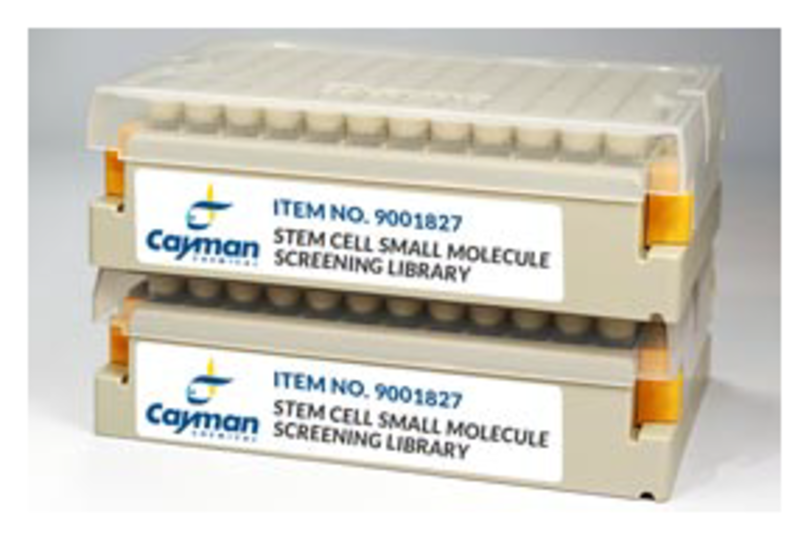
Contains >140 small molecules in two 96-well plates.
Includes compounds that induce differentiation, maintain self-renewal and proliferation, or improve the reprogramming efficiency of various stem cell populations.
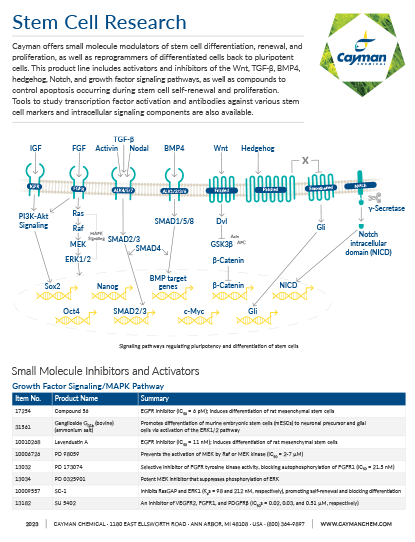
More Stem Cell Research Tools from Cayman
Further Reading
Protocols for Direct Reprogramming to Neurons
Biswas, D. and Jiang, P. Chemically induced reprogramming of somatic cells to pluripotent stem cells and neural cells. Int. J. Mol. Sci.17(2), 226 (2016).
Dai, P., Harada, Y., and Takamatsu, T. Highly efficient direct conversion of human fibroblasts to neuronal cells by chemical compounds. J. Clin. Biochem. Nutr.56(3), 166-170 (2015).
Hu, W., Qiu, B., Guan, W., et al. Direct conversion of normal and Alzheimer's disease human fibroblasts into neuronal cells by small molecules. Cell Stem Cell 17(2), 204-212 (2015).
Li, X., Zuo, X., Jing, J., et al. Small-molecule-driven direct reprogramming of mouse fibroblasts into functional neurons. Cell Stem Cell 17(2), 195-203 (2015).
Protocol for Direct Reprogramming to Neural Progenitor Cells
Cheng, L., Hu, W., Qiu, B., et al. Generation of neural progenitor cells by chemical cocktails and hypoxia. Cell Res.24(6), 665-679 (2014).
Protocols for Direct Reprogramming to Neural Stem Cells
Han, Y.C., Lim, Y., Duffieldl, M.D., et al. Direct reprogramming of mouse fibroblasts to neural stem cells by small molecules. Stem Cells Int. 2016:4304916 (2016).
Hou, P., Li, Y., Zhang, X., et al. Pluripotent stem cells induced from mouse somatic cells by small-molecule compounds. Science 341(6146), 651-654 (2013).
Tang, Y., Xiong, S., Yu, P., et al. Direct conversion of mouse fibroblasts into neural stem cells by chemical cocktail requires stepwise activation of growth factors and Nup210. Cell Rep. 24(5), 1355-1362.e3 (2018).
Zheng, J., Choi, K.A., Kang, P.J., et al. A combination of small molecules directly reprograms mouse fibroblasts into neural stem cells. Biochem. Biophys. Res. Commun. 476(1), 42-48 (2016).
Zhang, M., Lin, Y.H., Sun, Y.J., et al. Pharmacological reprogramming of fibroblasts into neural stem cells by signaling-directed transcriptional activation. Cell Stem Cell. 18(5), 653-667 (2016).
Contact Info
Cayman Chemical1180 East Ellsworth RoadAnn Arbor, Michigan 48108 USAToll Free: (800) 364-9897(USA and Canada only)Fax: (734) 971-3640


