
News & Announcements
Manipulating Mitochondrial Fuel Pathways
Manipulating Mitochondrial Fuel Pathways
Article from 2019-04-22
Three pathway inhibitors demonstrate the flexibility of cells to use glucose, glutamine, and long-chain fatty acids as mitochondrial fuel sources
Inhibitors of the glucose, glutamine, and long-chain fatty acid oxidation pathways can be mixed/matched and combined into a powerful tool to direct metabolism by pinpointing specific metabolic pathways. Strategies to modulate these fuel sources may have therapeutic potential by affecting glucose, lipid, and/or amino acid homeostasis that becomes dysregulated during diseases such as diabetes, obesity, fatty liver diseases, mitochondrial disorders, cardiac failure, neurodegeneration, and cancer. A critical step in this process is to understand how substrate utilization and metabolic activity are reprogrammed upon inhibition of enzymes and transporters driving mitochondrial oxidation pathways.
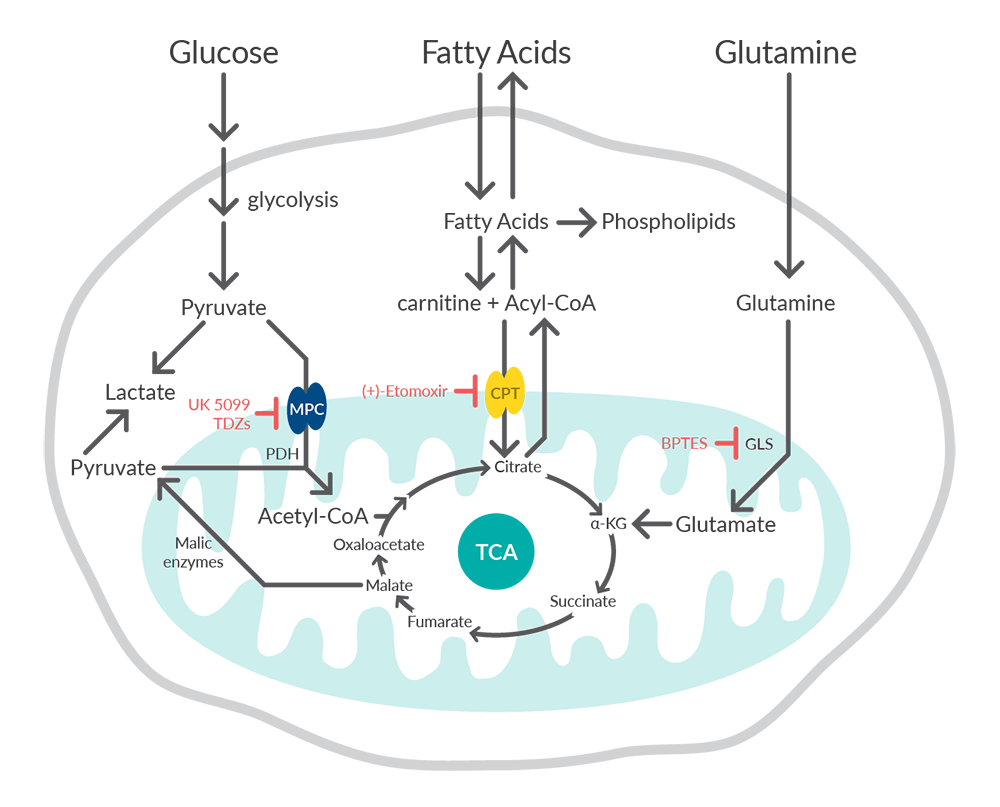
One of the primary ways that cells produce energy is from the mitochondrial oxidation of glucose, fatty acids, and glutamine. The cell’s flexibility to depend on any number of these fuel sources can be manipulated with specific pathway inhibitors.
Glucose Oxidation Pathway
Cells convert glucose to pyruvate through glycolysis. Pyruvate is then transported into the mitochondria through the mitochondrial pyruvate carrier (MPC) where it is decarboxylated and conjugated to CoA by the pyruvate dehydrogenase (PDH) complex for utilization by the TCA cycle. The MPC inhibitor UK 5099 prevents the facilitation of pyruvate transport, pushing mitochondria to maintain flux by relying on fatty acids and glutamine. In the absence of a functioning MPC, metabolic reprogramming depends on the glutaminolysis pathway whereby glutamine is oxidized in the mitochondria and converted to pyruvate via malic enzymes. A glutamine-derived acetyl-CoA pool can be generated by the PDH complex. This pool condenses with oxaloacetate to form citrate. Glutamine can also contribute carbon to fatty acid synthesis via reductive carboxylation. However, at high concentrations, cellular pyruvate will passively enter mitochondria—bypassing the MPC—to be converted to acetyl-CoA through the PDH complex. Insulin-sensitizing thiazolidinediones are a known target of the MPC and demonstrate how reducing glucose as a mitochondrial substrate can be useful in the context of metabolic disorders.
Fatty Acid Oxidation Pathway
Mitochondrial fatty acid oxidation by the liver provides an alternative source of fuel when glucose reserves are significantly reduced, most often due to fasting or illness. The pathway fuels ketogenesis for metabolism in peripheral tissues that cannot oxidize fatty acids. The mitochondrial enzyme carnitine palmitoyltransferase 1 (CPT1) is critical for the translocation of long-chain fatty acids from the cytosol into the mitochondria for β-oxidation. It works to combine fatty acyl-CoAs with carnitine for transport. The uptake of fatty acids into the mitochondria can be prevented by using a CPT1A inhibitor such as (+)-etomoxir. This compound forces cells to shift to using glutamine and glucose as their primary carbon sources. While reduced fatty acid oxidation may lead to an increase in cellular lipid accumulation, the reciprocal increase in glucose oxidation has been shown to improve insulin sensitivity in instances of diabetes and obesity.
Glutamine Oxidation Pathway
Glutamine enters the mitochondria through the glutaminolysis pathway where is it deaminated to glutamate via glutaminase (GLS). Glutamate is converted to α-ketoglutarate and then oxidized by α-ketoglutarate dehydrogenase in the TCA cycle to generate ATP and NADH. BPTES is an allosteric inhibitor of kidney-type GLS1 that prevents glutamine utilization by the mitochondria. In this case, fatty acids and pyruvate are relied upon as alternative fuels. While glutamine is an important substrate for proliferating cells, mounting evidence indicates that enhanced glutamine metabolism in cancer cells has critical roles in contributing to cancer cell proliferation and survival. Thus, some strategies for therapeutics have focused on coaxing cells in the tumor microenvironment to shift to a different metabolic process as a way to starve glutamine-dependent cancer cells.
Mitochondrial Substrate Oxidation Pathway Inhibitors
| UK 5099 (Item No. 16980) | (+)-Etomoxir (Item No. 11969) | BPTES (Item No. 19284) |
| Inhibits MPC | Inhibits CPT1 | Inhibits GLS1 |
| Prevents pyruvate transport into mitochondria | Prevents translocation of long-chain fatty acids from cytosol to mitochondria | Prevents the conversion of glutamine to glutamate |
| Blocks the glucose oxidation pathway | Blocks long chain fatty acid oxidation | Blocks the glutamine oxidation pathway |
| Alternate fuel source = fatty acids and glutamine | Alternate fuel source = glucose (pyruvate) and glutamine | Alternate fuel source = glucose (pyruvate) and fatty acids |
Determination of Mitochondrial Fuel Flexibility
The examples above show that mitochondrial capacity and dependency for fatty acid, glutamine, and pyruvate oxidation can be determined by employing a combination of small molecule inhibitors at key nodes of the oxidative pathway. By measuring oxygen consumption rate (OCR) in the presence and absence of these inhibitors, fuel flexibility (dependency and capacity) can be determined. In the example traces below, Cayman scientists calculated OCR in HCT116 cells using an Agilent Seahorse XFe96 upon adding differing combinations of (+)-etomoxir to inhibit fatty acid oxidation (FAO) via CPT1A, UK 5099 to inhibit mitochondrial pyruvate oxidation via MPC, and BPTES to inhibit glutamine oxidation via GLS. As shown in panel A below, the cell becomes reliant on endogenous substrates and exogenous fatty acids when pyruvate and glutamine transport are inhibited. Further inhibition of FAO reveals mitochondrial respiration in these cells is fully reliant on endogenous substrates. Similar concepts can be seen in panel B where exogenous FAO and pyruvate transport are inhibited, and panel C where exogenous glutamine transport and FAO are inhibited. These data can be used to determine a cell’s capacity to oxidize a specific substrate. In turn, a cell’s dependency on a specific pathway can be determined by inhibiting one uptake pathway as demonstrated in panels D-F, followed by inhibiting the remaining two. Information such as this can be used to determine the metabolic phenotype of many different types of cells. For instance, it can be used to identify the fuel source preference of a cancer cell. One can then test any alterations in relying on that fuel source under hypoxic conditions or if exposure to chemotherapy prevents the cancer cell’s ability to adapt to a different fuel source.
A. By inhibiting exogenous pyruvate and glutamine transport, the cell becomes reliant on endogenous substrates and exogenous fatty acids (FAO). B. Inhibition of FAO and pyruvate oxidation leads to a reliance on glutamine oxidation. C. Inhibition of glutamate oxidation and FAO leads to a reliance on pyruvate oxidation. D.-F. Inhibition of one uptake pathway followed by inhibition of the remaining two reveals the cell’s dependency on these fuel sources for mitochondrial respiration.
Cayman’s contract services offer fuel flexibility determination as part of their cellular metabolism services. These services include the ability to monitor mitochondrial respiration and glycolysis using an Agilent Seahorse XFe96 as well as assessment of electron transport chain activity, mitochondrial inner membrane permeability, and ROS generation using their suite of functional assays.
Learn more about Cayman’s Cellular Metabolism services from one of our experts
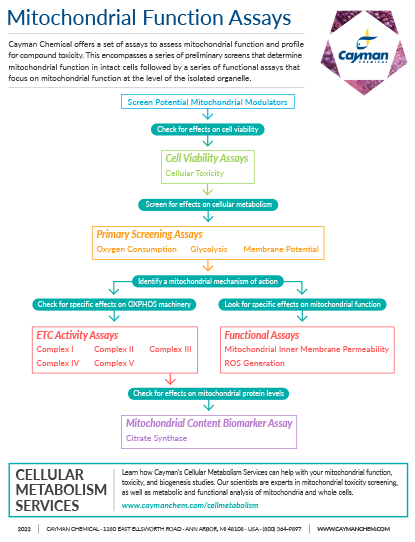
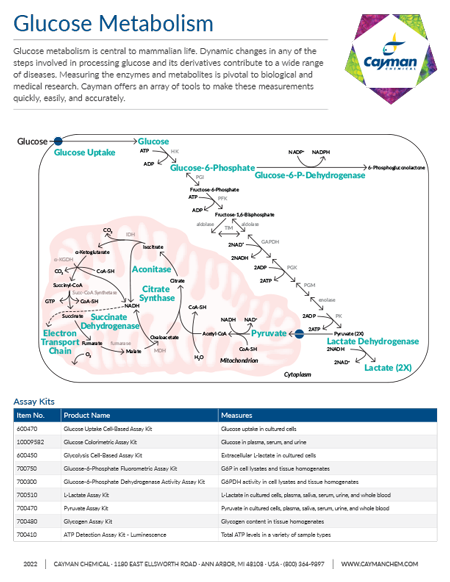
Cayman also offers a set of assays to assess mitochondrial function and glucose metabolism. Download our brochures to learn more:
Suggested Reading
Vacanti, N.M., Divakaruni, A.S., Green, C.R., et al. Regulation of substrate utilization by the mitochondrial pyruvate carrier. Mol. Cell 56(3), 425-435 (2014).
Colca, J.R., McDonald, W.G., and Kletzien, R.F. Mitochondrial target of thiazolidinediones. Diabetes Obes. Metab. 16(11), 1048-1054 (2014).
Keung, W., Ussher, J.R., Jaswal, J.S., et al. Inhibition of carnitine palmitoyltransferase-1 activity alleviates insulin resistance in diet-induced obese mice. Diabetes 62(3), 711-720 (2013).
Jin, L., Alesi, G.N., and Kang, S. Glutaminolysis as a target for cancer therapy. Oncogene 35(28), 3619-3625 (2016).
Contact Info
Cayman Chemical1180 East Ellsworth RoadAnn Arbor, Michigan 48108 USAToll Free: (800) 364-9897(USA and Canada only)Fax: (734) 971-3640


