
News & Announcements
Monosialoganglioside Standards
Monosialoganglioside Standards
Article from 2012-06-01
This article was originally published in the June 2012 edition of Matreya’s Newsletter for Glyco/Sphingolipid Research (PDF).
Monosialogangliosides are membrane sphingolipids that contain one sialic acid residue.1 They form lipid rafts in the outer leaflet of the cell plasma membrane, especially in neuronal cells in the central nervous system and have roles in cell proliferation, differentiation, and adhesion, as well as neuronal plasticity and repair.1-3 Monosialogangliosides accumulate in a variety of lysosomal storage disorders including Sandhoff, Tay-Sachs, and Niemann-Pick diseases.4,5
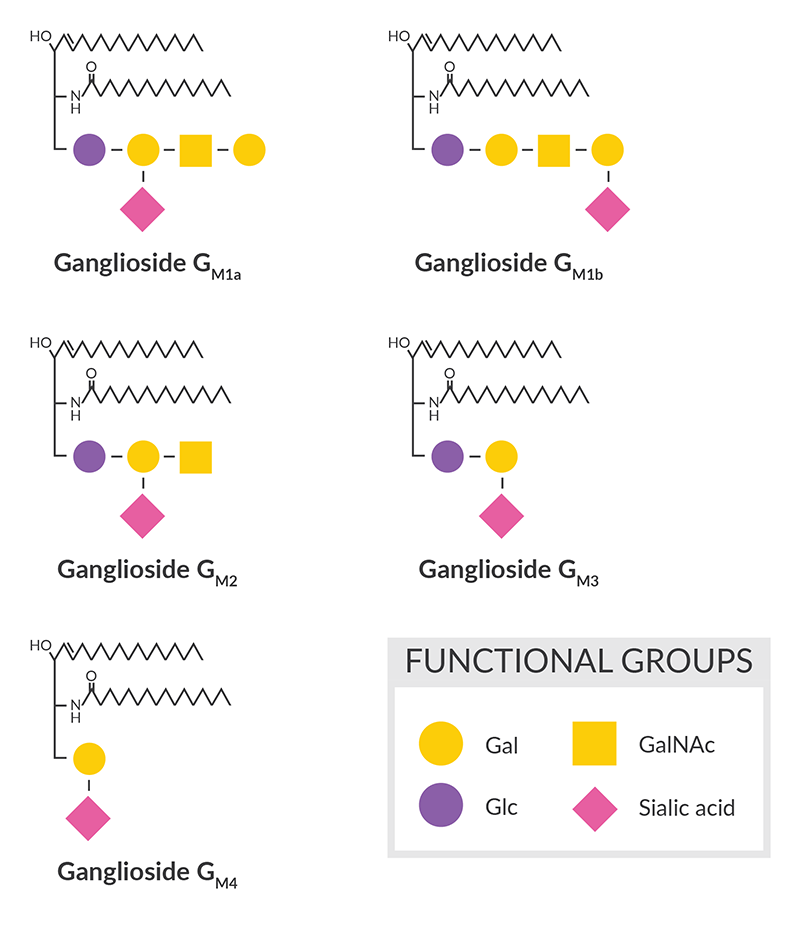
Ganglioside GM1
GM1 is the prototypic ganglioside for all other members of this series. It has roles in neuronal plasticity and repair mechanisms, as well as in the release of neurotrophins in the brain.1 GM1 stimulates neuronal sprouting and enhances the action of nerve growth factor (NGF) by directly and tightly associating with Trk, the high-affinity tyrosine kinase-type receptor for NGF. GM1 also acts as the site of binding for both cholera toxin and E. coli heat-labile enterotoxin.6
Ganglioside GM2
GM2 regulates the function of ciliary neurotrophic factor receptors. The enzymatic hydrolysis of GM2 requires that it be complexed with a substrate-specific cofactor, the GM2 activator. There are two isoenzymes of β-hexosaminidase, Hex A (with an αβ subunit structure) and Hex B (with a ββ subunit structure), where only Hex A can act on the ganglioside GM2/GM2 activator complex. Three types of GM2 gangliosidosis are caused by the accumulation of GM2 due to an inherited deficiency in β-hexosaminidase.7 Tay-Sachs disease results from mutations in the gene HEXA, which encodes the α-subunit of Hex A. Sandhoff disease results from a mutation in the gene HEXB, which encodes the β-subunit of Hex A and Hex B. GM2 activator deficiency results from a mutation in the GM2A gene, which encodes the GM2 activator.
Ganglioside GM3
GM3 demonstrates antiproliferative and proapoptotic effects in tumor cells by modulating cell adhesion, proliferation, differentiation, and tumor cell invasion.2,3 It is the main ganglioside of human fibroblasts and can induce a refractoriness to cell growth stimulation by fibroblast growth factor. It is capable of inhibiting epidermal growth factor (EGF)-stimulated phosphorylation of the EGF receptor in membrane preparations in human epidermoid carcinoma cell lines KB and A431.8 GM3 also induces dissociation of the insulin receptor-caveolin-1 complex from lipid microdomains, functioning as an inhibitor of insulin signaling and contributing to insulin resistance in adipocytes.9
Ganglioside GM4
GM4 is found primarily in the brain of mammals, particularly in human myelin and has been detected in adrenal neuroblastoma tumors.10,11 Replacement therapy for GM4 prevents development of myelin basic protein-induced experimental autoimmune encephalomyelitis.12 GM4 is also found on epithelial cells in the intestinal tract of the red sea bream where it is an attachment site for Gram-negative Vibrios, the bacteria that causes vibriosis in humans after ingestion of raw or undercooked seafood.13
Monosialoganglioside Reference Standards
Cayman offers a suite of high-purity monosialoganglioside standards that are ideal for the identification of gangliosides in samples and biological systems using mass spectrometry.
Ganglioside GM1 Asialo Mixture
Ganglioside GM2 Mixture (sodium salt)
Ganglioside GM2 Asialo Mixture
Ganglioside GM3 Mixture (sodium salt)
Ganglioside GM4 Mixture (ammonium salt)
Lyso-Monosialoganglioside GM1 (ammonium salt)
Fucosylated Ganglioside GM1 (ammonium salt)
C18 Ganglioside GM1-d3 (d18:1/18:0-d3) (ammonium salt)
C16 Ganglioside GM1-d9 (d18:1/16:0-d9) (ammonium salt)
C16 Ganglioside GM2-d9 (d18:1/16:0-d9) (ammonium salt)
C18 Ganglioside GM2-d3 (d18:1/18:0-d3) (ammonium salt)
C16 Ganglioside GM3-d9 (d18:1/16:0-d9) (ammonium salt)
C18 Ganglioside GM3-d3 (d18:1/18:0-d3) (ammonium salt)
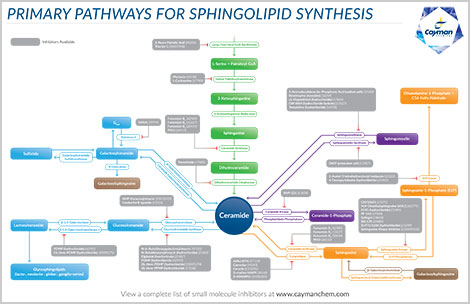
New Deuterium-Labeled Glycosphingolipids
Deuterated GD3 as a New Mass Spectrometry Ganglioside Standard
References
1. Kolter, T. Ganglioside biochemistry. ISRN Biochem. 2012, 506160 (2012).
2. Mukherjee, P., Faber, A.C., Shelton, L.M., et al. Thematic review series: Sphingolipids. Ganglioside GM3 suppresses the proangiogenic effects of vascular endothelial growth factor and ganglioside GD1a. J. Lipid Res. 49(5), 929-938 (2008).
3. Seyfried, T.N. and Mukherjee, P. Ganglioside GM3 is antiangiogenic in malignant brain cancer. J. Oncol. 2010, 961243 (2010).
4. Baek, R.C., Martin, D.R., Cox, N.R., et al. Comparative analysis of brain lipids in mice, cats, and humans with Sandhoff disease. Lipids 44(3), 197-205 (2009).
5. Walkley, S.U. Secondary accumulation of gangliosides in lysosomal storage disorders. Semin. Cell Dev. Biol. 15(4), 433-444 (2004).
6. Cho, J.A., Chinnapen, D.J.-F., Amar, E., et al. Insights on the trafficking and retro-translocation of glycosphingolipid-binding bacterial toxins. Front. Cell. Infect. Microbiol. 2, 51 (2012).
7. Gravel, R.A., Kaback, M.M., Proia, R.L., et al. The GM2 Gangliosidoses. The metabolic and molecular bases of inherited disease. Scriver, C.R., Beaudet, W.S., Sly, D., et al., editors 8th edition, McGraw-Hill Inc. (2001).
8. Bremer, E.G., Schlessinger, J., and Hakomori, S. Ganglioside-mediated modulation of cell growth. Specific effects of GM3 on tyrosine phosphorylation of the epidermal growth factor receptor. J. Biol. Chem. 261(5), 2434-2440 (1986).
9. Kabayama, K., Sato, T., Saito, K., et al. Dissociation of the insulin receptor and caveolin-1 complex by ganglioside GM3 in the state of insulin resistance. Proc. Natl. Acad. Sci. USA 104(34), 13678-13683 (2007).
10. Ueno, K., Ando, S., and Yu, R.K. Gangliosides of human, cat, and rabbit spinal cords and cord myelin. J. Lipid Res. 19(7), 863-871 (1978).
11. Robu, A.C., Vukelić, Ž., Schiopu, C., et al. Mass spectrometry of gangliosides in extracranial tumors: Application to adrenal neuroblastoma. Anal. Biochem. 509, 1-11 (2016).
12. Mullin, B.R., Patrick, D.H., Poore, C.M., et al. Prevention of experimental allergic encephalomyelitis by ganglioside GM4. Brain Res. 296(1), 174-176 (1984).
13. Chisada, S., Shimizu, K., Kamada, H., et al. Vibrios adhere to epithelial cells in the intestinal tract of red sea bream, Pagrus major, utilizing GM4 as an attachment site. FEMS Microbiol. Lett. 341(1), 18-26 (2013).
Contact Info
Cayman Chemical1180 East Ellsworth RoadAnn Arbor, Michigan 48108 USAToll Free: (800) 364-9897(USA and Canada only)Fax: (734) 971-3640


