
News & Announcements
Natural Products for Drug Discovery in Modern Medicine
Article from 2025-03-06
Natural products have been a historically invaluable source of bioactive compounds with well-recognized potential therapeutic uses.1-4 Today, they continue to represent important sources for new drugs.
PharmacognosyFär-mə- 'käg-nə-sē The study of the physical, chemical, biochemical, and biological properties of drugs, drug substances, or potential drugs or drug substances of natural origin as well as the search for new drugs from natural sources. |
In comparison with small molecules typically encountered in synthetic chemical libraries, natural products possess unique and complex scaffolds that are not commonly found in medicinal chemistry, making them valuable building blocks that can be further modified through structure-activity relationship (SAR) studies to improve the drug-like properties of natural products.5
Many highly impactful treatments for numerous diseases have arisen from natural products or their derivatives. Differences in how natural products are defined in the literature make it difficult to assign an exact figure. A recent paper by Rose and coworkers estimated that unmodified natural products represent 5% of US FDA-approved drugs, whereas Newman and Cragg estimated that 32% of approved small molecules between 1981 and 2019 were "direct or direct from" natural products.6,7
Nevertheless, natural products and their derivatives have made important contributions to medicine, particularly for infectious disease, cancer, hypertension, metabolic diseases, and inflammation.7
Examples of natural products used for drug development include:
A β-glucoside isolated from the bark of willow (Salix) trees.8 It is converted to salicylic acid, a key precursor in the synthesis of acetylsalicylic acid. Acetylsalicylic acid, widely known as aspirin, is a non-steroidal anti-inflammatory drug (NSAID). | |
A diterpene taxane derived from the bark of the Pacific yew tree Taxus brevifolia widely used as a chemotherapeutic agent.9 | |
A cardiac glycoside that has been found in foxglove (Digitalis).10 It was once used in the treatment of congestive heart failure and cardiac arrythmias. | |
| Structure of penicillin G (potassium salt) shown | A group of β-lactam antibiotics produced by Penicillium species widely used in the treatment of bacterial infections.11 |
A sesquiterperene isolated from sweet wormwood Artemisiaannua that is used in the treatment of malaria.2 | |
A microbial metabolite produced by Penicillium brevicompactum.12 It is a potent immunosuppressive agent used to prevent organ transplant rejection and treat inflammatory diseases. | |
A metabolite produced by fungi, including Monascus pilosus and Aspergillus terreus, that has been used in the treatment of hypercholesterolemia.13 | |
| Erythromycin A polyketide antibiotic representing the macrolide class of antibiotics, which are highly successful natural product therapeutics. |
Other natural products are consumed in food products or incorporated into dietary supplements or cosmetic products for their reported biological activities.3,14
Examples of natural products in foods and dietary supplements include:
A methylxanthine alkaloid found in coffee, tea, and cocoa that promotes wakefulness and improved mood.15 | |
| Structure of ginsenoside F1 shown | A group of triterpenoid glycosides found in Panax ginseng with many biological activities, including anticancer, anti-inflammatory, and antioxidant properties.16 |
A flavonoid that is abundant in a variety of fruits and vegetables and has diverse biological activities, including antioxidant, anticancer, and anti-inflammatory properties.17 | |
A red-colored carotenoid found in tomatoes and other red fruits and vegetables with many biological activities, including anti-inflammatory, antioxidant, and cardioprotective activities.18 | |
A precursor to calcitriol found in fatty fish and egg yolks that has roles in bone growth and remodeling.19,20 | |
A terpene that has been found in Cannabis and has antioxidative properties.21 | |
A polyphenolic diterpene found in rosemary R. officinalis with diverse biological activities, including antioxidant and anti-inflammatory properties.22 |
View all Natural Products available from Cayman
Sources of Natural Products
Natural products can be categorized into two main groups based on their metabolic origin: primary and secondary metabolites.3
Primary metabolites include macromolecules such as carbohydrates, lipids, nucleic acids, and proteins that are essential for basic life functions, including growth and reproduction.
Secondary metabolites found in fungi, plants, and bacteria are organic compounds that are not directly required for normal growth and development of the organism but provide a selective long-term advantage in their survival. This class of metabolites includes alkaloids, flavonoids, glycosides, terpenes, saponins, and polyphenols, among others, that improve the organism's response to abiotic and biotic factors by enhancing stress adaptation, attracting pollinators, or providing defense strategies against pathogens or predators.3,23,24 Herein, the term natural products will be used to encompass secondary metabolites.
It is within reason that the same mechanisms by which these natural products protect source organisms could be harnessed to protect human health (Figure 1). Accordingly, there is a wide range of possibilities to harness natural products or their derivatives for new therapies in various human health conditions.
Figure 1. Secondary metabolites produced in response to abiotic and biotic factors can potentially interfere with factors that contribute to disease in humans.
Human use of natural products as medicine to combat a variety of diseases predates recorded human history and the advent of modern drug discovery has continued to leverage secondary metabolites for improving human health.25,26
Advantages with Natural Product Drug Discovery
Natural products are highly valued for drug discovery in many areas of medicine for their biological, structural, and chemical diversity. Natural products serve as excellent lead compounds in drug discovery and often contain "privileged scaffolds" in reference to their chemical structures that have evolved under selective pressure for potent and often selective interactions with a wide variety of biological targets.27 There is a broad range of biological activities that have been associated with natural products, including antimicrobial, anticancer, anti-inflammatory, antioxidant, and neuroprotective properties.4,23
The applications of natural products in drug discovery are near limitless, and there is broad and current research in identifying natural products for therapeutic use in a wide range of conditions.
Natural products can interfere with inflammatory pathways or dampen oxidative stress, processes which underlie the pathogenesis of many conditions, and some can bind to many targets implicated in disease. This is especially important as drug discovery and development efforts shift away from “one target, one drug” strategies and ongoing research gains further insight into the complexity of multifactorial diseases.25
Obtaining Natural Products for Drug Discovery
There are approximately 400,000 known natural products, representing significant opportunities but also substantial challenges to identifying new discoveries.28
The chemical composition of the available natural sources can vary due to maturity stage at harvest, seasonal and environmental conditions, as well as post-harvest handling and processing conditions, which can influence the reproducibility and bioactivity of the preparations.29,30
Natural products sourced from biological materials are typically found in low quantities and in the presence of many other biomolecules, some of which may be inactive, toxic, or have low potency.30 For these reasons, extraction and separation is performed to isolate the individual compound(s) of interest.
Extraction and isolation are time- and resource-intensive processes (Figure 2).5 To isolate individual compounds, natural product chemists generally begin with the extraction of raw materials to obtain crude extracts. Fractionation techniques can then be employed to separate crude extracts into distinct component fractions based on differences in their chemical or physical properties. These fractions are then typically further purified using additional techniques, such as chromatography, recrystallization, or solid-phase extraction, to isolate the individual compound(s) of interest.
Figure 2. The extraction and isolation of natural products for drug discovery.
Great care and attention must be taken during extraction and isolation to protect the integrity of the preparations, as unintended chemical transformations can occur during this process, which can alter or degrade the bioactive components.
Meet the Experts in Cayman's Natural Product Chemistry Division
Bioactivity Screening
Crude extracts, fractionated extracts, and single, pure compounds derived from natural products have been used for bioactivity screening.5 Because fractionated extracts contain multiple components, it is difficult to assign bioactivity to any one given compound or glean any SAR insights, necessitating the use of further screening studies. Extracts also tend to contain high amounts of pan-assay interference compounds (PAINS) or cytotoxic compounds, which could mask potentially active compounds.
High-Throughput Screening for Identifying Candidate Natural Products
High-throughput screening (HTS) is used extensively in drug discovery to rapidly identify candidate hit compounds for hit-to-lead development. HTS enables the automated screening of large compound libraries against a phenotypic or biological target of interest. Assays for HTS can be selected to screen for various endpoints, including biochemical activity, cell cytotoxicity, protein-protein interactions, and gene expression.
Hits obtained from HTS screening studies then undergo a series of experiments to further assess and evaluate their bioactivity to validate their selection as potential drug candidates. The list of hits obtained is narrowed down to a smaller list of lead candidates that can be further refined with medicinal chemistry approaches to improve their potency and/or drug-like properties.
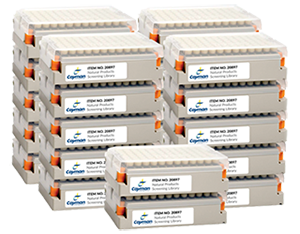
Natural Products Screening Library
More than 1,600 compounds
Cayman's Natural Product Screening Library is a collection of over 1,600 natural products, including alkaloids, flavonoids, glycosides, terpenes, saponins, and polyphenols.
The library is comprised almost entirely of isolated, pure single compounds that have been extracted and purified from animal, plant, microbial, or marine organisms. It also includes some fully synthetic versions of natural products.
Key Features of Cayman's Natural Products Screening Library
- Chemically, structurally, and biologically diverse: compounds selected on structural class and known reported bioactivity to provide maximum chemical and biological diversity
- Designed as a focused library to streamline further characterization and validation studies
- High quality standards ensure purity and identity conformation for individual components
- Product name, individual component item number, description, synonyms, CAS number, formula weight, molecular formula, and biological characteristics based on literature reports are provided
- All compounds are available as single components for further evaluation of hits
Configuration
- Consists of 22 plates in a 96-well Matrix™ tube rack format
- 50 μl of each compound is provided as 2 mM or 2 mg/ml stock solutions in DMSO
- Certain customizations available
- Contact sales@caymanchem.com to inquire about customization
HTS Resources Available from Cayman
Cayman has compound libraries and HTS services available to support hit identification and lead discovery.
Compound Libraries
Cayman offers several small molecule screening libraries for cell biology, drug discovery, and drug identification.
Learn more about Cayman's compound libraries
View all compound libraries available from Cayman
High-Throughput Screening Services
As part of a medicinal chemistry or drug discovery program, our high-throughput screening (HTS) services can aid in hit identification and lead discovery, SAR studies, and hit-to-lead optimization.
Post-HTS Resources Available from Cayman
We offer a wide range of products and services to support further studies after hit identification.
Natural Products Chemistry
Cayman's Natural Products Chemistry division specializes in the extraction and isolation of relevant compounds from biological sources and the preparation of natural products through biocatalytic, semi-, or total chemical synthesis.
Medicinal Chemistry & Structural Biology
Cayman's Medicinal Chemistry and Structural Biology Services offer a fully integrated multidisciplinary approach from design and synthesis to screening and optimization with experienced scientists and state-of-the-art equipment for lead generation or optimization, route and methods development, screening, and scale-up.
Assay Kits
Over 800 assay kits to monitor target analytes, assess cellular function and health, determine receptor activation or inhibition, and measure enzyme activity or inhibition.
Custom Assay Development
Along with our extensive catalog of commercial assays, Cayman offers custom assay development. We can build robust quantitative assays on a variety of detection platforms to suit your specific target and application.
References
1. Zhang, Q.-W., Lin, L.-G., and Ye, W.-C. Techniques for extraction and isolation of natural products: A comprehensive review. Chin. Med. 13, 20 (2018).
2. Li, Z., Chen, K., Rose, P. et al. Natural products in drug discovery and development: Synthesis and medicinal perspective of leonurine. Front. Chem. 10, 1036329 (2022).
3. Elshafie, H.S., Camele, I., and Mohamed, A.A. A comprehensive review on the biological, agricultural and pharmaceutical properties of secondary metabolites based-plant origin. Int. J. Mol. Sci. 24(4), 3266 (2023).
4. Atanasov, A.G., Zotchev, S.B., Dirsch, V.M. et al. Natural products in drug discovery: Advances and opportunities. Nat. Rev. Drug Discov. 20(3), 200-216 (2021).
5. Wilson, B.A.P., Thornburg, C.C., Henrich, C.J., et al. Creating and screening natural product libraries. Nat. Prod. Rep. 37(7), 893-918 (2020).
6. Rose, T.M., Baranek, M., Kaka, M., et al. Natural drugs: Trends, properties, and decline in FDA approvals. J. Pharm. Sci. (2024).
7. Newman, D.J. and Cragg, G.M. Natural products as sources of new drugs over the nearly four decades from 01/1981 to 09/2019. J. Nat. Prod. 83(3), 770-803 (2020).
8. Mahdi, J.G., Mahdi, A.J., Mahdi, A.J. et al. The historical analysis of aspirin discovery, its relation to the willow tree and antiproliferative and anticancer potential. Cell Prolif. 39(2), 147–155 (2006).
9. Sharifi-Rad, J., Quispe, C., Patra J.K., et al. Paclitaxel: Application in modern oncology and nanomedicine-based cancer therapy. Oxid. Med. Cell. Longev. 3687700 (2021).
10. Kepp, O., Menger, L., Vacchelli, E., et al. Anticancer activity of cardiac glycosides: At the frontier between cell-autonomous and immunological effects. Oncoimmunology 1(9), 1640–1642 (2012).
11. Bush, K. and Bradford, P.A. β-Lactams and β-lactamase inhibitors: An overview. Cold Spring Harb. Perspect. Med. 6(8), a025247 (2016).
12. Demain, A.L. and Martens, E. Production of valuable compounds by molds and yeasts. J. Antibiot. (Tokyo)70(4), 347-360 (2017).
13. Na, H. Zheng, Y.-Y., Jia, Y., et al. Screening and genetic engineering of marine-derived Aspergillus terreus for high-efficient production of lovastatin. Microb. Cell Fact. 23(1), 134 (2024).
14. González-Manzano, S. and Dueñas, M. Applications of natural products in food. Foods 10(2), 300 (2021).
15. Franco, R., Oñatibia-Astibia, A., and Martínez-Pinilla, E. Health benefits of methylxanthines in cacao and chocolate. Nutrients 5(10), 4159-4173 (2013).
16. Shi, Z.-Y., Zeng, J.-Z., and Wong, A.S.T. Chemical structures and pharmacological profiles of ginseng saponins. Molecules 24(13), 2443 (2019).
17. Aghababaei, F. and Hadidi, M. Recent advances in potential health benefits of quercetin. Pharmaceuticals (Basel) 16(7), 1020 (2023).
18. Khan, U.M., Sevindik, M., Zarrabi, A. et al. Lycopene: Food sources, biological activities, and human health benefits. Oxid. Med. Cell. Longev. 2713511 (2021).
19. Swami, S., Krishnan, A.V., Wang, J.Y., et al. Dietary vitamin D3 and 1,25-dihydroxyvitamin D3 (calcitriol) exhibit equivalent anticancer activity in mouse xenograft models of breast and prostate cancer. Endocrinology 153(6), 2576-2587 (2012).
20. Li, Y., Zhao, P., Jiang, B., et al. Modulation of the vitamin D/vitamin D receptor system in osteoporosis pathogenesis: Insights and therapeutic approaches. J. Orthop. Surg. Res. 18(1), 860 (2023).
21. Lewis, M.A., Russo, E.B., and Smith, K.M. Pharmacological foundations of Cannabis chemovars. Planta Med. 84(4), 225-233 (2018).
22. Lešnik, S. and Bren, U. Mechanistic insights into biological activities of polyphenolic compounds from rosemary obtained by inverse molecular docking. Foods 11(1), 67 (2021).
23. Aware, C.B., Patil, D.N., Suryawanshi, S.S., et al. Natural bioactive products as promising therapeutics: A review of natural product-based drug development. S. Afr. J. Bot. 151 (Part B), 512-528 (2022).
24. Khare, S., Singh, N.B., Singh, A., et al. Plant secondary metabolites synthesis and their regulations under biotic and abiotic constraints. J. Plant Biol. 63, 203-216 (2020).
25. Ji, H.-F., Li, X.-J., and Zhang, H.-Y. Natural products and drug discovery. EMBO Rep. 10(3), 194-200 (2009).
26. Dias, D.A., Urban, S., and Roessner, U. A historical overview of natural products in drug discovery. Metabolites 2(2), 303-336 (2012).
27. Koehn, F.E. and Carter, G.T. The evolving role of natural products in drug discovery. Nat. Rev. Drug Discov. 4(3), 206-220 (2005).
28. Tay, D.W.P., Yeo, N.Z.X., Adaikkappan, K., et al. 67 million natural product-like compound database generated via molecular language processing. Sci. Data 10(1), 296 (2023).
29. Shipkowski, K.A., Betz, J.M., Birnbaum, L.S., et al. Naturally complex: Perspectives and challenges associated with botanical dietary supplement safety assessment. Food Chem. Toxicol. 118, 963–971 (2018).
30. Atanasov, A.G., Waltenberger, B., Pferschy-Wenzig, E.-M., et al. Discovery and resupply of pharmacologically active plant-derived natural products: A review. Biotechnol. Adv. 33(8), 1582-1614 (2015).
Contact Info
Cayman Chemical1180 East Ellsworth RoadAnn Arbor, Michigan 48108 USAToll Free: (800) 364-9897(USA and Canada only)Fax: (734) 971-3640


