
News & Announcements
Post-Translational Modification through Citrullination
Post-Translational Modification through Citrullination
Article from 2017-07-12
Citrullination occurs as a post-translational modification (PTM) in which positively charged arginine is deiminated to a neutrally charged citrulline. Peptidylarginine deiminases (PADs) catalyze the removal of the terminal guanidine group, resulting in the loss of arginine’s positive charge and a disruption of ionic interactions with negatively charged macromolecules. This process must be tightly regulated, as widespread arginine deimination could disrupt intramolecular interactions within individual proteins, promoting protein unfolding and loss of function and increasing susceptibility to proteolytic degradation (Figure 1). Furthermore, by transforming positively charged arginine to neutrally charged citrulline, PAD alters the ability of processed peptides containing citrulline to bind to the major histocompatibility complex (MHC) Class II proteins on antigen presenting cells. This effect could result in the misidentification of “self” peptides as “non-self” by T lymphocytes, leading to a T cell-dependent autoimmune response directed towards the citrullinated protein.
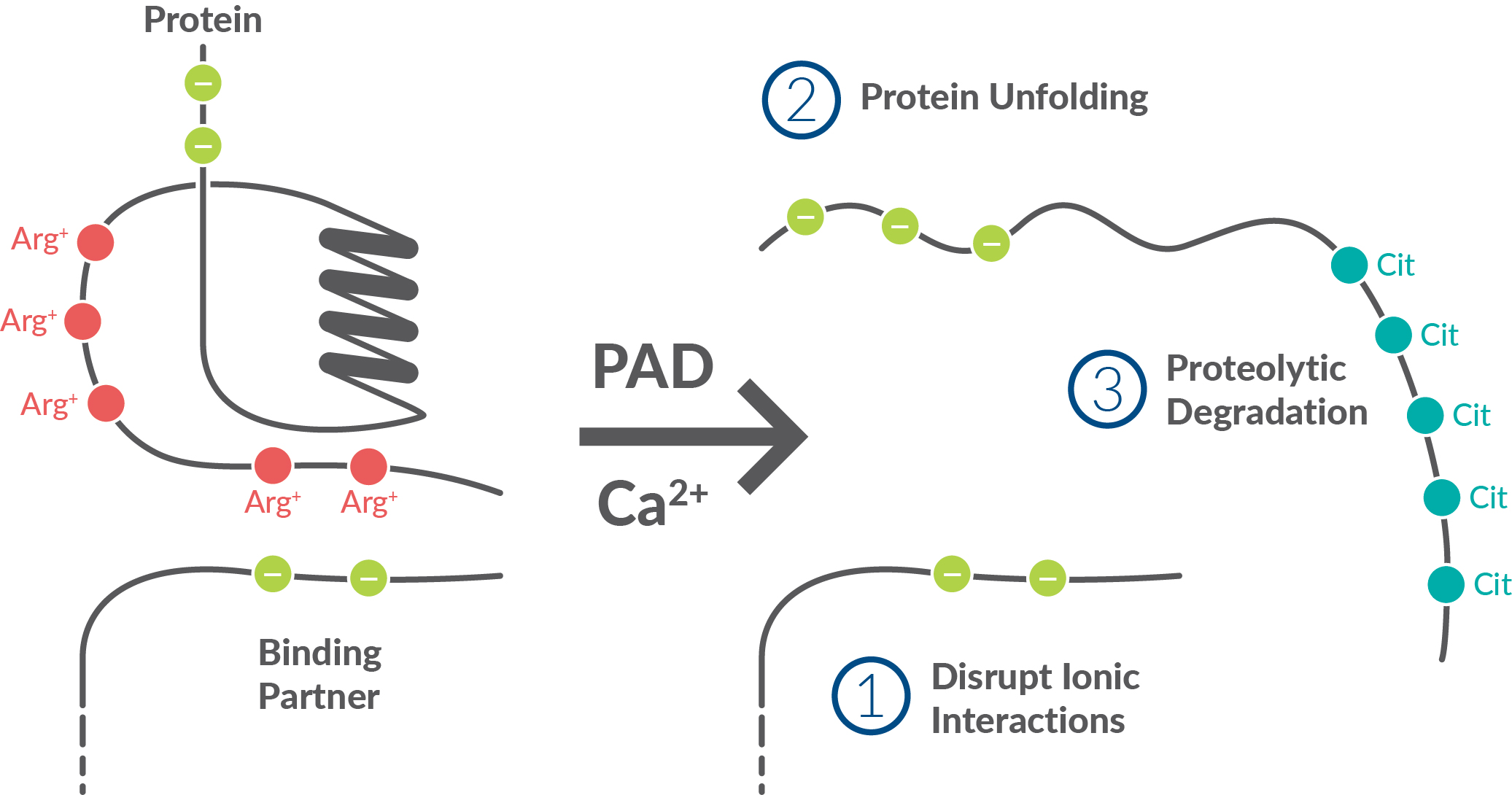
The functional role of citrullination is both important and complicated. It is critical in early embryogenesis, embryonic stem cell pluripotency, epithelial-to-mesenchymal transition, apoptosis, gene regulation, the formation of antibacterial neutrophil extracellular traps (NETs) via chromatin decondensation, and additional immune cell functions. It also has pathological roles in rheumatoid arthritis, several types of cancer, colitis, lupus, multiple sclerosis, Alzheimer's disease, and Parkinson’s disease.
Citrullination is mediated by PAD1 to PAD4 and PAD6. Each display a specific expression pattern yet have overlapping target substrates (Table 1).
| Isotype | Localization | Substrates |
| PAD1 | epidermis, uterus | cytokeratin, carotene, filaggrin |
| PAD2 | skeletal muscle, brain, spleen, hematopoietic cells, macrophages, cancer cell lines, secretory glands, female reproductive tissues, mammary gland epithelial cells | histones, vimentin, myelin basic protein, IKKγ in macrophages |
| PAD3 | hair follicles, keratinocytes | trichohyalin, filaggrin |
| PAD4 | granulocytes, monocytes, macrophages, natural killer cells, cancer cell lines | histones, nucleophosmin, antithrombin, α-enolase, fibrinogen, filaggrin, actin, transcription factors (NF-κB p65, p53, ELK1, p300, p21, CIP1), tumor suppressor ING4, human 40S ribosomal protein, lamin C, Hsp60, PAD4 (autocitrullination) |
| PAD6 | mammalian oocytes, preimplantation embryo, peripheral blood leukocytes | cytoskeleton microfilaments/microtubules |
Cayman has developed a complete line of assays and reagents to explore the function and discover novel inhibitors for PAD enzymes. Antibodies, modified recombinant proteins, and a selection of inhibitors and probes have been developed to aid in evaluating the expression and activity of PAD2 and PAD4 in cells and in vivo efficacy models. Human recombinant PAD1 is also available. Custom inhibitors, screening assays, protein expression, and medicinal chemistry services are available through our Contract Research Services for all PAD enzymes.
Contact Info
Cayman Chemical1180 East Ellsworth RoadAnn Arbor, Michigan 48108 USAToll Free: (800) 364-9897(USA and Canada only)Fax: (734) 971-3640


