
News & Announcements
Sapienic Acid in Antimicrobial Skin Barrier Defense
Article from 2017-10-02
This article was originally published in the October 2017 edition of Matreya’s Newsletter for Glyco/Sphingolipid Research (PDF).
cis-6-Hexadecenoic acid is an unusual unsaturated fatty acid found in the human body, some marine organisms, and some seed oils. In humans, cis-6-hexadecenoic acid is the major constituent of human sebaceous lipids, from which it derives its common name sapienic acid. In the skin, it is involved in self-sterilization and amelioration of atopic dermatitis.1 Among all hair-bearing animals, humans are the only ones to produce this fatty acid, and it is not found in any organ other than the skin.2 Sapienic acid is formed from palmitic acid by the action of the enzyme Δ6-desaturase (or fatty acid desaturase 2).3 It can then be converted to sebaleic acid (cis,cis-5,8-octadecadienoic acid), another fatty acid unique to sebum (an oily secretion of sebaceous glands), by the extension of two carbons and the addition of a double bond.4
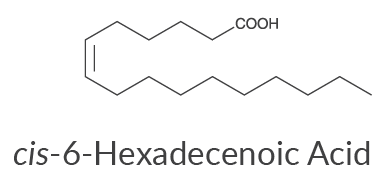
As a skin lipid, a primary purpose of sapienic acid is to act as an antimicrobial lipid for the skin barrier. Unsaturated long-chain fatty acids, including sapienic acid and linoleic acid, cause membrane depolarization in certain bacteria leading to large transcriptional changes, especially in those pathways associated with cellular energetics. From the transcriptomic response, it is inferred that membrane depolarization leads to disruption of the electron transport chain.5 Sapienic acid seems to be linked to the prevention of various illnesses. For example, the bacteria S. aureus is strongly linked with dermatological conditions such as atopic dermatitis. Individuals with large S. aureus colonization have low levels of sapienic acid, thus strongly indicating it as a host factor that can contribute to the prevention of some long-term skin diseases.5 In this and other cases, the contribution of other lipids and the specific mechanisms involved have not been fully elucidated.
You May Also Be Interested In
Essential Role of Esterified ω-Hydroxy Ceramides as Skin Lipids
References
1. Downing, D.T., Stewart, M.E., Wertz, P.W., et al. Essential fatty acids and acne. J. Am. Acad. Dermatol. 14(2 Pt. 1), 221-225 (1986).
2. Nicolaides, N. Skin lipids: Their biochemical uniqueness. Science 186(4158), 19-26 (1974).
3. Ge, L., Gordon, J.S., Hsuan, C., et al. Identification of the Δ-6 desaturase of human sebaceous glands: Expression and enzyme activity. J. Invest. Dermatol. 120(5), 707-714 (2003).
4. Ottaviani, M., Camera, E., and Picardo, M. Lipid mediators in acne. Mediators Inflamm. 858176 (2010).
5. Moran, J.C., Alorabi, J.A., and Horsburgh, M.J. Comparative transcriptomics reveals discrete survival responses of S. aureus and S. epidermidis to sapienic acid. Front. Microbiol. 8:33 (2017).
Contact Info
Cayman Chemical1180 East Ellsworth RoadAnn Arbor, Michigan 48108 USAToll Free: (800) 364-9897(USA and Canada only)Fax: (734) 971-3640


