
Technical Support & Resources
Visit our FAQ
Contact Us
Toll Free Phone (USA and Canada Only): (888) 526-5351
Direct Phone: (734) 975-3888
Product Categories
Fatty Acid Desaturase 2 (human recombinant)
Item No. 25828
Technical Information
- Acyl-CoA 6-Desaturase
- D6D
- DES6
- EC 1.14.19.3
- FADS2
- FADSD6
- Δ6 Fatty Acid Desaturase
- Linoleoyl-CoA Desaturase (Δ6-Desaturase)-Like 2
- LLCDL2
- SLL0262
- TU13
Shipping & Storage Information
Recommended Products
Certificates of Analysis & Batch Specific Data
Provide batch numbers separated by commas to download or request available product inserts, QC sheets, certificates of analysis, data packs, and GC-MS data.
Lipid Resource Center
Discover Products & Resources for Lipid Research
- High-purity lipid standards
- Lipid roles in biology
- Lipids in health & disease
- Lipids for pharmaceutical development
- Protocols, advice, & resources
Product Description
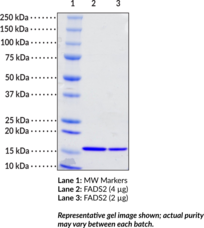
Fatty acid desaturase 2 (FADS2), also known as Δ6-desaturase, is a 444-amino acid transmembrane protein encoded by FADS2.1 This product is the N-terminal cytoplasmic domain of FADS2, corresponding to residues 2-131 of the full-length sequence. It catalyzes the rate-limiting step in the conversion of the ω-6 and ω-3 precursors linoleic acid (Item Nos. 90150 | 21909) and α-linolenic acid (Item No. 90210) to their respective long-chain polyunsaturated fatty acids (LC-PUFAs), inserting a cis double bond at position 6 of the fatty acid chain to convert linoleic acid to γ-linolenic acid (Item No. 90220) and α-linolenic acid to stearidonic acid (Item No. 90320), respectively. Following secondary desaturation by FADS1 (Item No. 25827) and chain elongation, FADS2 catalyzes desaturation of 24-carbon LC-PUFA intermediates. FADS2 also catalyzes the desaturation of palmitic acid (Item No. 10006627) to sapienic acid in human sebaceous glands and in various cancer cell lines that express FADS2.2,3 Hepatic FADS2 protein levels and mRNA expression are increased in mice with high-fat diet-induced obesity and non-alcoholic steatohepatitis (NASH).4 FADS2 knockout (fads2-/-) mice are infertile, resistant to obesity, and have altered subcellular membrane diacylglycerol composition which leads to dysregulated post-translational processing of SREBP1c, a key transcription factor in the regulation of lipid metabolism.5
WARNING This product is not for human or veterinary use.
References & Product Citations
1. FADS gene cluster polymorphisms: Important modulators of fatty acid levels and their impact on atopic diseases. J. Nutrigenet. Nutrigenomics 2(3), 119-128 (2009).
2. Identification of the Δ-
3. Evidence for an alternative fatty acid desaturation pathway increasing cancer plasticity. Nature 566(7744), 403-406 (2019).
4. Molecular interplay between Δ5/Δ6 desaturases and long-
5. Obesity resistance and deregulation of lipogenesis in Δ6-
Contact Info
Cayman Chemical1180 East Ellsworth RoadAnn Arbor, Michigan 48108 USAToll Free: (800) 364-9897(USA and Canada only)Fax: (734) 971-3640


