
News & Announcements
Standardized Naming System for Substituted Tryptamines
Article from 2022-05-20
By Danielle St. Germaine and Donna M. Iula, Ph.D. - Forensic Chemistry Division, Cayman Chemical
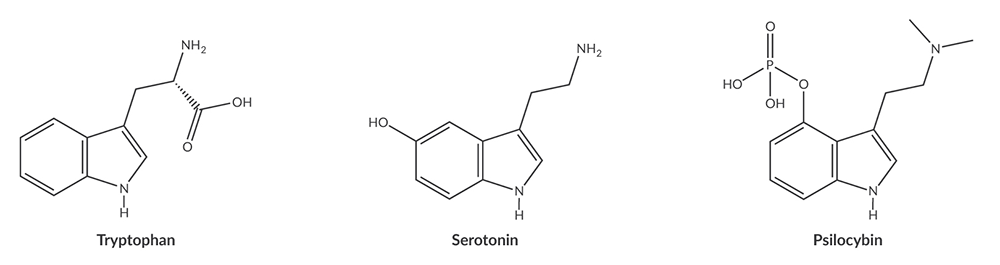
Tryptamines are a broad class of indole-based compounds, many of which are biologically active. Many are entirely synthetic while some occur naturally such as tryptophan (an essential amino acid), serotonin (a neurotransmitter), and psilocybin (a hallucinogenic substance found in certain mushrooms). Numerous tryptamines that were originally synthesized for legitimate pharmaceutical research have been co-opted for recreational use on grey market websites. Common shorthand names, which are often depicted as three-letter codes (e.g., DMT), are frequently given to these substances. This article aims to provide some clarity and structure to how these common names are derived.
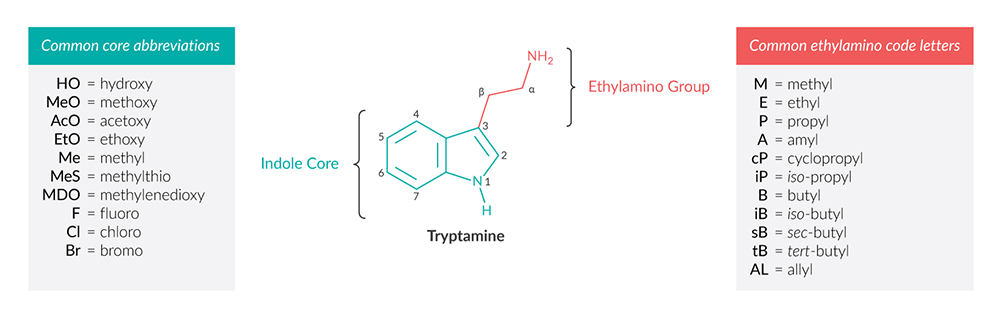
As illustrated below, tryptamines can be thought of as "indole ethylamines" with a scaffold comprised of a substituted or unsubstituted indole core (indicated in blue) connected at the 3-position to a substituted or unsubstituted ethylamino group (indicated in red). The locations of substituents around the scaffold are designated by the numerical location along the indole core (1-7) or by the Greek letters α (alpha) and β (beta) if either of the two carbons of the ethyl chain are modified. The NH2 group may or may not be alkylated. If the amine is alkylated, it is typically with one of the groups listed below (on the right) and may be designated by "N-" in the name.
Many tryptamine analogs were synthesized, named, and tested for psychedelic properties by Alexander and Ann Shulgin in the book 'TiHKAL: The Continuation'. The Shulgin naming convention is a shorthand code system whereby the first two or three letters in the common name represent substitutions along the tryptamine scaffold followed by the final letter "T," which stands for the word tryptamine (see the simple DMT example below).
DMT is the common shorthand name for N,N-dimethyltryptamine. The letters "DM" are added before the letter "T" to represent "dimethyl," which completes the three-letter code. The use of "DM" makes the use of "N,N" unnecessary in cases where the NH2 is di-substituted with the same group.
Many tryptamine analogs have two different alkyl groups off the NH2 moiety; in those cases, such as N-methyl-N-propyltryptamine shown below, the code letters for the two alkyl groups (methyl and propyl) are inserted before the letter "T", giving the shorthand name "MPT." The following are common amine substituents and their shorthand abbreviations: methyl ("M"), ethyl ("E"), propyl ("P"), iso-propyl ("iP"), butyl ("B"), iso-butyl ("iB"), sec-butyl ("sB"), tert-butyl ("tB"), amyl ("A"), etc.
While the N-prefix is often omitted from the three-letter short code of di-alkylated amines, the letter "N" is used as the first letter of the three-letter code to indicate mono-substitution, and the second letter is code for the substituent (as in N-propyltryptamine, "NPT"). In the rare cases where there is tri-substitution on the alkylamine nitrogen with the same R group, "T" represents tri-substitution (as in trimethyltryptamine, "TMT"). For consistency, Cayman utilizes "T" with regard to tri-substitution on the nitrogen, whereas Shulgin has used "T" to represent tri-substitution anywhere on the tryptamine core. For α-substituted tryptamines, the letter "A" (for alpha) is used as the first letter in the three-letter code, followed by the substituent code letter. An example of this is AMT, where "AMT" stands for alpha-methyltryptamine.
Substituents on the indole ring are designated by numbers 1-7, with the indolyl nitrogen as position 1, and a and b are used to indicate substituents on the ethylamine carbon bridge (as illustrated earlier). Common core abbreviations are hydroxy ("HO"), methoxy ("MeO"), methyl ("Me"), methylthio ("MeS"), methylenedioxy ("MDO"), etc. If there are multiple substituents, the common name sequence from left to right is typically assigned by denoting the indole substituent (designated by numerical location), followed by the bridge substituent (denoted as α, β), followed by the amine substituent (letters), and then finally the scaffold core ("T" for tryptamine). Several examples are given below:
While a Shulgin-style shorthand naming system is used quite often in naming tryptamines and is handy for ease of communication, it must be applied carefully to avoid ambiguity. It has been observed that some code letter usage fails to either denote the exact location of a substituent and/or clearly identify the exact nature of a substituent. The code letters used for alkoxy and acyl substituents need to be clearly differentiated. For example, on the grey market, "PrO" has been used to both represent propyl ethers and propanoyloxy substituents. To remedy this, methoxy, ethoxy, and propoxy ethers should be represented as "MeO," "EtO," and "PrO," whereas acetoxy, ethanoyloxy, and propanoyloxy should utilize the acronyms "AcO," "EtoO," and "ProO" as illustrated below. In Cayman's approach to naming tryptamines, we will often spell out the substituent ("methoxy", "acetoxy", etc.) in a further attempt to avoid ambiguity.
It should be noted that the conventions covered in this article are by no means an exhaustive list of the various ways in which tryptamines can be described. There are other, although less common, ways to name substituted tryptamines and exceptions to the general conventions in use. The naming systems covered here are intended as a guide to illustrate substituent placement on tryptamines in a more unambiguous way.
Our staff of more than 50 chemists is skilled at the synthesis of internal standards for tryptamines and tryptamine metabolites. We offer more than 100 analytical standards for the identification of tryptamines and their metabolites to accredited laboratories. Our Tryptamine Analytical Standards Panel is available to qualified pharmaceutical researchers screening tryptamines for beneficial therapeutic use. We also offer multi-gram syntheses to federally licensed laboratories.
Cayman's Forensic Chemistry Division keeps abreast of new analogs appearing in forensic casework and/or on the grey market and can quickly provide reference standards upon request to help identify emerging drugs of abuse. Cayman also has tools to help chemists identify and name novel analogs on our Forensic Science Products page such as our Spectral Library, GC-MS Drug identification Tool, and Wall Poster Guides. If you are having trouble identifying or finding a compound of interest, please contact our technical support department.
To cite this article: St. Germaine, D.M. and Iula, D.M. Standardized Naming System for Substituted Tryptamines. Article, Cayman Chemical (2022).
You May Also Be Interested In
 Rediscovering Psilocybin and Its Therapeutic Potential |  LSD and Its Structural Derivatives |
 Meet the Expert: Novel Psychoactive Substances |
Contact Info
Cayman Chemical1180 East Ellsworth RoadAnn Arbor, Michigan 48108 USAToll Free: (800) 364-9897(USA and Canada only)Fax: (734) 971-3640


