
News & Announcements
Sulfatides in Alzheimer's Disease and Multiple Sclerosis
Article from 2019-03-04
This article was originally published in the March 2019 edition of Matreya’s Newsletter for Glyco/Sphingolipid Research (PDF).
Sulfatides are 3’-sulfated galactosylceramides that are found primarily in the central nervous system (CNS) and are abundant in the myelin sheath and myelinating cells. Over the last several decades, sulfatides have been linked to many physiological functions and recently there has been a renewed interest in their role in diseases. Sulfatides are highly multifunctional glycolipids that function in the nervous system, diabetes, the immune system, hemostasis/thrombosis, bacterial infection, and viral infection.1 By understanding the relationship between normal physiological functions of sulfatides and their specific roles in disease, new diagnostic and therapeutic methods can be evaluated.
Due to the prevalence of sulfatides in the myelin sheath of nerves, it is not surprising that sulfatide metabolism has been implicated in many neurodegenerative illnesses, such as Alzheimer's disease and multiple sclerosis. Sulfatide content is found to precipitously drop in Alzheimer's disease patients, with its concentration in the CNS being modulated by apolipoprotein E.2,3 Low levels of sulfatides are specific for Alzheimer-diseased brains as this phenomenon does not occur in other CNS disorders, such as Parkinson’s disease, Lewy body dementia, frontotemporal dementia, or multiple sclerosis.1
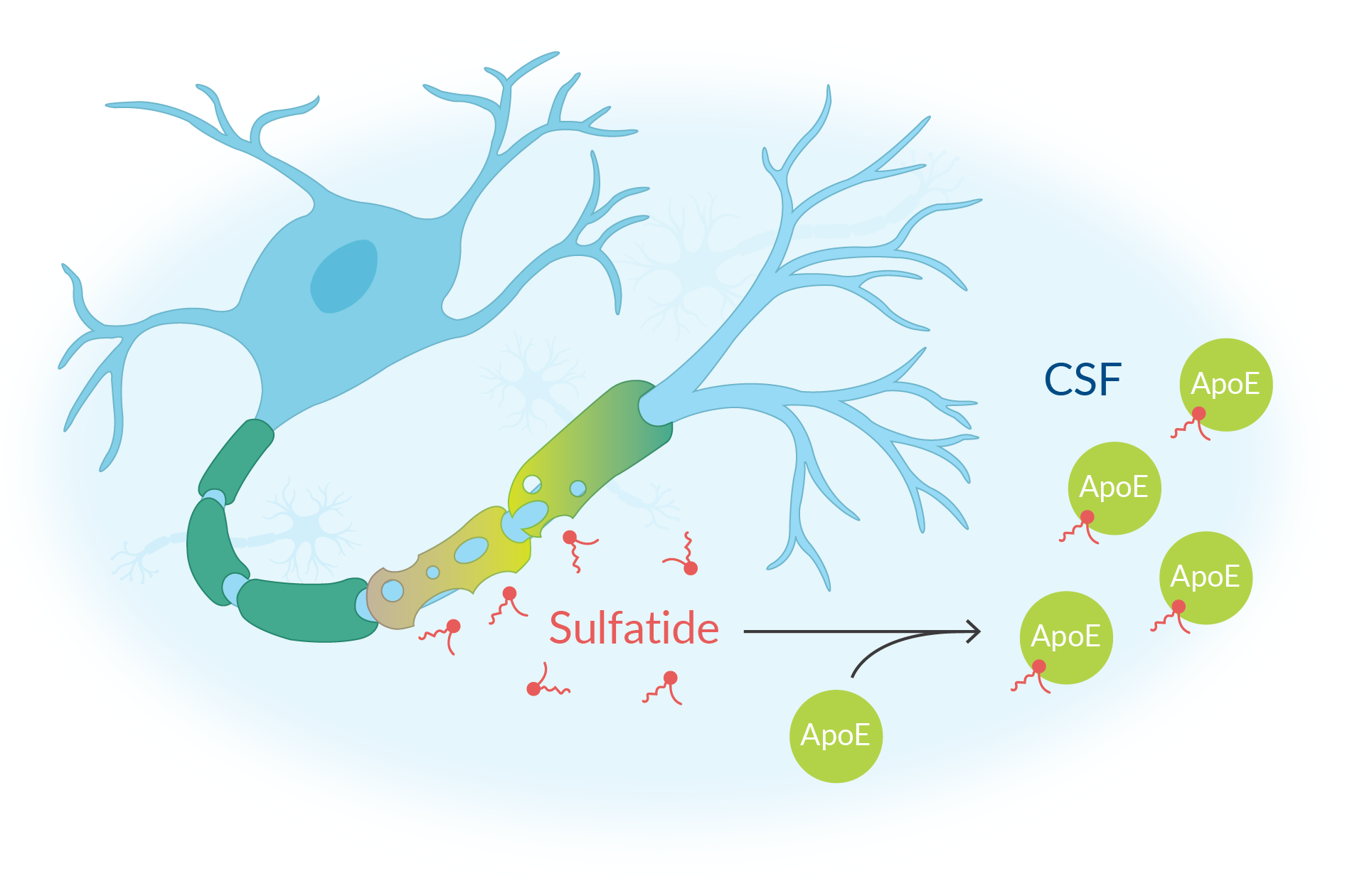
Apolipoprotein E (ApoE)‐associated lipoprotein particles acquire sulfatide from the myelin sheath. These sulfatide‐containing, ApoE‐associated lipoproteins can be metabolized through an endocytic pathway or transported to destinations in the peripheral system through the cerebrospinal fluid (CSF). Sulfatide release that accompanies myelin destruction can trigger immune cell activation.
Conversely, sulfatide levels are higher with multiple sclerosis, a chronic inflammatory disease of the CNS where the myelin sheath around nerve fibers becomes the target of an autoimmune attack leading to demyelination, axonal loss, and subsequent progressive functional neurological deficits. The identity of the target antigen of multiple sclerosis has not been identified, but it was recently demonstrated that levels of anti-sulfatide antibodies were significantly higher in the cerebrospinal fluid (CSF) of multiple sclerosis patients than in control CSF.4 Sulfatides can also activate inflammatory responses as an endogenous stimulator in brain-resident immune cells.
Sulfatides are highly dynamic glycosphingolipids with far-reaching biological processes. A greater understanding of these functions may lead to the elucidation of associated diseases and the development of corresponding therapeutic treatments. Cayman offers various sulfatides that can be used to study their biological function.
References
1. Chornenkyy, Y., Wang, W.-X., Wei, A.H., et al. Alzheimer's disease and type 2 diabetes mellitus are distinct diseases with potential overlapping metabolic dysfunction upstream of observed cognitive decline. Brain Pathol. 29(1), 3-17 (2019).
2. Cheng, H., Wang, M., Li, J.-L., et al. Specific changes of sulfatide levels in individuals with preclinical Alzheimer's disease: An early event in disease pathogenesis. J. Neurochem. 127(6), 733-738 (2013).
3. Zeng, Y. and Han, X. Sulfatides facilitate apolipoprotein E-mediated amyloid-β peptide clearance through an endocytotic pathway. J. Neurochem. 106(3), 1275-1286 (2008).
4. Ilyas, A.A., Chen, Z.-W., and Cook, S.D. Antibodies to sulfatide in cerebrospinal fluid of patients with multiple sclerosis. J. Neuroimmunol. 139(1-2), 76-80 (2003).
Contact Info
Cayman Chemical1180 East Ellsworth RoadAnn Arbor, Michigan 48108 USAToll Free: (800) 364-9897(USA and Canada only)Fax: (734) 971-3640


