
News & Announcements
Which PAD Inhibitor Screening Assay is Right for You?
Which PAD Inhibitor Screening Assay is Right for You?
Article from 2017-06-22
Ammonia versus AMC
Altering histones and other proteins through post-translational modifications (PTMs) directly influences both physiological homeostasis and the pathological progression of numerous inflammatory and autoimmune diseases. Protein arginine deiminases (PADs) are responsible for the PTM termed citrullination, a process in which calcium-dependent PAD enzymes catalyze the hydrolytic deimination of peptidyl-arginine residues to produce equimolar amounts of citrulline and ammonia. Cayman has developed a set of orthogonal assays to enable the screening of large libraries of compounds for next generation PAD inhibitors. These fluorescence-based assays monitor the activity of either PAD2 or PAD4 by one of two methods: 1) detecting the ammonia released by the deimination reaction or 2) exploiting the substrate specificity of trypsin to monitor the citrullination reaction.
Ammonia Detection
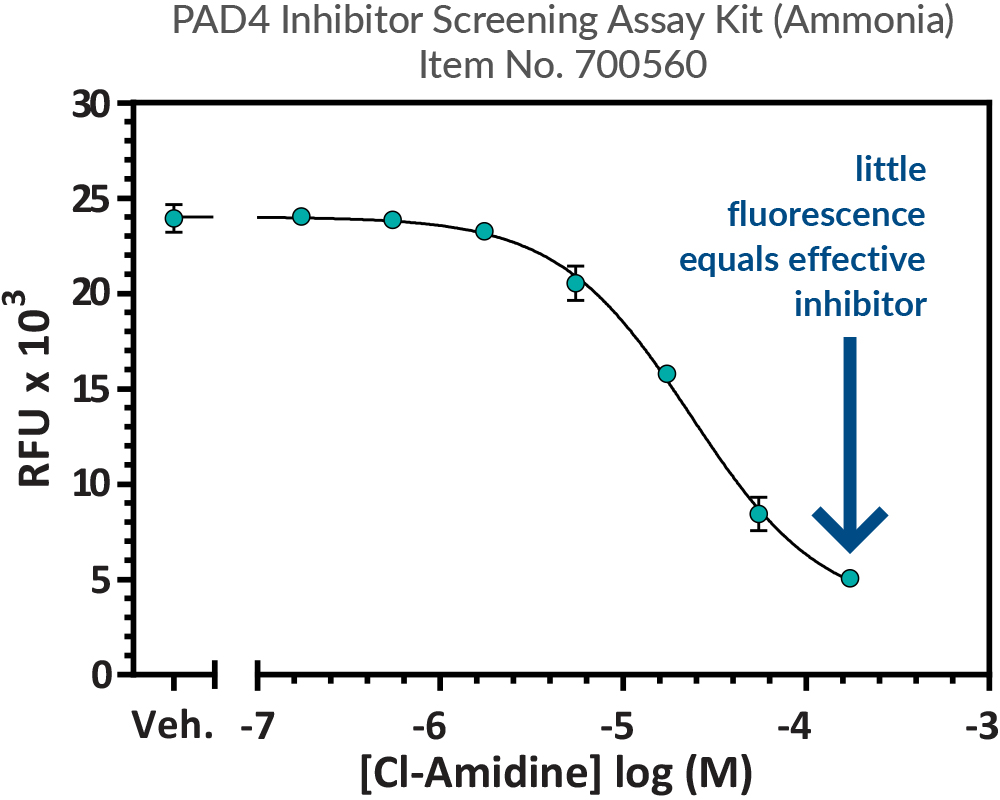
Cayman’s PAD1 Inhibitor Screening Assay Kit (Ammonia), PAD2 Inhibitor Screening Assay Kit (Ammonia), PAD3 Inhibitor Screening Assay Kit (Ammonia), and PAD4 Inhibitor Screening Assay Kit (Ammonia) link citrullination to the amount of ammonia produced when either PAD 1, PAD2, PAD3, or PAD4 deiminate N-α-benzoyl-L-arginine ethyl ester (BAEE), a non-natural substrate with similar kinetic properties to the natural substrates of PADs.1 Ammonia reacts with a detector resulting in a fluorescent product to indicate that citrullination has occurred. Thus, a fluorescent signal would be absent in the presence of an effective PAD inhibitor. Ammonia-based assays reflect one of the most classic methods used to measure the activity of PADs.
AMC-tagged Arginine as a Trypsin Substrate
Alternatively, Cayman’s PAD1 Inhibitor Screening Assay Kit (AMC), PAD2 Inhibitor Screening Assay Kit (AMC), and PAD4 Inhibitor Screening Assay Kit (AMC) link citrullination to the inability of trypsin to hydrolyze the amide bond of a modified PAD substrate. This reaction scheme utilizes a fluorescent substrate consisting of an arginine residue coupled to a 7-amino-4-methylcoumarin (AMC) fluorophore.2 Acylation of AMC onto the arginine residue masks the fluorescence of the AMC. In the presence of an effective PAD inhibitor, the substrate remains uncitrullinated, allowing free AMC to be released after the introduction of a trypsin developer. Conversely, if the arginine of the substrate becomes citrullinated due to ineffective PAD inhibition, free AMC will not be released on the addition of the developer. In this case, the fluorescent signal is inversely proportional to the amount of citrullination by PAD. Thus, inhibitors of PAD activity are confirmed by visualizing the intensity of a fluorescent signal. This readout is less prone to false positives resulting from small molecules quenching the fluorophore, as may be the case for assays that result in a decrease in fluorescence signal.
.jpg)
Orthogonal Comparison
Because false positives are inevitable in every high-throughput screening campaign, orthogonal assays are recommended to confirm hits and eliminate errors. Since the ammonia and AMC readouts derive a similar answer using very different approaches, testing lead compounds with both assay formats can be valuable for reducing the potential for incorrect hits. Both formats can also be used to perform dose-response curve experiments to determine the concentration that results in half-maximal activity (IC50) and to determine selectivity/minimal potency towards alternative PAD isoforms.
Cayman has created a complete line of assays to accurately and efficiently identify novel PAD inhibitors. Many additional assays and a suggested workflow for their use can be viewed in our Guide to Screening Inhibitors of Citrullination. We also offer full-service contract screening and profiling, including lead optimization and development, to further help you identify the next generation of PAD inhibitors.
References
1. Kearney, P.L., Bhatia, M., Jones, N.G., et al. Biochemistry44, 10570-10582 (2005).
2. Wildeman, E. and Pires, M.M. Chem. Bio. Chem. 14(8), 963-967 (2013).
Contact Info
Cayman Chemical1180 East Ellsworth RoadAnn Arbor, Michigan 48108 USAToll Free: (800) 364-9897(USA and Canada only)Fax: (734) 971-3640


