
Technical Support & Resources
Visit our FAQ
Contact Us
Toll Free Phone (USA and Canada Only): (888) 526-5351
Direct Phone: (734) 975-3888
Product Categories
Research Area
Technical Information
- Cannabinoid Receptor 1
Shipping & Storage Information
Recommended Products
Certificates of Analysis & Batch Specific Data
Provide batch numbers separated by commas to download or request available product inserts, QC sheets, certificates of analysis, data packs, and GC-MS data.
Cannabinoid Resource Center
Discover Our Tools to Support Cannabinoid Research and Analysis.
- Cannabinoid signaling research products
- Analytical standards and certified reference materials
- Endocannabinoid profiling services
- Lab wall posters
- Articles, application notes, and webinars
Product Description
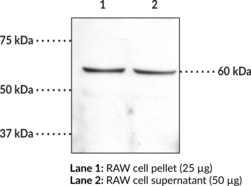
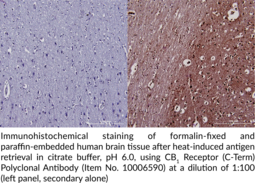
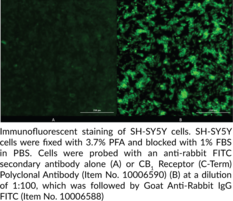
The CB1 receptor is a G-protein coupled receptor that binds the active component of cannabis, Δ9-tetrahydrocannabinol. This antibody has been raised against the C-terminal (amino acids 461-472) intracellular region of the human CB1 receptor and can be used for western blotting.1,2 Human and rat CB1 receptors exhibit 97.3% homology at the amino acid level over the complete protein, and 100% homology within the peptide sequence used to make this antibody.3,4 This peptide exhibits no homology with the CB2 receptor. Based on the amino acid sequence, the CB1 receptor has a molecular weight of approximately 52,800.4 The CB1 receptor and the splice variant CB1a are localized mainly in the brain, whereas the CB2 receptor is localized predominantly in peripheral tissues, including the spleen and hemopoietic cells.3,4,5,6
WARNING This product is not for human or veterinary use.
References & Product Citations
1. Characterization of CB1 cannabinoid receptors using receptor peptide fragments and site-
2. CB1 cannabinoid receptor: Cellular regulation and distribution in N18TG2 neuroblastoma cells. Brain Res. Mol. Brain Res. 53(1-2), 163-173 (1998).
3. Molecular cloning of a human cannabinoid receptor which is also expressed in testis. Biochem. J. 279(Pt 1), 129-134 (1991).
4. Structure of a cannabinoid receptor and functional expression of the cloned cDNA. Nature 346(6284), 561-564 (1990).
5. An amino-
6. Molecular cloning, expression and function of the murine CB2 peripheral cannabinoid receptor. Biochim. Biophys. Acta 1307(2), 132-136 (1996).
Vasoactive intestinal polypeptide-
The cannabinoid-
Modulation of type-
Immunohistochemical analysis of cannabinoid receptor 1 expression in steatotic rat livers. Exp. Ther. Med. 11(4), 1227-1230 (2016).
. Mol. Metab. 3, 495-504 (2014).
Expression and functional relevance of cannabinoid receptor 1 in Hodgkin lymphoma. PLoS one 9(12), e81675 (2013).
HINT1 protein cooperates with cannabinoid 1 receptor to negatively regulate glutamate NMDA receptor activity. Mol. Brain 6, 42 (2013).
Heptatitis C virus induces the cannabinoid receptor 1. PLoS ONE 5(9), e12841 (2010).
Contact Info
Cayman Chemical1180 East Ellsworth RoadAnn Arbor, Michigan 48108 USAToll Free: (800) 364-9897(USA and Canada only)Fax: (734) 971-3640


