
A potent CB1 receptor antagonist
Technical Support & Resources

Visit our FAQ

Contact Us

Toll Free Phone (USA and Canada Only): (888) 526-5351
Direct Phone: (734) 975-3888
Request Technical Support

Technical Support Request

To streamline the process attach the appropriate questionnaire to your inquiry.

Download IHC QuestionnaireDownload WB Questionnaire

View Our Privacy Statement for details on how we use and protect your data. In addition, this site is protected by hCaptcha and its Privacy Policy and Terms of Service apply.

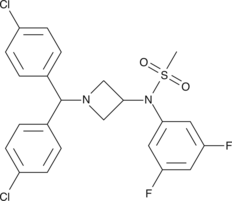
AVE-1625

Item No. 10009021

Technical Information
Formal Name
N-[1-[bis(4-chlorophenyl)methyl]-3-azetidinyl]-N-(3,5-difluorophenyl)-methanesulfonamide
CAS Number
358970-97-5
Synonyms
  • Drinabant
Molecular Formula
C23H20Cl2F2N2O2S
Formula Weight
Purity
≥98%
Formulation
A crystalline solid
DMF: 15 mg/mlDMSO: 15 mg/mlDMSO:PBS (pH 7.2) (1:2): 0.3 mg/mlEthanol: 0.15 mg/ml
λmax
231 nm
SMILES
Clc1ccc(cc1)C(c1ccc(Cl)cc1)N1CC(C1)N(c1cc(F)cc(F)c1)S(=O)(=O)C
InChi Code
InChI=1S/C23H20Cl2F2N2O2S/c1-32(30,31)29(21-11-19(26)10-20(27)12-21)22-13-28(14-22)23(15-2-6-17(24)7-3-15)16-4-8-18(25)9-5-16/h2-12,22-23H,13-14H2,1H3
InChi Key
IQQBRKLVEALROM-UHFFFAOYSA-N
Shipping & Storage Information
Storage
-20°C
Shipping
Room temperature in continental US; may vary elsewhere
Recommended Products

Certificates of Analysis & Batch Specific Data

Provide batch numbers separated by commas to download or request available product inserts, QC sheets, certificates of analysis, data packs, and GC-MS data.

    Add

    Add

    Add

    Cayman Chemical
    Explore Obesity & Metabolic Disease Resources

    Discover high-quality research tools to investigate GLP-1 mechanisms and next-generation metabolic targets.

    OBESITY RESEARCH SOLUTIONS
    Product Description

    The central cannabinoid (CB1) receptor is a G protein-coupled receptor that is widely distributed in the central nervous system and several peripheral tissues and binds the active component of cannabis, Δ9-tetrahydrocannabinol.1 Signaling through the CB1 receptor is implicated in attentional and working memory deficits as well as obesity.2,3,4 AVE-1625 is a highly potent, selective antagonist for the CB1 receptor with Ki values of 0.16-0.44 nM.4 At 1-3 mg/kg, AVE-1625 significantly improves the performance of rodents in working memory tasks.4 At 30 mg/kg, AVE-1625 reduces caloric intake by more than 50% of controls and significantly increases lipolysis from fat tissues and reduces hepatic glycogen levels in rodents.5

    WARNING This product is not for human or veterinary use.

    References & Product Citations
    Product Description References

    1. Howlett, A.C., Song, C., Berglund, B.A., et alCharacterization of CB1 cannabinoid receptors using receptor peptide fragments and site-directed antibodies. Mol. Pharmacol. 53(3), 504-510 (1998).

    2. Gómez, R., Navarro, M., Ferrer, B., et alA peripheral mechanism for CB1 cannabinoid receptor-dependent modulation of feeding. J. Neurosci. 22(21), 9612-9617 (2002).

    3. Mackie, K. Cannabinoid receptors as therapeutic targets. Annu. Rev. Pharmacol. Toxicol. 46, 101-122 (2006).

    4. Borowsky, B., Stevens, R., Mark, B., et alAVE1625, a cannabinoid CB1 antagonist, as a co-treatment for Schizophrenia: Improvement in cognitive function and reduction of antipsychotic-side effects in animal models. Neuropsychopharmacology 30, S116-S117 (2005).

    5. Herling, A.W., Gossel, M., Haschke, G., et alThe CB1 receptor antagonist AVE1625 affects primarily metabolic parameters independently of reduced food intake in wistar rats. Am. J. Physiol. Endocrinol. Metab. 293(3), E826-E832 (2007).

