
Technical Support & Resources
Visit our FAQ
Contact Us
Toll Free Phone (USA and Canada Only): (888) 526-5351
Direct Phone: (734) 975-3888
Product Categories
Product Type
Application
PPARα Ligand-binding Domain (human, recombinant)
Item No. 10009088
Technical Information
- Peroxisome Proliferator-activated Receptor α Ligand Binding Domain
- PPARα LBD
Shipping & Storage Information
Recommended Products
Certificates of Analysis & Batch Specific Data
Provide batch numbers separated by commas to download or request available product inserts, QC sheets, certificates of analysis, data packs, and GC-MS data.

Explore Obesity & Metabolic Disease Resources
Discover high-quality research tools to investigate GLP-1 mechanisms and next-generation metabolic targets.
OBESITY RESEARCH SOLUTIONSProduct Description
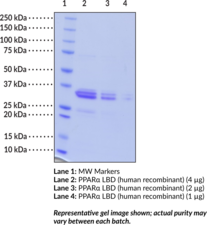
Peroxisome proliferator-activated receptor α (PPARα) is a member of the nuclear receptor family of ligand-activated transcription factors that regulates a variety of metabolic functions and inflammation.1 It contains an N-terminal domain that is subject to phosphorylation, a DNA-binding domain, and a C-terminal ligand-binding domain.2 PPARα is highly expressed in tissues with high fatty acid oxidation rates, including the liver, heart, skeletal muscle, brown adipose tissue, and kidney, as well as in macrophages and T cells.3,2 It is activated by a variety of endogenous ligands such as fatty acids, eicosanoids, and endocannabinoids, as well as synthetic agents, including fenofibrate (Item No. 10005368) and gemfibrozil (Item No. 14835).4 Upon activation, PPARα heterodimerizes with the retinoid X receptor (RXR) and binds to PPAR response elements in PPARα target genes, recruiting RNA polymerase II and initiating gene transcription.1 PPARα transcriptionally regulates a variety of genes involved in several cellular processes, including lipid and hormone transport, peroxisomal and mitochondrial β-oxidation, amino acid metabolism, and inflammation.1,2 Genome-wide deletion of Ppara protects mice from high-fat diet-induced hyperinsulinemia and insulin resistance.5 Ppara SNPs have been found in individuals with a variety of cardiovascular conditions, including hypertension, atherosclerosis, coronary artery disease, left ventricular hypertrophy, or myocardial infarction.1 Formulations containing PPARα agonists have been used in the treatment of hyperlipidemia. Cayman's PPARα Ligand-binding Domain protein can be used for Western blot (WB) applications.
WARNING This product is not for human or veterinary use.
References & Product Citations
1. Targeting PPARα for the treatment and understanding of cardiovascular diseases. Cell Physiol. Biochem. 51(6), 2760-2775 (2018).
2. Molecular mechanism of PPARa action and its impact on lipid metabolism, inflammation and fibrosis in non-
3. Peroxisome proliferator-
4. Impact of PPAR-
5. PPAR-
Contact Info
Cayman Chemical1180 East Ellsworth RoadAnn Arbor, Michigan 48108 USAToll Free: (800) 364-9897(USA and Canada only)Fax: (734) 971-3640


