
Technical Support & Resources
Visit our FAQ
Contact Us
Toll Free Phone (USA and Canada Only): (888) 526-5351
Direct Phone: (734) 975-3888
Product Categories
Research Area
Technical Information
- GIIC sPLA2
- Group IIA phospholipase A2
- Non-Pancreatic Secretory Phospholipase A2
- Phosphatidylcholine 2-Acylhydrolase 2A
- PLA2G2A
- Secretory Phospholipase A2 (Group IIA)
- sPLA2-IIA
Shipping & Storage Information
Recommended Products
Certificates of Analysis & Batch Specific Data
Provide batch numbers separated by commas to download or request available product inserts, QC sheets, certificates of analysis, data packs, and GC-MS data.
Lipid Resource Center
Discover Products & Resources for Lipid Research
- High-purity lipid standards
- Lipid roles in biology
- Lipids in health & disease
- Lipids for pharmaceutical development
- Protocols, advice, & resources
Product Description
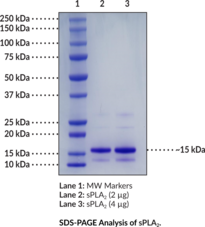
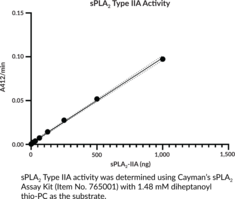
Secretory phospholipase A2 (sPLA2) (Type IIA) is a calcium-dependent PLA2 superfamily member that is encoded by PLA2G2A in humans.1 It is composed of a highly-conserved calcium-binding loop, a catalytic domain, sPLA2 Type I- and II-specific disulfides that provide stability, and a C-terminal extension but lacks the N-terminal signal peptide found in sPLA2 (Type IB) and sPLA2 (Type X). sPLA2 (Type IIA) is expressed in platelets, synovial fluid, vascular smooth muscle cells, adipose tissue, the liver, and the gut.2,3 sPLA2 (Type IIA) functions in a cell- and tissue type-specific manner, preferentially hydrolyzing bacterial membrane phosphatidylglycerol (PG) and phosphatidylethanolamine (PE) as a mechanism of host defense. sPLA2 (Type IIA) is upregulated at sites of acute and chronic inflammation where it generates lysophosphatidic acid and arachidonic acid, which is further metabolized to inflammatory lipid mediators and a variety of eicosanoid autocrine and paracrine signaling molecules.4 Plasma levels of sPLA2 (Type IIA) are associated with the presence of sepsis and are increased in patients with rheumatoid arthritis, acute coronary syndrome, asthma, or inflammatory bowel disease (IBD). Cayman's sPLA2 (human, recombinant Type IIA) protein contains an asparagine to alanine substitution at position 1 to ensure proper removal of the N-terminal methionine during protein expression. Cayman's sPLA2 (human, recombinant Type IIA) can be used for enzyme activity assays. The specific activity of Cayman’s sPLA2 (human, recombinant Type IIA) was established using Cayman’s sPLA2 Assay Kit (Item No. 765001) with 1.48 mM 1,2-bis(heptanoylthio) glycerophosphocholine (Item No. 62235) as the substrate.
WARNING This product is not for human or veterinary use.
References & Product Citations
1. Secreted phospholipase A2 revisited. J. Biochem. 150(3), 233-255 (2011).
2. Group IIA secreted phospholipase A2 (PLA2G2A) augments adipose tissue thermogenesis. The FASEB Journal 35(10), e21881 (2021).
3. Cloning, chromosomal mapping, and expression of a novel human secretory phospholipase A2. The Journal of Biological Chemisty 272(25), 15745-15752 (1997).
4. Human group IIA phospholipase A2—three decades on from its discovery. Molecules 26(23), 7267 (2021).
Contact Info
Cayman Chemical1180 East Ellsworth RoadAnn Arbor, Michigan 48108 USAToll Free: (800) 364-9897(USA and Canada only)Fax: (734) 971-3640


