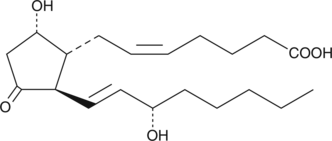
A major prostaglandin produced by mast cells
Technical Support & Resources

Visit our FAQ

Contact Us

Toll Free Phone (USA and Canada Only): (888) 526-5351
Direct Phone: (734) 975-3888

Request Technical Support

Technical Support Request

To streamline the process attach the appropriate questionnaire to your inquiry.

Download IHC QuestionnaireDownload WB Questionnaire

View Our Privacy Statement for details on how we use and protect your data. In addition, this site is protected by hCaptcha and its Privacy Policy and Terms of Service apply.

Prostaglandin D2

Item No. 12010

Technical Information
Formal Name
9α,15S-dihydroxy-11-oxo-prosta-5Z,13E-dien-1-oic acid
CAS Number
41598-07-6
Synonyms
  • PGD2
Molecular Formula
C20H32O5
Formula Weight
Purity
≥98%
Formulation
A crystalline solid
DMF: 100 mg/mlDMSO: 50 mg/mlEthanol: 50 mg/mlPBS (pH 7.2): 5 mg/ml
SMILES
CCCCCC(O)/C=C/[C@H]1C(=O)CC(O)C1C/C=C\CCCC(=O)O
InChi Code
InChI=1S/C20H32O5/c1-2-3-6-9-15(21)12-13-17-16(18(22)14-19(17)23)10-7-4-5-8-11-20(24)25/h4,7,12-13,15-18,21-22H,2-3,5-6,8-11,14H2,1H3,(H,24,25)/b7-4-,13-12+/t15-,16+,17+,18-/m0/s1
InChi Key
BHMBVRSPMRCCGG-OUTUXVNYSA-N
Shipping & Storage Information
Storage
-20°C
Shipping
Wet ice in continental US; may vary elsewhere
Recommended Products

Certificates of Analysis & Batch Specific Data

Provide batch numbers separated by commas to download or request available product inserts, QC sheets, certificates of analysis, data packs, and GC-MS data.

    Add

    Add

    Add

    Add

    Lipid Resource Center
    Discover Products & Resources for Lipid Research
    • High-purity lipid standards
    • Lipid roles in biology
    • Lipids in health & disease
    • Lipids for pharmaceutical development
    • Protocols, advice, & resources
    EXPLORE NOW
    Product Description

    Prostaglandin D2 (PGD2) is the major eicosanoid product of mast cells and is released in large quantities during allergic and asthmatic anaphylaxis.1 Mastocytosis patients produce excessive amounts of PGD2, which causes vasodilation, flushing, hypotension, and syncopal episodes.1 PGD2 is also produced in the brain via an alternative pathway involving a soluble, secreted PGD-synthase also known as β-trace.2,3 In the brain, PGD2 produces normal physiological sleep and lowering of body temperature.2,3 Further pharmacological actions include inhibition of platelet aggregation and relaxation of vascular smooth muscle.4 PGD2 inhibits human ovarian tumor cell proliferation with an IC50 of 6.8 µM.5

    WARNING This product is not for human or veterinary use.

    References & Product Citations
    Product Description References

    1. Roberts, L.J., II, and Sweetman, B.J. Metabolic fate of endogenously synthesized prostaglandin D2 in a human female with mastocytosis. Prostaglandins 30(3), 383-400 (1985).

    2. Hayaishi, O. Sleep-wake regulation by prostaglandins D2 and E2. The Journal of Biological Chemisty 263(29), 14593-14596 (1988).

    3. Onoe, H., Ueno, R., Fujita, I., et alProstaglandin D2, a cerebral sleep-inducing substance in monkeys. Proc. Natl. Acad. Sci. USA 85(11), 4082-4086 (1988).

    4. Giles, H., and Leff, P. The biology and pharmacology of PGD2. Prostaglandins 35(2), 277-300 (1988).

    5. Kikuchi, Y., Kita, T., Hirata, J., et alPreclinical studies of antitumor prostaglandins by using human ovarian cancer cells. Cancer Metastasis Rev. 13(3-4), 309-315 (1994).

    Product Citations

    Wu, Z., Xiao, H., Rao, D., et alAnalytical strategy for oxylipin annotation by combining chemical derivatization-based retention index algorithm and feature tandem mass spectrometric fragmentation as a biomarker discovery tool. Anal. Chem. 95(43), 15933-15942 (2023).

    Pang, Y., Liu, X., Zhao, C., et alLC-MS/MS-based arachidonic acid metabolomics in acute spinal cord injury reveals the upregulation of 5-LOX and COX-2 products. Free Radic. Biol. Med. 193(Pt 1), 363-372 (2022).

    Archambault, A.-S., Brassard, J., Bernatchez, É., et alHuman and mouse eosinophils differ in their ability to biosynthesize eicosanoids, docosanoids, the endocannabinoid 2-arachidonoyl-glycerol and its congeners. Cells 11(1), 141 (2022).

    Archambault, A.-S., Zaid, Y., Rakotoarivelo, V., et alHigh levels of eicosanoids and docosanoids in the lungs of intubated COVID-19 patients. The FASEB Journal 35(6), e21666 (2021).

    Roberts, L.M., Schwarz, B., Speranza, E., et alPulmonary infection induces persistent, pathogen-specific lipidomic changes influencing trained immunity. iScience 24(9), 103025 (2021).

    Hartling, I., Cremonesi, A., Osuna, E., et alQuantitative profiling of inflammatory and pro-resolving lipid mediators in human adolescents and mouse plasma using UHPLC-MS/MS. Clin. Chem. Lab. Med. 59(11), 1811-1823 (2021).

    Oyesola, O.O., Duque, C., Huang, L.C., et alThe prostaglandin D2 receptor CRTH2 promotes IL-33-induced ILC2 accumulation in the lung. J. Immunol. 204(4), 1001-1011 (2020).

    Archambault, A.-S., Zaid, Y., Rakotoarivelo, V., et alLipid storm within the lungs of severe COVID-19 patients: Extensive levels of cyclooxygenase and lipoxygenase-derived inflammatory metabolites. medRxiv (2020).

    Brouwers, H., Jónasdóttir, H.S., Kuipers, M.E., et alAnti-inflammatory and proresolving effects of the omega-6 polyunsaturated fatty acid adrenic acid. J. Immunol. 205(10), 2840-2849 (2020).

    Meriwether, D., Sulaiman, D., Volpe, C., et alApolipoprotein A-I mimetics mitigate intestinal inflammation in COX2-dependent inflammatory bowel disease model. J. Clin. Invest. 130, 3670-3685 (2019).

    Schmidleithner, L., Thabet, Y., Schönfeld, E., et alEnzymatic activity of HPGD in Treg cells suppresses Tconv cells to maintain adipose tissue homeostasis and prevent metabolic dysfunction. Immunity 50(5), 1232-1248 (2019).

    Dalli, J., Colas, R.A., Walker, M.E., et alLipid Mediator Metabolomics via LC-MS/MS Profiling and Analysis. Clinical Metabolomics 59-72 (2018).

    Sorgi, C.A., Peti, A.P.F., Petta, T., et alComprehensive high-resolution multiple-reaction monitoring mass spectrometry for targeted eicosanoid assays. Sci. Data 5, 180167 (2018).

    Suganami, A., Fujino, H., Okura, I., et alHuman DP and EP2 prostanoid receptors take on distinct forms depending on the diverse binding of different ligands. FEBS J. 283(21), 3931-3940 (2016).

    Gouveia-Figueira, S., Karlsson, J., Deplano, A., et alCharacterisation of (R)-2-(2-fluorobiphenyl-4-yl)-N-(3-methylpyridin-2-yl)propanamide as a dual fatty acid amide hydrolase: Cyclooxygenase inhibitor. PLoS One 10(9), e0139212 (2015).

    Sasaki, A., Fukuda, H., Shiida, N., et alDetermination of ω-6 and ω-3 PUFA metabolites in human urine samples using UPLC/MS/MS. Anal. Bioanal. Chem. 407(6), 1625-1639 (2015).

    Schröder, R., Xue, L., Konya, V., et alPGH1, the precursor for the anti-inflammatory prostaglandins of the 1-series, is a potent activator of the pro-inflammatory receptor CRTH2/DP2. PLoS One 7(3), e33329 (2012).

    Whittle, B.J., Silverstein, A.M., Mottola, D.M., et alBinding and activity of the prostacyclin receptor (IP) agonists, treprostinil and iloprost, at human prostanoid receptors: Treprostinil is a potent DP1 and EP2 agonist. Biochem. Pharmacol. 84(1), 68-75 (2012).

    Qi, H.-Y., Daniels, M.P., Liu, Y., et alA cytosolic phospholipase A2-initiated lipid mediator pathway induces autophagy in macrophages. J. Immunol. 187(10), 5286-5292 (2011).

    Woodward, D.F., Krauss, A.H.P., Chen, J., et alPharmacological characterization of a novel antiglaucoma agent, bimatoprost (AGN 192024). J. Pharmacol. Exp. Ther. 305(2), 772-785 (2003).

    Waffo-Téguo, P., Hawthorne, M.E., Cuendet, M., et alPotential cancer-chemopreventive activities of wine stilbenoids and flavans extracted from grape (Vitis vinifera) cell cultures. Nutr. Cancer 40(2), 173-179 (2001).

    Rao, C.V., Desai, D., Rivenson, A., et alChemoprevention of colon carcinogenesis by phenylethyl-3-methylcaffeate. Cancer Res. 55(11), 2310-2315 (1995).