
Features
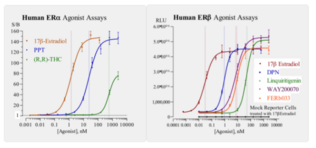
- Screen test samples to quantify functional activity, either agonist or antagonist, that they may exert against human ERα and ERβ
- Robust technology provides sustained response for consistent and reproducible data acquisition
- Included in kit: 2 vials of ready-to-use, pre-transfected reporter cells for ERα and ERβ | Optimized media | Reference agonist - 17β-estradiol | Luciferase detection reagent | Cell culture ready assay plate
Technical Support & Resources
Visit our FAQ
Contact Us
Toll Free Phone (USA and Canada Only): (888) 526-5351
Direct Phone: (734) 975-3888
Product Categories
Product Type
Application
Human Estrogen Receptors Reporter Assay Panel
Item No. 15739
Technical Information
- ERα
- ERβ
Shipping & Storage Information
Recommended Products
Certificates of Analysis & Batch Specific Data
Provide batch numbers separated by commas to download or request available product inserts, QC sheets, certificates of analysis, data packs, and GC-MS data.


Explore Obesity & Metabolic Disease Resources
Discover high-quality research tools to investigate GLP-1 mechanisms and next-generation metabolic targets.
OBESITY RESEARCH SOLUTIONSProduct Description
This PANEL of Estrogen Receptors Reporter Assays utilizes non-human mammalian cells engineered to express distinct human ERα (NR3A1) and ERβ (NR3A2) proteins. Estrogen receptor alpha (ER-alpha), also known as NR3A1 (nuclear receptor subfamily 3, group A, member 1), is a nuclear receptor which is activated by the sex hormone estrogen. ER-alpha is encoded by the human gene ESR1 (EStrogen Receptor 1).The estrogen receptor (ESR) is a ligand-activated transcription factor composed of several domains important for hormone binding, DNA binding, and activation of transcription. Alternative splicing results in several ESR1 mRNA transcripts, which differ primarily in their 5-prime untranslated regions. The translated receptors show less variability. Estrogen receptor beta (ER-beta), also known as NR3A2 (nuclear receptor subfamily 3, group A, member 2), is a nuclear receptor which is activated by the sex hormone estrogen. ER-beta is encoded by the human gene ESR2 (EStrogen Receptor 2). This gene encodes a member of the family of estrogen receptors and superfamily of nuclear receptor transcription factors. The gene product contains an N-terminal DNA binding domain and C-terminal ligand binding domain and is localized to the nucleus, cytoplasm, and mitochondria. Upon binding to 17beta-estradiol or related ligands, the encoded protein forms homo- or hetero-dimers that interact with specific DNA sequences to activate transcription. Some isoforms dominantly inhibit the activity of other estrogen receptor family members. Several alternatively spliced transcript variants of this gene have been described, but the full-length nature of some of these variants has not been fully characterized. ER-β is expressed by many tissues including blood monocytes and tissue macrophages, colonic and pulmonary epithelial cells and in prostatic epithelium and in malignant counterparts of these tissues.ER-β may have anti-proliferative effects and therefore oppose the actions of ER-α in reproductive tissue.[4] ER-β may also have an important role in adpative function of the lung during pregnancy. ER Reporter Cells are prepared using INDIGO’s proprietary CryoMite™ process. This cryo-preservation method yields high cell viability post-thaw, and provides the convenience of immediately dispensing healthy, division-competent reporter cells into assay plates. There is no need for intermediate spin-and-wash steps, viability determinations, or cell titer adjustments. [INDIGO Catalog No. IB00421-48P]
WARNING This product is not for human or veterinary use.
Contact Info
Cayman Chemical1180 East Ellsworth RoadAnn Arbor, Michigan 48108 USAToll Free: (800) 364-9897(USA and Canada only)Fax: (734) 971-3640


