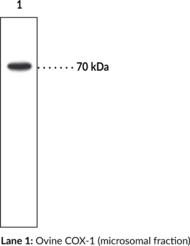
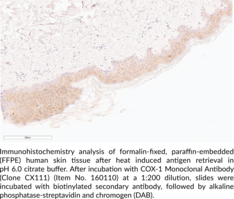
For immunochemical detection of COX-1
Technical Support & Resources

Visit our FAQ

Contact Us

Toll Free Phone (USA and Canada Only): (888) 526-5351
Direct Phone: (734) 975-3888

Request Technical Support

Technical Support Request

To streamline the process attach the appropriate questionnaire to your inquiry.

Download IHC QuestionnaireDownload WB Questionnaire

View Our Privacy Statement for details on how we use and protect your data. In addition, this site is protected by hCaptcha and its Privacy Policy and Terms of Service apply.

COX-1 Monoclonal Antibody (Clone CX111)

Item No. 160110

Technical Information
Synonyms
  • Cyclooxygenase 1
  • Prostaglandin Endoperoxide Synthase 1
  • Prostaglandin G/H Synthase 1
  • Prostaglandin H2 Synthase 1
  • PGHS-1
Immunogen
Purified ovine COX-1
Clone Designation
CX111
MW
70 kDa
500 µg of purified monoclonal antibody
Storage Buffer
PBS, pH 7.2, with 0.01% sodium azide
Host
Mouse
Isotype
IgG2b
Applications
IHC, WB
Cross Reactivity
(+) Human COX-2(+) Ovine COX-2(-) Mouse COX-2
Species Reactivity
(+) Human(+) Mouse(+) Rat(+) Bovine
UniProt Accession №
P05979
Origin
Animal/Mouse
Shipping & Storage Information
Storage
-20°C
Shipping
Wet ice in continental US; may vary elsewhere
Recommended Products

Certificates of Analysis & Batch Specific Data

Provide batch numbers separated by commas to download or request available product inserts, QC sheets, certificates of analysis, data packs, and GC-MS data.

    Add

    Lipid Resource Center
    Discover Products & Resources for Lipid Research
    • High-purity lipid standards
    • Lipid roles in biology
    • Lipids in health & disease
    • Lipids for pharmaceutical development
    • Protocols, advice, & resources
    EXPLORE NOW
    Product Description

    Cyclooxygenase 1 (COX-1) is a bifunctional enzyme that exhibits both COX and peroxidase activities.1,2 It is composed of an N-terminal signal peptide, an EGF-like domain, a membrane binding domain, a catalytic domain, and a C-terminal tail.3 COX-1 is constitutively expressed in the gastrointestinal tract, kidney, spleen, liver, and lung and localizes to the endoplasmic reticulum.4,5 The COX component converts arachidonic acid (Item Nos. 90010 | 90010.1 | 10006607) to a hydroperoxyl endoperoxide prostaglandin G2 (PGG2; Item No. 17010) and the peroxidase component reduces the endoperoxide to the corresponding alcohol PGH2 (Item No. 17020), the precursor of PGs, thromboxanes, and prostacyclins.1,2 COX-1 is the target of many non-steroidal anti-inflammatory drugs (NSAIDs) and is responsible for the undesirable gastrointestinal and renal side effects, such as ulcer formation and reductions in the glomerular filtration rate, respectively.6,7 Cayman’s COX-1 Monoclonal Antibody (Clone CX111) can be used for immunohistochemistry (IHC) and Western blot (WB) applications.

    WARNING This product is not for human or veterinary use.

    References & Product Citations
    Product Description References

    1. Nugteren, D.H., and Hazelhof, E. Isolation and properties of intermediates in prostaglandin biosynthesis. Biochim. Biophys. Acta 326(3), 448-461 (1973).

    2. Hamberg, M., and Samuelsson, B. Detection and isolation of an endoperoxide intermediate in prostaglandin biosynthesis. Proc. Natl. Acad. Sci. USA 70(3), 899-903 (1973).

    3. Smith, W.L., and DeWitt, D.L. Prostaglandin endoperoxide H synthases-1 and -2. Adv. Immunol. 62, 167-215 (1995).

    4. Seibert, K., Zhang, Y., Leahy, K., et alPharmacological and biochemical demonstration of the role of cyclooxygenase 2 in inflammation and pain. Proc. Natl. Acad. Sci. USA 91(25), 12013-12017 (1994).

    5. Morita, I., Schindler, M., Regier, M.K., et alDifferent intracellular locations for prostaglandin endoperoxide H synthase-1 and -2. The Journal of Biological Chemisty 270(18), 10902-10908 (1995).

    6. Gierse, J.K., Hauser, S.D., Creely, D.P., et alExpression and selective inhibition of the constitutive and inducible forms of human cyclo-oxygenase. Biochem. J. 305(Pt. 2), 379-484 (1995).

    7. Frölich, J.C. A classification of NSAIDs according to the relative inhibition of cyclooxygenase isoenzymes. Trends Pharmacol. Sci. 18(1), 30-34 (1997).

    Product Citations

    Shojo, H., Borlongan, C.V., and Mabuchi, T. Genetic and histological alterations reveal key role of prostaglandin synthase and cyclooxygenase 1 and 2 in traumatic brain Injury-induced neuroinflammation in the cerebral cortex of rats exposed to moderate fluid percussion injury. Cell Transplant 26(7), 1301-1313 (2017).

    Bhatt, D.P., Puig, K.L., Gorr, M.W., et alA pilot study to assess effects of long-term inhalation of airborne particulate matter on early Alzheimer-like changes in the mouse brain. PLoS One 10(5), e0127102 (2015).

    Wobst, I., Schiffmann, S., Birod, K., et alDimethylcelecoxib inhibits prostaglandin E2 production. Biochem. Pharmacol. 76(1), 62-69 (2008).

    Petzold, G.C., Albeanu, D.F., Sato, T.F., et alCoupling of neural activity to blood flow in olfactory glomeruli is mediated by astrocytic pathways. Neuron. 58(6), 897-910 (2008).

    Deeb, R.S., Shen, H., Gamss, C., et alInducible nitric oxide synthase mediates prostaglandin H2 synthase nitration and suppresses eicosanoid production. Am. J. Pathol. (168(1), 349-362 (2006).