
Technical Support & Resources
Visit our FAQ
Contact Us
Toll Free Phone (USA and Canada Only): (888) 526-5351
Direct Phone: (734) 975-3888
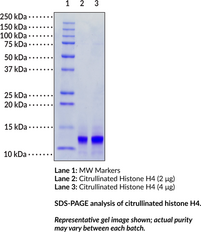
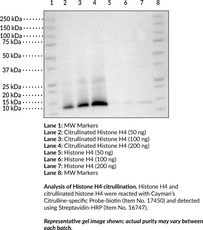
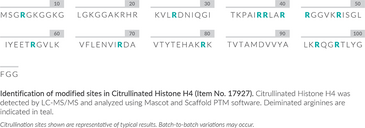
Technical Information
Shipping & Storage Information
Recommended Products
Certificates of Analysis & Batch Specific Data
Provide batch numbers separated by commas to download or request available product inserts, QC sheets, certificates of analysis, data packs, and GC-MS data.

Visit Our Cancer Resource Center
Find Tools & Resources to Study the Hallmarks of Cancer
- Cancer cell signaling & regulation
- Cancer metabolism
- Tumor microenvironment
Product Description
Histone H4 is one of four core histone proteins, the others being H3, H2B, and H2A, that are involved in the organization of DNA into chromatin.1 Histones are subject to a variety of posttranslational modifications, such as methylation, acetylation, and citrullination, that can influence chromatin structure and regulate gene transcription. Histone H4 can be citrullinated at the arginine residue at position 3 (H4R3) by protein arginine deiminase 4 (PAD4; Item No. 10500).2 Citrullination of H4R3 increases in U2OS cells following induction of DNA damage by adriamycin (doxorubicin; Item No. 15007) and is localized near fragmented nuclei.3 H4R3 citrullination is associated with smaller tumor size and inversely associated with p53 levels in tumor tissue samples derived from patients with non-small cell lung cancer (NSCLC). Citrullinated histone H4 is present in neutrophil extracellular traps (NETs) generated by stimulation of granulocytes with phorbol 12-myristate 13-acetate (PMA; Item No. 10008014) and can be recognized by autoantibodies present in the serum of patients with rheumatoid arthritis.4 This product contains purified histone H4 (human, recombinant) (Item No. 10264) that has been modified with PAD4 enzyme, which is subsequently depleted by affinity chromatography.
WARNING This product is not for human or veterinary use.
References & Product Citations
1. Histone hypercitrullination mediates chromatin decondensation and neutrophil extracellular trap formation. J. Cell Biol. 184(2), 205-213 (2009).
2. Protein arginine methylation and citrullination in epigenetic regulation. ACS Chem. Biol. 11(3), 654-668 (2016).
3. Regulation of histone modification and chromatin structure by the p53-
4. Antibodies from patients with rheumatoid arthritis target citrullinated histone 4 contained in neutrophils extracellular traps. Ann. Rheum. Dis. 73(7), 1414-1422 (2014).
Cytotoxic CD8+ T cells target citrullinated antigens in rheumatoid arthritis. Nat. Commun. 14(1), 319 (2023).
Contact Info
Cayman Chemical1180 East Ellsworth RoadAnn Arbor, Michigan 48108 USAToll Free: (800) 364-9897(USA and Canada only)Fax: (734) 971-3640


