
Technical Support & Resources
Information provided in the product description is from published literature. Due to the nature of scientific experimentation, your results (e.g., selectivity and effective concentrations) or specific application for this product may differ. If you have questions about how this product fits your application, please contact our technical support staff.
Visit our FAQ
Contact Us
Toll Free Phone (USA and Canada Only): (888) 526-5351
Direct Phone: (734) 975-3888
Product Categories
Research Area
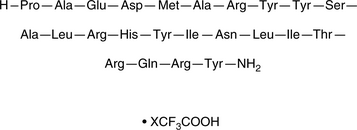
Neuropeptide Y (13-36) (human, rat) (trifluoroacetate salt)
Item No. 24714
Technical Information
- NPY (13-36) (human, rat)
Shipping & Storage Information
Recommended Products
Certificates of Analysis & Batch Specific Data
Provide batch numbers separated by commas to download or request available product inserts, QC sheets, certificates of analysis, data packs, and GC-MS data.
Product Description
Neuropeptide Y (NPY) (13-36) is a C-terminal fragment of NPY, a neuropeptide involved in controlling appetite, blood pressure, cardiac contractility, and intestinal secretion.1 NPY (13-36) is an agonist of the NPY receptor Y2 with Ki values of 1.28 and 2.62 nM for the rat recombinant receptor in CHO cells and in rat jejunal crypt cell membranes, respectively.2 It inhibits forskolin-induced cAMP accumulation with EC50 values of 300, 2.2, >1,000, and 20 at Y1, Y2, Y4, and Y5 receptors, respectively, in vitro .3 NPY (13-36) inhibits basal short circuit currents (EC50 = ~2 µM) and electrical field stimulated-secretory responses in isolated rat jejunal mucosa (EC50 = ~200 nM) but does so less potently than NPY (Item Nos. 24716 | 15071).4 NPY (13-36) also reduces the frequency of spontaneous excitatory postsynaptic currents (EPSCs) in the CA3 region of hippocampal slices from wild-type but not Y5 receptor knockout mice.5
WARNING This product is not for human or veterinary use.
References & Product Citations
1. Neuropeptide Y family of hormones: Receptor subtypes and antagonists. Peptides 18(3), 445-457 (1997).
2. The peptide YY-
3. A receptor subtype involved in neuropeptide-
4. The effects of neuropeptide Y and its fragments upon basal and electrically stimulated ion secretion in rat jejunum mucosa. Br. J. Pharmacol. 101(2), 247-252 (1990).
5. Y5 receptors mediate neuropeptide Y actions at excitatory synapses in area CA3 of the mouse hippocampus. J. Neurophysiol. 87(1), 558-566 (2002).
Contact Info
Cayman Chemical1180 East Ellsworth RoadAnn Arbor, Michigan 48108 USAToll Free: (800) 364-9897(USA and Canada only)Fax: (734) 971-3640


