
Technical Support & Resources
Visit our FAQ
Contact Us
Toll Free Phone (USA and Canada Only): (888) 526-5351
Direct Phone: (734) 975-3888
Product Categories
Application
Fatty Acid Desaturase 1 (human recombinant)
Item No. 25827
Technical Information
- Acyl-CoA (8-3)-Desaturase, Δ5 Desaturase
- Δ5D
- Δ5 Desaturase
- EC 1.14.19.
- FADS1
- FADSΔ5
- FADS6
- Δ5 Fatty Acid Desaturase
- Linoleoyl-CoA Desaturase (Δ6 Desaturase)-Like 1
- TU12
Shipping & Storage Information
Recommended Products
Certificates of Analysis & Batch Specific Data
Provide batch numbers separated by commas to download or request available product inserts, QC sheets, certificates of analysis, data packs, and GC-MS data.
Lipid Resource Center
Discover Products & Resources for Lipid Research
- High-purity lipid standards
- Lipid roles in biology
- Lipids in health & disease
- Lipids for pharmaceutical development
- Protocols, advice, & resources
Product Description
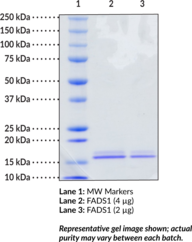
Fatty acid desaturase 1 (FADS1), also known as Δ5 desaturase, is a 444-amino acid transmembrane protein encoded by FADS1.1 This product is the N-terminal cytoplasmic domain of FADS1, corresponding to residues 2-121 of the full-length sequence. It catalyzes conversion of dihomo-γ-linolenic acid (Item No. 90230) to arachidonic acid (Item No. 90010) and ω-3 arachidonic acid (Item No. 90011) to eicosapentaenoic acid (Item Nos. 90110 | 90110.1 | 21908) during the production of ω-6 and ω-3 long-chain polyunsaturated fatty acids (LC-PUFAs), respectively. Hepatic FADS1 protein levels and mRNA expression are increased in mice with high-fat diet-induced obesity and non-alcoholic steatohepatitis (NASH).2 Tissue-selective knockdown of fads1 in the liver, adipose tissue, and reticuloendothelial system of adult hyperlipidemic LDL receptor-null mice promotes hepatic inflammation and formation of atherosclerotic plaques and suppresses hepatic lipogenesis.3 Increased expression of FADS1 positively correlates with disease-free survival and overall survival times in patients with esophageal squamous cell carcinoma (ESCC).4
WARNING This product is not for human or veterinary use.
References & Product Citations
1. .
2. .
3. .
4. .
Contact Info
Cayman Chemical1180 East Ellsworth RoadAnn Arbor, Michigan 48108 USAToll Free: (800) 364-9897(USA and Canada only)Fax: (734) 971-3640


