
Technical Support & Resources
Visit our FAQ
Contact Us
Toll Free Phone (USA and Canada Only): (888) 526-5351
Direct Phone: (734) 975-3888
Product Categories
Technical Information
- ALXDRD
- Glial Fibrillary Acidic Protein, Intermediate Filament Protein
Shipping & Storage Information
Recommended Products
Certificates of Analysis & Batch Specific Data
Provide batch numbers separated by commas to download or request available product inserts, QC sheets, certificates of analysis, data packs, and GC-MS data.
Product Description
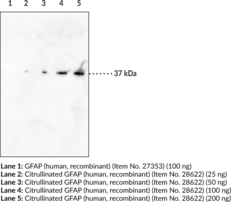
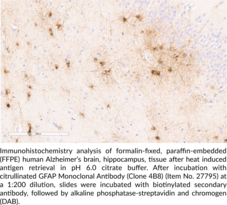
Citrullinated glial fibrillary acidic protein (citGFAP) is a citrullinated form of GFAP (Item No. 27353), a class III intermediate filament (IF) protein that is expressed in mature astrocytes and contributes to cytoskeletal structure and strength.1 GFAP can be citrullinated in a calcium-dependent manner on the arginine residue at position 270 (R270) and at R416 by protein arginine deiminase 1 (PAD1; Item No. 10784) and PAD2 (Item No. 10785).2 citGFAP levels are increased by the calcium ionophore ionomycin (Item No. 10004974) in an in vitro model of traumatic brain injury (TBI) using NHA CC-2565 human astrocytes and are induced by controlled cortical impact in the cerebral cortex in a rat model of TBI.3 It has been found in the hippocampus in a rat model of Alzheimer's disease induced by amyloid-β (25-35), as well as in the retina in a mouse model of alkali-induced eye injury.4,5 citGFAP has also been found in postmortem hippocampus from patients with Alzheimer's disease, and citGFAP levels are increased in postmortem-derived brain lesions from patients with multiple sclerosis.2,6 Cayman's Citrullinated GFAP (R416) Monoclonal Antibody (Clone 4B8) can be used for ELISA, Immunohistochemistry, and Western blot applications. The antibody recognizes recombinant GFAP and citGFAP at 37 kDa.
WARNING This product is not for human or veterinary use.
References & Product Citations
1. Type III intermediate filaments desmin, glial fibrillary acidic protein (GFAP), vimentin, and peripherin. Cold Spring Harb. Perspect. Biol. 9(12), a021642 (2017).
2. Mass spectrometric identification of citrullination sites and immunohistochemical detection of citrullinated glial fibrillary acidic protein in Alzheimer’s disease brains. J. Neurosci. Res. 93(11), 1664-1674 (2015).
3. Protein citrullination: A proposed mechanism for pathology in traumatic brain injury. Front. Neurol. 6:204, (2015).
4. Increased expression of PAD2 after repeated intracerebroventricular infusions of soluble Aβ25-
5. Citrullination of glial intermediate filaments is an early response in retinal injury. Mol. Vis. 22, 1137-1155 (2016).
6. Localisation of citrullinated proteins in normal appearing white matter and lesions in the central nervous system in multiple sclerosis. J. Neuroimmunol. 273(1-2), 85-95 (2014).
Contact Info
Cayman Chemical1180 East Ellsworth RoadAnn Arbor, Michigan 48108 USAToll Free: (800) 364-9897(USA and Canada only)Fax: (734) 971-3640


