
Technical Support & Resources
Visit our FAQ
Contact Us
Toll Free Phone (USA and Canada Only): (888) 526-5351
Direct Phone: (734) 975-3888
Product Categories
Product Type
Research Area
Application
Technical Information
- IFG
- IFI
- Interferon-γ
- Type II Interferon
Shipping & Storage Information
Recommended Products
Certificates of Analysis & Batch Specific Data
Provide batch numbers separated by commas to download or request available product inserts, QC sheets, certificates of analysis, data packs, and GC-MS data.

Explore Obesity & Metabolic Disease Resources
Discover high-quality research tools to investigate GLP-1 mechanisms and next-generation metabolic targets.
OBESITY RESEARCH SOLUTIONSProduct Description
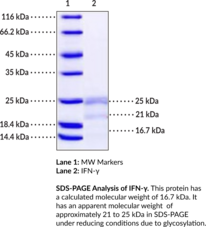
Interferon γ (IFN-γ) is a cytokine and type II interferon with roles in innate and adaptive immunity.1 It is initially produced by natural killer (NK) and natural killer T (NKT) cells as part of the innate immune response to pathogens, and then by CD4+ T helper (Th1) cells and CD8+ cytotoxic effector T cells as adaptive antigen-specific immunity is developed.1,2 IFN-γ production is induced in response to pathogen-induced secretion of IL-12 and IL-18 by macrophages and is inhibited by IL-4, IL-10, TGF-β, and various glucocorticoids. It facilitates amplification of antigen presentation, the production of reactive oxygen species (ROS), and the induction of antiviral and antibacterial responses by binding to the interferon γ receptor extracellular domain IFNGR1 (Item No. 32006) to induce signal transduction and gene transcription.1,3 In addition to its role in infectious disease, IFN-γ enhances the antigenicity of tumor cells, making them more susceptible to IFN-γ-stimulated immune effector cells.4 It induces tumor cell apoptosis and necroptosis, and inhibits tumor angiogenesis in vitro and in vivo. However, IFN-γ-induced removal of highly antigenic tumor cells can leave behind a population with reduced immunogenicity that can evade immune detection and enhance metastasis. Knockdown of Ifng improves insulin resistance in a mouse model of high-fat diet-induced obesity and increases susceptibility to various pathogens in mice.1,5 Cayman's IFN-γ (human, recombinant) protein can be used for cell-based assay applications. The protein consists of 143 amino acids, has a calculated molecular weight of 16.7 kDa, and a predicted N-terminus of Gln24 after signal peptide cleavage. By SDS-PAGE, under reducing conditions, Cayman's IFN-γ (human, recombinant) migrates as two bands at 21 and 25 kDa due to apparent differential glycosylation.
WARNING This product is not for human or veterinary use.
References & Product Citations
1. Interferon-
2. Regulation of interferon-
3. Sodium tanshinone IIA sulfonate attenuates cardiac dysfunction and improves survival of rats with cecal ligation and puncture-
4. The interferon-
5. IFNγ: Signalling, epigenetics and roles in immunity, metabolism disease and cancer immunotherapy. Nat. Rev. Immunol. 18(9), 545-558 (2018).
Contact Info
Cayman Chemical1180 East Ellsworth RoadAnn Arbor, Michigan 48108 USAToll Free: (800) 364-9897(USA and Canada only)Fax: (734) 971-3640


