
Technical Support & Resources
Visit our FAQ
Contact Us
Toll Free Phone (USA and Canada Only): (888) 526-5351
Direct Phone: (734) 975-3888
TRAIL Intracellular Domain (human, recombinant)
Item No. 32049
Technical Information
- Apo-2L
- Apo-2 Ligand
- CD253
- TNF Ligand Superfamily Member 10
- TNFSF10
Shipping & Storage Information
Recommended Products
Certificates of Analysis & Batch Specific Data
Provide batch numbers separated by commas to download or request available product inserts, QC sheets, certificates of analysis, data packs, and GC-MS data.

Explore Obesity & Metabolic Disease Resources
Discover high-quality research tools to investigate GLP-1 mechanisms and next-generation metabolic targets.
OBESITY RESEARCH SOLUTIONSProduct Description
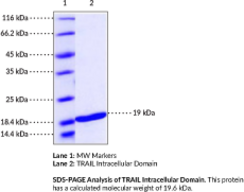
TNF-related apoptosis-inducing ligand (TRAIL) is a protein encoded by the TNFSF10 gene in humans and a member of the TNF superfamily of proteins.1 TRAIL contains an N-terminal cytoplasmic domain, a transmembrane domain, and a C-terminal extracellular receptor binding domain.1,2 It is produced in immune effector cells as a transmembrane precursor protein from which mature, soluble TRAIL is formed by proteolysis.2 Soluble TRAIL is cleaved from the precursor protein on the extracellular side of the membrane in response to stimulation by cytokines, such as IFN-γ (Item No. 32008).1 TRAIL monomers form trimers with a single zinc atom bound at the trimer interface, which is required for its structural stability and function.3 The trimer binds to the pro-apoptotic death receptors DR4 and DR5 and the decoy receptors DcR1 and DcR2, which lack functional intracellular domains.1 The intracellular death domains of DR4 or DR5 colocalize upon TRAIL binding, which recruits Fas-associated death domain (FADD) and pro-caspase-8 and initiates either the extrinsic or intrinsic apoptotic pathways depending on the cell type. DR4 and DR5 are highly expressed on a variety of cancer cells while DcR1 and DcR1 are primarily expressed on non-cancerous cells, which allows TRAIL to selectively induce apoptosis in cancer cells.4 Recombinant human TRAIL induces apoptosis in a variety of cancer cell lines and reduces tumor growth in mouse xenograft models.5 However, it increases proliferation in certain cancer cells in vitro, and other cells lines develop resistance, which can sometimes be partially mitigated by combining it with other agents. A cysteine-to-threonine mutation at position 723 of TNFSF10 is associated with sporadic breast cancer, and SNPs in TNFSF10 are associated with fatty liver disease, multiple sclerosis, and asthma.1 TNFSF10 expression is decreased in breast cancer patients with brain metastases and increased in patients with multiple sclerosis. In addition, protein levels of TRAIL are increased in patients with systemic lupus erythematosus (SLE) and multiple sclerosis. Cayman’s TRAIL Intracellular Domain (human, recombinant) protein consists of 169 amino acids and has a calculated molecular weight of 19.6 kDa.
WARNING This product is not for human or veterinary use.
References & Product Citations
1. Regulation of the human TRAIL gene. Cancer Biol. Ther. 13(12), 1143-1151 (2012).
2. Emerging non-
3. A unique zinc-
4. The TRAIL to cancer therapy: Hindrances and potential solutions. Crit. Rev. Oncol. Hematol. 143, 81-94 (2019).
5. Targeting TRAIL death receptors. Curr. Opin. Pharmacol. 8(4), 433-439 (2008).
Contact Info
Cayman Chemical1180 East Ellsworth RoadAnn Arbor, Michigan 48108 USAToll Free: (800) 364-9897(USA and Canada only)Fax: (734) 971-3640


