
Technical Support & Resources
Visit our FAQ
Contact Us
Toll Free Phone (USA and Canada Only): (888) 526-5351
Direct Phone: (734) 975-3888
Product Categories
Product Type
Application
Technical Information
- Kit Ligand
- c-Kit Ligand
- Mast Cell Growth Factor
- MGF
- Steel Factor
- Stem Cell Factor
Shipping & Storage Information
Recommended Products
Certificates of Analysis & Batch Specific Data
Provide batch numbers separated by commas to download or request available product inserts, QC sheets, certificates of analysis, data packs, and GC-MS data.
Kinase Resource Center
Discover Products & Resources for Kinase Research
- Kinase inhibitors, screening libraries, assay kits, & more
- Tools to study kinase signaling pathways:
- Growth factor signaling
- PI3K/Akt/mTOR
- MAPKs (ERK, p38, & JNK)
- JAK/STAT signaling
- Articles, resources, & advice
Product Description
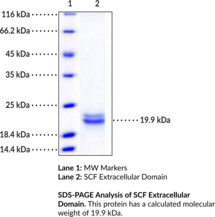
Stem cell factor (SCF), also known as steel factor or c-Kit ligand, is a growth factor and cytokine that promotes proliferation, migration, survival, and differentiation of hematopoietic progenitors, germ cells, and melanocytes and is encoded by KITLG in humans.1 It is composed of an extracellular domain that contains a c-Kit binding region, a transmembrane domain, and a C-terminal intracellular tail and is ubiquitously expressed by fibroblasts and endothelial cells. SCF also exists as a soluble form produced by proteolytic cleavage of a membrane-bound isoform of SCF produced by alternative splicing and lacking exon 6. Both membrane-bound and soluble SCF homodimerize and bind to the SCF receptor, also known as c-Kit, to induce intracellular signaling. Allergen exposure increases lung and serum levels of SCF in a mouse model of allergic inflammation, and airway levels of SCF are increased in patients with asthma.2 Exogenous administration of SGF decreases infarct size and improves motor function in a spontaneously hypertensive rat model of stroke induced by middle cerebral artery occlusion.3 SCF inhibits apoptosis of CD34+ acute myeloid leukemia cells induced by cytarabine (Item No. 16069), daunorubicin (Item No. 14159), or carboplatin (Item No. 13112).4 Cayman's SCF Extracellular Domain (human, recombinant) protein can be used for cell-based assay applications. This protein consists of 175 amino acids, has a calculated molecular weight of 19.9 kDa, and a predicted N-terminus of Glu26 after signal peptide cleavage.
WARNING This product is not for human or veterinary use.
References & Product Citations
1. Stem cell factor receptor/c-
2. Stem cell factor expression, mast cells and inflammation in asthma. Fundam. Clin. Pharmacol. 20(1), 21-39 (2006).
3. The role of stem cell factor and granulocyte-
4. Stem cell factor as a survival and growth factor in human normal and malignant hematopoiesis. Acta Haematol. 95(3-4), 257-262 (1996).
Contact Info
Cayman Chemical1180 East Ellsworth RoadAnn Arbor, Michigan 48108 USAToll Free: (800) 364-9897(USA and Canada only)Fax: (734) 971-3640


