
Technical Support & Resources
Visit our FAQ
Contact Us
Toll Free Phone (USA and Canada Only): (888) 526-5351
Direct Phone: (734) 975-3888
Product Categories
Product Type
Application
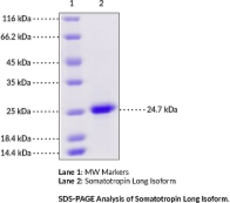
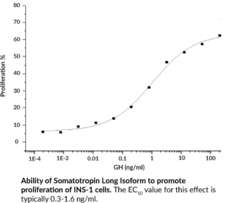
Technical Information
- Growth Hormone 1
- Pituitary Growth Hormone
Shipping & Storage Information
Recommended Products
Certificates of Analysis & Batch Specific Data
Provide batch numbers separated by commas to download or request available product inserts, QC sheets, certificates of analysis, data packs, and GC-MS data.
Kinase Resource Center
Discover Products & Resources for Kinase Research
- Kinase inhibitors, screening libraries, assay kits, & more
- Tools to study kinase signaling pathways:
- Growth factor signaling
- PI3K/Akt/mTOR
- MAPKs (ERK, p38, & JNK)
- JAK/STAT signaling
- Articles, resources, & advice
Product Description
Somatotropin is a circulating peptide hormone encoded by GH1 in humans that has roles in growth, cellular proliferation and differentiation, muscle and bone anabolism, and lipolysis.1 Alternative splicing of the GH1 pre-mRNA produces one full-length 22 kDa isoform and a short-length 20 kDa isoform, which has reduced affinity for the somatotropin receptor.2 Somatotropin contains a central hydrophobic core and a bundle of four α-helices that forms two somatotropin receptor binding sites.3 It is synthesized and stored by somatotrophs in the anterior pituitary gland and is secreted episodically as a monomer or dimer in a circadian rhythm that peaks during night sleep.3,2 Somatotropin production is induced by stimulation with growth hormone-releasing hormone, ghrelin, or sex steroids and inhibited by somatostatin, IGF-1, or glucocorticoid stimulation.4 Binding of somatotropin to the somatotropin receptor, which is ubiquitously expressed, activates a variety of intracellular signal transduction pathways, including JAK-STAT, that lead to IGF-1, MAPK, PPARγ (Item No. 61700), or SIRPα signaling.5,1,3 Decreased serum levels of somatotropin have been found in patients with dwarfism.6 Increased somatotropin serum levels have been found in patients with acromegaly, a condition characterized by abnormal bone growth, and are positively correlated with early mortality.6,7 Cayman's Somatotropin Long Isoform (human, recombinant) protein can be used for cell-based assay applications. This protein consists of 212 amino acids and has a calculated molecular weight of 24.7 kDa.
WARNING This product is not for human or veterinary use.
References & Product Citations
1. Multiple effects of growth hormone in the body: Is it really the hormone for growth? Clin. Med. Insights Endocrinol. Diabetes 9, 47-71 (2016).
2. Growth hormone isoforms. Growth Horm. IGF Res. 19(4), 333-340 (2009).
3. Growth hormone — past, present and future. Nat. Rev. Endocrinol. 14(5), 285-300 (2018).
4. Growth hormone receptor mutations related to individual dwarfism. Int. J. Mol. Sci. 19(5), 1433 (2018).
5. Growth hormone receptor signaling pathways and its negative regulation by SOCS2. Mol. Endocrinol. 20(2), 241-253 (2016).
6. Pituitary hypoplasia in patients with a mutation in the growth hormone–releasing hormone receptor gene. Am. J. Neuroradiol. 21(4), 685-689 (2000).
7. Evaluation of growth hormone (GH) action in mice: Discovery of GH receptor antagonists and clinical indications. Mol. Cell Endocrinol. 386(1-2), 34-45 (2014).
Contact Info
Cayman Chemical1180 East Ellsworth RoadAnn Arbor, Michigan 48108 USAToll Free: (800) 364-9897(USA and Canada only)Fax: (734) 971-3640


