
Technical Support & Resources
Visit our FAQ
Contact Us
Toll Free Phone (USA and Canada Only): (888) 526-5351
Direct Phone: (734) 975-3888
Product Categories
Technical Information
- PEG
Shipping & Storage Information
Recommended Products
Certificates of Analysis & Batch Specific Data
Provide batch numbers separated by commas to download or request available product inserts, QC sheets, certificates of analysis, data packs, and GC-MS data.
Product Description
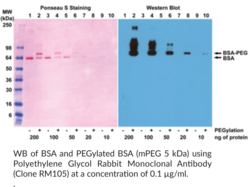
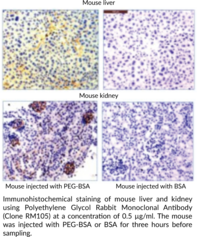
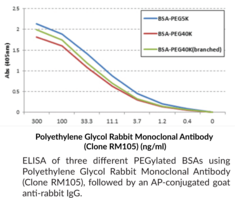
Polyethylene glycols (PEGs) are synthetic and hydrophilic polymers.1,2 They are linear or branched and contain a reactive end group, such as acrylate, methacrylate, dibenzocyclooctynol, or vinyl sulfonate, for covalent attachment to macromolecules or linkers. The opposite end group of PEGs is commonly a methyl group (methoxy PEG), however, hydroxy, amino, butoxy, and tert-butoxy end groups have also been used.1 PEGs are non-toxic and are commonly used to prolong the in vivo circulation time of pharmaceutical agents.2 Free PEGs are non-immunogenic but become immunogenic when conjugated to a drug delivery nanosystem (DDS) or a macromolecule.1 Immunogenicity of PEGs varies based on polymer length and branching, end group composition, and chemical nature of the PEG acceptor structure. Cayman’s Polyethylene Glycol Rabbit Monoclonal Antibody (Clone RM105) can be used for ELISA, immunohistochemistry (IHC), and Western blot (WB) applications. The antibody recognizes PEGs containing a methoxy end group.
WARNING This product is not for human or veterinary use.
References & Product Citations
1. Anti-
2. Recent advances in the bioanalytical methods of polyethylene glycols and PEGylated pharmaceuticals. J. Sep. Sci. 43(9-10), 1978-1997 (2020).
Contact Info
Cayman Chemical1180 East Ellsworth RoadAnn Arbor, Michigan 48108 USAToll Free: (800) 364-9897(USA and Canada only)Fax: (734) 971-3640


