
Technical Support & Resources
Visit our FAQ
Contact Us
Toll Free Phone (USA and Canada Only): (888) 526-5351
Direct Phone: (734) 975-3888
Product Categories
Technical Information
- PEG
Shipping & Storage Information
Recommended Products
Certificates of Analysis & Batch Specific Data
Provide batch numbers separated by commas to download or request available product inserts, QC sheets, certificates of analysis, data packs, and GC-MS data.
Product Description
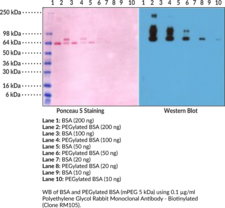
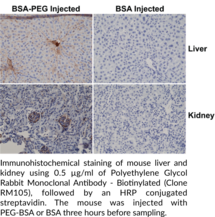
Polyethylene glycols (PEGs) are synthetic and hydrophilic polymers.1,2 They are linear or branched and contain a reactive end group, such as acrylate, methacrylate, dibenzocyclooctynol, or vinyl sulfonate, for covalent attachment to macromolecules or linkers. The opposite end group of PEGs is commonly a methyl group (methoxy PEG), however, hydroxy, amino, butoxy, and tert-butoxy end groups have also been used.1 PEGs are non-toxic and are commonly used to prolong the in vivo circulation time of pharmaceutical agents.2 Free PEGs are non-immunogenic but become immunogenic when conjugated to a drug delivery nanosystem (DDS) or a macromolecule.1 Immunogenicity of PEGs varies based on polymer length and branching, end group composition, and chemical nature of the PEG acceptor structure. Cayman’s Polyethylene Glycol Rabbit Monoclonal Antibody - Biotinylated (Clone RM105) can be used for ELISA, immunohistochemistry (IHC), and Western blot (WB) applications. The antibody recognizes PEGs containing a methoxy end group.
WARNING This product is not for human or veterinary use.
References & Product Citations
1. Anti-
2. Recent advances in the bioanalytical methods of polyethylene glycols and PEGylated pharmaceuticals. J. Sep. Sci. 43(9-10), 1978-1997 (2020).
Contact Info
Cayman Chemical1180 East Ellsworth RoadAnn Arbor, Michigan 48108 USAToll Free: (800) 364-9897(USA and Canada only)Fax: (734) 971-3640


