
Technical Support & Resources
Visit our FAQ
Contact Us
Toll Free Phone (USA and Canada Only): (888) 526-5351
Direct Phone: (734) 975-3888
Product Categories
Technical Information
- p90 Ribosomal S6 Kinase 1 (phospho-T359/S363)
Shipping & Storage Information
Recommended Products
Certificates of Analysis & Batch Specific Data
Provide batch numbers separated by commas to download or request available product inserts, QC sheets, certificates of analysis, data packs, and GC-MS data.
Kinase Resource Center
Discover Products & Resources for Kinase Research
- Kinase inhibitors, screening libraries, assay kits, & more
- Tools to study kinase signaling pathways:
- Growth factor signaling
- PI3K/Akt/mTOR
- MAPKs (ERK, p38, & JNK)
- JAK/STAT signaling
- Articles, resources, & advice
Product Description
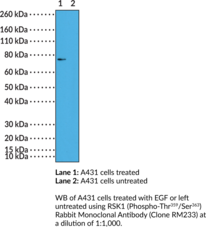
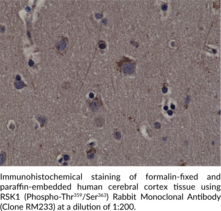
p90 ribosomal S6 kinase 1 (RSK1) is a member of the RSK family of serine/threonine kinases that mediates RAS/RAF/MEK/ERK/MAPK signaling.1 It contains N- and C-terminal kinase domains connected by a linker region, which contains various residues, including threonine 359 (Thr359) and serine 363 (Ser363), that are subject to phosphorylation and lead to its activation. RSK1 is ubiquitously expressed and localized to the cytoplasm, where it is in a complex with its activator ERK1/2 in quiescent cells.1,2 Upon stimulation of receptor tyrosine kinases (RTKs) by a variety of cytokines, neurotransmitters, or hormones, RSK1 accumulates at the plasma membrane and is phosphorylated by ERK1/2 and 3-phosphoinositide-dependent protein kinase 1 (PDK1), resulting in dissociation of the ERK1/2-RSK1 complex and activation of RSK1.3,1,2 RSK1 phosphorylates a variety of substrates that have roles in several cellular processes, including cell growth, survival, and proliferation.2 Tumor RSK1 levels are increased in patients with breast or prostate cancer.1 Cayman’s RSK1 (Phospho-Thr359/Ser363) Rabbit Monoclonal Antibody (Clone RM233) can be used for immunohistochemistry (IHC) and Western blot (WB) applications.
WARNING This product is not for human or veterinary use.
References & Product Citations
1. Selective targeting of RSK isoforms in cancer. Trends Cancer 3(4), 302-312 (2017).
2. Regulation and function of the RSK family of protein kinases. Biochem. J. 441(2), 553-569 (2012).
3. The RSK family of kinases: Emerging roles in cellular signalling. Nat. Rev. Mol. Cell Biol. 9(10), 747-758 (2008).
Contact Info
Cayman Chemical1180 East Ellsworth RoadAnn Arbor, Michigan 48108 USAToll Free: (800) 364-9897(USA and Canada only)Fax: (734) 971-3640


