
Technical Support & Resources
Visit our FAQ
Contact Us
Toll Free Phone (USA and Canada Only): (888) 526-5351
Direct Phone: (734) 975-3888

Technical Information
- Epidermal Growth Factor Receptor
- ErbB-1
- HER1
Shipping & Storage Information
Recommended Products
Certificates of Analysis & Batch Specific Data
Provide batch numbers separated by commas to download or request available product inserts, QC sheets, certificates of analysis, data packs, and GC-MS data.
Kinase Resource Center
Discover Products & Resources for Kinase Research
- Kinase inhibitors, screening libraries, assay kits, & more
- Tools to study kinase signaling pathways:
- Growth factor signaling
- PI3K/Akt/mTOR
- MAPKs (ERK, p38, & JNK)
- JAK/STAT signaling
- Articles, resources, & advice
Product Description
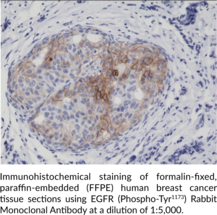
Epidermal growth factor receptor (EGFR), also known as HER1 and ERBB1, is a cell surface receptor and member of the EGF family of receptor tyrosine kinases with roles in cell proliferation, differentiation, and survival.1,2 It is a transmembrane receptor composed of an intracellular tyrosine kinase domain, a transmembrane lipophilic segment, and an extracellular domain that is expressed in epithelial, mesenchymal, and neuronal tissues.1,2,3 Under unstimulated conditions, EGFR is an auto-inhibited monomer in the plasma membrane.1 Upon canonical ligand binding, EGFR undergoes homodimerization or heterodimerization with HER2, HER3, or HER4, which induces a conformational change in the cytoplasmic domain that facilitates autophosphorylation and intracellular signaling. EGFR contains five C-terminal autophosphorylation sites, tyrosine 1068 (Tyr1068), Tyr1148, Tyr1173, Tyr1086, and Tyr992.4 EGFR autophosphorylation at Tyr1173 (phospho-Tyr1173) leads to interaction with phospholipase Cγ (PLCγ) and Shc, which have roles in activating the MAPK signaling pathway. Increased levels of EGFR (phospho-Tyr1173) are associated with poor progression-free survival in patients with non-small cell lung cancer (NSCLC). Levels of EGFR (phospho-Tyr1173) are increased in, and positively correlate with activation of MAPK signaling and cytokine production in, bronchial epithelial biopsies from healthy individuals exposed to diesel exhaust.5 Cayman’s EGFR (Phospho-Tyr1173) Rabbit Monoclonal Antibody (Clone RM269) can be used for immunohistochemistry (IHC) and Western blot (WB) applications.
WARNING This product is not for human or veterinary use.
References & Product Citations
1. Emerging functions of the EGFR in cancer. Mol. Oncol. 12(1), 3-20 (2018).
2. Review of epidermal growth factor receptor biology. Int. J. Radiat. Oncol. Biol. Phys. 59(2 Suppl), 21-26 (2004).
3. Distribution and function of EGFR in human tissue and the effect of EGFR tyrosine kinase inhibition. Anticancer Res. 23(5A), 3639-3650 (2003).
4. Phosphorylated EGFR expression may predict outcome of EGFR-
5. Diesel exhaust increases EGFR and phosphorylated C-
Contact Info
Cayman Chemical1180 East Ellsworth RoadAnn Arbor, Michigan 48108 USAToll Free: (800) 364-9897(USA and Canada only)Fax: (734) 971-3640


