
Technical Support & Resources
Visit our FAQ
Contact Us
Toll Free Phone (USA and Canada Only): (888) 526-5351
Direct Phone: (734) 975-3888

Technical Information
- Myeloid Differentiation Primary Response Protein MyD88
Shipping & Storage Information
Recommended Products
Certificates of Analysis & Batch Specific Data
Provide batch numbers separated by commas to download or request available product inserts, QC sheets, certificates of analysis, data packs, and GC-MS data.
Kinase Resource Center
Discover Products & Resources for Kinase Research
- Kinase inhibitors, screening libraries, assay kits, & more
- Tools to study kinase signaling pathways:
- Growth factor signaling
- PI3K/Akt/mTOR
- MAPKs (ERK, p38, & JNK)
- JAK/STAT signaling
- Articles, resources, & advice
Product Description
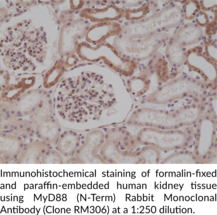
MyD88 is an adaptor protein involved in the innate immune response.1,2 It is composed of an N-terminal death domain, intermediate domain, and C-terminal toll-interleukin-1 receptor (TIR) domain.1 It is expressed in both myeloid and non-myeloid tissues, and its expression can be induced by immune-related factors, such as IL-6, LPS, and IFNs.2 As an adaptor protein, the TIR domain of MyD88 interacts with the TIR domain of toll-like receptor 1 (TLR1), -2, -4, -5, and -6, and IL-1 receptor (IL-1R) at the plasma membrane and TLR7, -8, and -9 at the endosomal membrane, while the MyD88 death domain interacts with IL-1R-associated kinases (IRAKs).1,3 In this way, MyD88 translates signals from TLRs and IL-1Rs to IRAKs, inducing signaling that leads to activation of NF-κB and subsequent cytokine production, as well as MAPK signaling.1,2 MyD88 is associated with inflammatory carcinogenesis but is also associated with protection from oncogenic pathogens.4 Mice deficient for Myd88 are protected from endotoxic shock induced by the TLR4 agonist LPS but have an increased susceptibility to bacterial pathogens and parasites.1 A leucine-to-proline mutation at position 265 of MYD88, within the TIR domain, is associated with certain cancers, including Waldenström’s macroglobulinemia and activated B cell diffuse large B cell lymphomas.5 Cayman’s MyD88 (N-Term) Rabbit Monoclonal Antibody (Clone RM306) can be used for immunohistochemistry (IHC) and Western blot (WB) applications.
WARNING This product is not for human or veterinary use.
References & Product Citations
1. MyD88: A central player in innate immune signaling. F1000Prime Rep. 6, 97 (2014).
2. A universal role for MyD88 in TLR/IL-
3. Inflammatory tole of TLR-
4. MyD88 and its divergent toll in carcinogenesis. Trends Immunol. 34(8), 379-389 (2013).
5. MYD88 L265P Mutation in Lymphoid Malignancies. Cancer Res. 78(10), 2457-2462 (2018).
Contact Info
Cayman Chemical1180 East Ellsworth RoadAnn Arbor, Michigan 48108 USAToll Free: (800) 364-9897(USA and Canada only)Fax: (734) 971-3640


