
Features
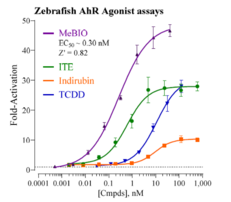
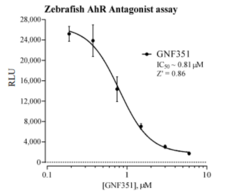
- Screen test samples to quantify functional activity, either agonist or antagonist, that they may exert against zebrafish zfAhR
- Robust technology provides sustained response for consistent and reproducible data acquisition
- Included in kit: Ready-to-use, pre-transfected reporter cells | Optimized media | Reference agonist | Luciferase detection reagent | Cell-culture ready assay plate
Technical Support & Resources
Visit our FAQ
Contact Us
Toll Free Phone (USA and Canada Only): (888) 526-5351
Direct Phone: (734) 975-3888
Product Categories
Application
Technical Information
- zfAhR
Shipping & Storage Information
Recommended Products
Certificates of Analysis & Batch Specific Data
Provide batch numbers separated by commas to download or request available product inserts, QC sheets, certificates of analysis, data packs, and GC-MS data.


Visit Our Environmental Toxicology Resource Center
Explore additional resources to study natural toxins, pollutants including PFAS and 6-PPD-Q, and their biological effects.
ENVIRONMENTAL TOXICOLOGY TOOLS & SERVICESProduct Description
INDIGO's Zebrafish Aryl Hydrocarbon Receptor (zfAhR) Reporter Cells are constructed in zebrafish ZF4 cells, a cell line derived from Brachydanio rerio embryos. This zebrafish cell line has been modified to contain the luciferase reporter gene functionally linked to tandem DRE/XRE genetic response elements and a minimal promoter sequence. The principal application of this assay is in the screening of test samples to quantify any functional activity, either agonist or antagonist, that they may exert against the native zebrafish AhR. While technically not a nuclear receptor, the AhR is mechanistically and functionally similar to members of that super-family, being both a receptor and a ligand-activated transcription factor. More formally, the AhR is a member of the basic helix-loop-helix, Per-Arnt-Sim family of transcription factors. As its name implies, the Aryl Hydrocarbon Receptor (AhR) is a xenobiotic-sensing receptor. It is responsible for the adverse toxicologic effects elicited by various polycyclic aromatic hydrocarbon environmental and industrial pollutants, perhaps the most infamous being 2,3,7,8-tetrachlorodibenzo-p-dioxin (TCDD). The AhR is present in the cytosol where, in the non-active state, it is in a complex with chaperone proteins such as Hsp90. Binding of a polycyclic aromatic hydrocarbon to AhR leads to nuclear translocation and association with its partner protein ARNT. The AhRARNT hetero-dimer binds to specific cognate DNA sequence elements known as dioxin/xenobiotic response elements (DRE/XRE) present in the regulatory region of a variety of target genes. Binding of AhR:ARNT to these elements, and subsequent recruitment of transcription co-activator complexes, induces the transcription of a battery of target genes, including several cytochrome P450 genes. Other target genes of the TCDD/AhR-complex encode inhibitory or stimulatory growth factors that mediate cellular growth and differentiation. zAhR Reporter Cells are prepared using INDIGO’s proprietary CryoMite™ process. This cryo-preservation method yields high cell viability post-thaw, and provides the convenience of immediately dispensing healthy, division-competent reporter cells into assay plates. There is no need for intermediate spin-and-wash steps, viability determinations, or cell titer adjustments. [INDIGO Catalog Nos. Z06001-32, Z06001]
WARNING This product is not for human or veterinary use.
Contact Info
Cayman Chemical1180 East Ellsworth RoadAnn Arbor, Michigan 48108 USAToll Free: (800) 364-9897(USA and Canada only)Fax: (734) 971-3640


