
Technical Support & Resources
Visit our FAQ
Contact Us
Toll Free Phone (USA and Canada Only): (888) 526-5351
Direct Phone: (734) 975-3888
Product Categories
Application
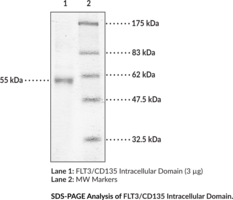
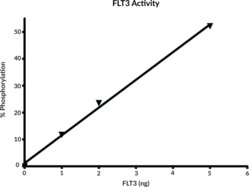
Technical Information
- Fetal Liver Kinase-2
- FL Cytokine Receptor
- FLK2
- FMS-like Tyrosine Kinase 3
- Receptor-type Tyrosine-protein Kinase
- Stem Cell Tyrosine Kinase 1
- STK1
Shipping & Storage Information
Recommended Products
Certificates of Analysis & Batch Specific Data
Provide batch numbers separated by commas to download or request available product inserts, QC sheets, certificates of analysis, data packs, and GC-MS data.
Kinase Resource Center
Discover Products & Resources for Kinase Research
- Kinase inhibitors, screening libraries, assay kits, & more
- Tools to study kinase signaling pathways:
- Growth factor signaling
- PI3K/Akt/mTOR
- MAPKs (ERK, p38, & JNK)
- JAK/STAT signaling
- Articles, resources, & advice
Product Description
FMS-like tyrosine kinase 3 (FLT3), also known as CD135, is a transmembrane cytokine receptor and member of the class III receptor tyrosine kinase family.1 It is composed of five extracellular immunoglobulin-like (Ig-like) domains, a transmembrane domain, an intracellular juxtamembrane domain, and two intracellular kinase domains. FLT3 is expressed in immature myeloid, lymphoid, and dendritic progenitor cells. Upon binding of FLT3 ligand, FLT3 forms a homodimer and the kinase domains are trans-phosphorylated, leading to activation of the RAS/MEK/ERK, PI3K, and STAT5A signaling pathways in a cell type-dependent manner.1,2 It is involved in the growth, survival, and differentiation of hematopoietic cells. FLT3 is considered a protooncogene, and activating mutations in it are associated with shorter disease-free survival in patients with hematologic malignancies.1,3 A mutation in FLT3 that results in an internal tandem duplication (ITD) of the juxtamembrane domain in FLT3 is found in approximately 20% of patients with acute myeloid leukemia (AML) and is associated with leukocytosis and poor prognosis.3,4 Formulations containing inhibitors of FLT3 have been used in the treatment of AML but are associated with chemoresistance.2 Cayman’s FLT3/CD135 Intracellular Domain (human, recombinant) protein can be used for enzyme activity assays.
WARNING This product is not for human or veterinary use.
References & Product Citations
1. The cytokine Flt3-
2. FLT3 inhibitors in acute myeloid leukemia: Challenges and recent developments in overcoming resistance. J. Med. Chem. 64(6), 2878-2900 (2021).
3. Activating mutation of D835 within the activation loop of FLT3 in human hematologic malignancies. Blood 97(8), 2434-2439 (2001).
4. Internal tandem duplication of the FLT3 gene is preferentially seen in acute myeloid leukemia and myelodysplastic syndrome among various hematological malignancies. A study on a large series of patients and cell lines. Leukemia 11(10), 1605-1609 (1997).
Contact Info
Cayman Chemical1180 East Ellsworth RoadAnn Arbor, Michigan 48108 USAToll Free: (800) 364-9897(USA and Canada only)Fax: (734) 971-3640


