
Technical Support & Resources
Visit our FAQ
Contact Us
Toll Free Phone (USA and Canada Only): (888) 526-5351
Direct Phone: (734) 975-3888

Technical Information
- Insulin-like Growth Factor-1
- Mechano Growth Factor
- Somatomedin-C
Shipping & Storage Information
Recommended Products
Certificates of Analysis & Batch Specific Data
Provide batch numbers separated by commas to download or request available product inserts, QC sheets, certificates of analysis, data packs, and GC-MS data.

Explore Obesity & Metabolic Disease Resources
Discover high-quality research tools to investigate GLP-1 mechanisms and next-generation metabolic targets.
OBESITY RESEARCH SOLUTIONSProduct Description
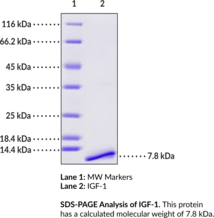
Insulin-like growth factor-1 (IGF-1) is a polypeptide hormone that regulates cell growth, maturation, and proliferation.1 It shares sequence homology with insulin and is composed of an N-terminal signal peptide, B-, C-, A-, and D-regions, and a C-terminal extension (E) peptide. Alternative splicing of the IGF1 pre-mRNA generates three isoforms, IGF-1Ea, IGF-1Eb, and IGF-1Ec, which have variable E peptides that are post-transcriptionally cleaved to produce the mature peptide. IGF-1 synthesis is induced by growth hormone (GH) and occurs primarily in the liver, where it is transported in the serum to other tissues via IGF binding proteins (IGFBPs), but it is also produced by a variety of other tissues, including the bone, where it acts in a paracrine or autocrine manner.2 IGF-1 binds the IGF-1 receptor (IGF-1R) with higher affinity than the IGF-2 receptor (IGF-2R) or insulin receptor (IR), inducing activation of a variety of signaling pathways, including PI3K/Akt and RAS/MAPK pathways, that stimulate cell proliferation and protect against apoptosis.3 IGF1 SNPs have been associated with increased risk of breast cancer, and serum IGF-1 levels are decreased in children with malnutrition.3,4 Cayman's IGF-1 (human, recombinant) protein can be used for binding assay and cell-based assay applications. The protein was synthesized from a DNA sequence encoding the mature form of human IGF-1 (Gly49-Ala118) with an N-terminal translation-initiating methionine (Met1). The expressed protein consists of 71 amino acids, has a calculated molecular weight of 7.8 kDa, and a predicted N-terminus of Met1.
WARNING This product is not for human or veterinary use.
References & Product Citations
1. The complexity of the IGF1 gene splicing, posttranslational modification and bioactivity. Mol. Med. 20(1), 202-214 (2014).
2. Insulin-
3. The role of the insulin-
4. Correlates of serum IGF-
Contact Info
Cayman Chemical1180 East Ellsworth RoadAnn Arbor, Michigan 48108 USAToll Free: (800) 364-9897(USA and Canada only)Fax: (734) 971-3640


