
Technical Support & Resources
Visit our FAQ
Contact Us
Toll Free Phone (USA and Canada Only): (888) 526-5351
Direct Phone: (734) 975-3888
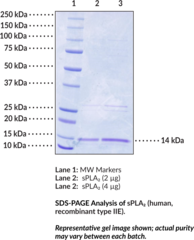
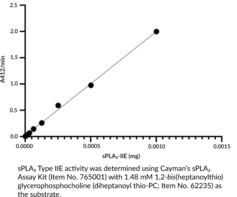
Technical Information
- GIIE sPLA2
- Group IIE Secretory Phospholipase A2
- Phosphatidylcholine 2-Acylhydrolase 2E
- Phospholipase A2 Group IIE
- sPLA2-IIE
Shipping & Storage Information
Recommended Products
Certificates of Analysis & Batch Specific Data
Provide batch numbers separated by commas to download or request available product inserts, QC sheets, certificates of analysis, data packs, and GC-MS data.
Lipid Resource Center
Discover Products & Resources for Lipid Research
- High-purity lipid standards
- Lipid roles in biology
- Lipids in health & disease
- Lipids for pharmaceutical development
- Protocols, advice, & resources
Product Description
Secretory phospholipase A2 (sPLA2) (Type IIE) is a calcium-dependent PLA2 superfamily member encoded by PLA2G2E in humans.1 It is composed of a highly conserved calcium-binding loop, a catalytic domain, and a Type II-specific disulfide-containing C-terminal extension but lacks the N-terminal signal peptide found in sPLA2 (Type IB) and sPLA2 (Type X). It also contains a second calcium-binding site that is essential for its catalytic activity.2,3 sPLA2 (Type IIE) is expressed in the brain, heart, lung, and placenta, as well as in hair follicles.4 It catalyzes the hydrolysis of phospholipids at the sn-2 position, preferentially releasing oleic acid (Item Nos. 90260 | 24659) from phosphatidylglycerol (PG) but also linoleic acid (Item Nos. 90150 | 90150.1 | 21909) or oleic acid from phosphatidylethanolamine (PE). It is involved in lipid metabolism, inflammatory processes, and regulation of lipolysis in adipocytes.2,4,5 sPLA2 (Type IIE) protein is upregulated in the kidney, small intestine, and lung following LPS administration in mice.4 Cayman’s sPLA2 (human, recombinant type IIE) protein can be used for enzyme activity assays.
WARNING This product is not for human or veterinary use.
References & Product Citations
1. Secreted phospholipase A2 revisited. J. Biochem. 150(3), 233-255 (2011).
2. Structural basis for functional selectivity and ligand recognition revealed by crystal structures of human secreted phospholipase A2 group IIE. Sci. Rep. 7(1), 10815 (2017).
3. The atypical binding mechanism of second calcium on phospholipase A2 group IIE. Biochem. Biophys. Res. Commun. 557, 267-272 (2021).
4. Structures, enzymatic properties, and expression of novel human and mouse secretory phospholipase A2s. The Journal of Biological Chemisty 275(8), 5785-5793 (2000).
5. Group IIE secretory phospholipase A2 regulates lipolysis in adipocytes. Obesity (Silver Spring) 23(4), 760-768 (2015).
Contact Info
Cayman Chemical1180 East Ellsworth RoadAnn Arbor, Michigan 48108 USAToll Free: (800) 364-9897(USA and Canada only)Fax: (734) 971-3640


