
Technical Support & Resources
Visit our FAQ
Contact Us
Toll Free Phone (USA and Canada Only): (888) 526-5351
Direct Phone: (734) 975-3888
Product Categories
Product Type
INHBE (human, recombinant) (Low Endotoxin)
Item No. 38059
Technical Information
- Activin β-E Chain
- Inhibin β-E Chain
- Inhibin Subunit β E
Shipping & Storage Information
Recommended Products
Certificates of Analysis & Batch Specific Data
Provide batch numbers separated by commas to download or request available product inserts, QC sheets, certificates of analysis, data packs, and GC-MS data.

Explore Obesity & Metabolic Disease Resources
Discover high-quality research tools to investigate GLP-1 mechanisms and next-generation metabolic targets.
OBESITY RESEARCH SOLUTIONSProduct Description
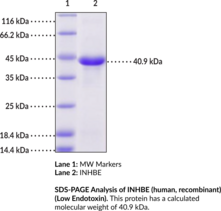
Inhibin beta E chain (INHBE) is a member of the TGF-β superfamily.1 INHBE encodes a 350-amino acid pre-protein, which is proteolytically cleaved at Thr237 to release the mature INHBE peptide, and is a secreted protein mainly expressed in the liver. It exists as a homodimer, also known as activin E, or forms heterodimers with other inhibin beta chains such as INHBC.2 INHBE is a hepatokine that is involved in hepatocyte viability, thermogenesis, and insulin sensitivity and binds to follistatin (Item No. 31839).2,3,1 Overexpression of INHBE induces apoptosis in hepatocytes and INHBE-containing conditioned medium induces expression of genes involved in adipocyte differentiation, which can be blocked by the activin receptor-like kinase (ALK) inhibitor SB-431542 (Item No. 13031).2,3 Hepatic expression of human INHBE decreases plasma glucose levels and increases body temperature in mice.3 Loss-of-function mutations in INHBE are associated with favorable body fat distribution and a decreased risk of developing type 2 diabetes.4 Increased tumor levels of INHBE positively correlate with increasing tumor grade and negatively correlate with poor overall survival in patients with clear-cell renal cell carcinoma (ccRCC).5 Cayman’s INHBE (human, recombinant) protein is a disulfide-linked homodimer. The reduced monomer, composed of INHBE (amino acids 237-350) fused to human IgG1 Fc at its N-terminus, consists of 374 amino acids and has a calculated molecular weight of 40.9 kDa.
WARNING This product is not for human or veterinary use.
References & Product Citations
1. cDNA cloning and expression of human activin βE subunit. Mol. Cell. Endocrinol. 194(1-2), 117-122 (2002).
2. Comparison of the function of the βC and βE subunits of activin in AML12 hepatocytes. Endocr. J. 52(2), 169-175 (2005).
3. Activin E controls energy homeostasis in both brown and white adipose tissues as a hepatokine. Cell Rep. 25(5), 1193-1203 (2018).
4. Multiancestry exome sequencing reveals INHBE mutations associated with favorable fat distribution and protection from diabetes. Nat. Commun. 13(1), 4844 (2022).
5. The significance of INHBE expression in the cancer cells of clear-
Contact Info
Cayman Chemical1180 East Ellsworth RoadAnn Arbor, Michigan 48108 USAToll Free: (800) 364-9897(USA and Canada only)Fax: (734) 971-3640


